
I didn't notice it at first.
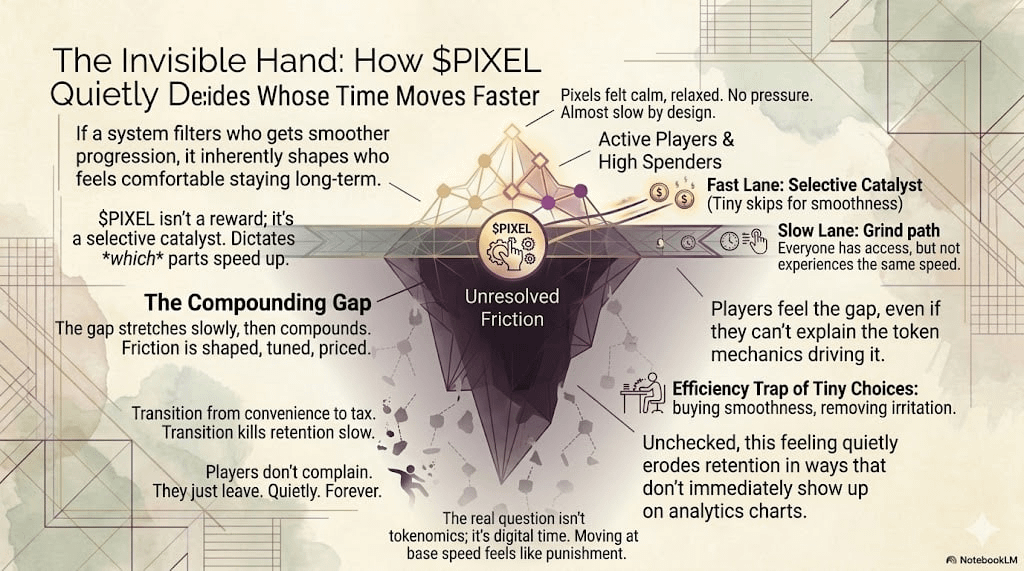
Pixels felt calm. Relaxed. You log in, water crops, wait, repeat. No pressure. Almost slow by design.
I've watched enough Web3 games to know that when something feels this "chill," it usually isn't. The pressure is just hiding.
After a few weeks, that calm surface started cracking.
Some players weren't just ahead. They were moving through the game at a completely different speed. Same actions. Same loops. Different outcomes.
That's when I started looking at PIXEL differently.
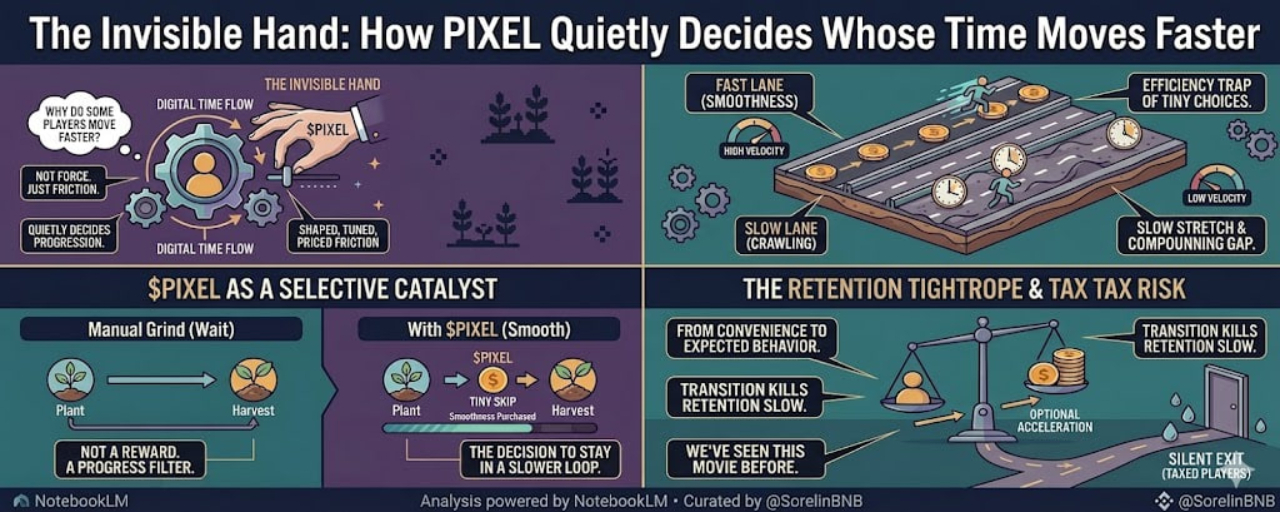
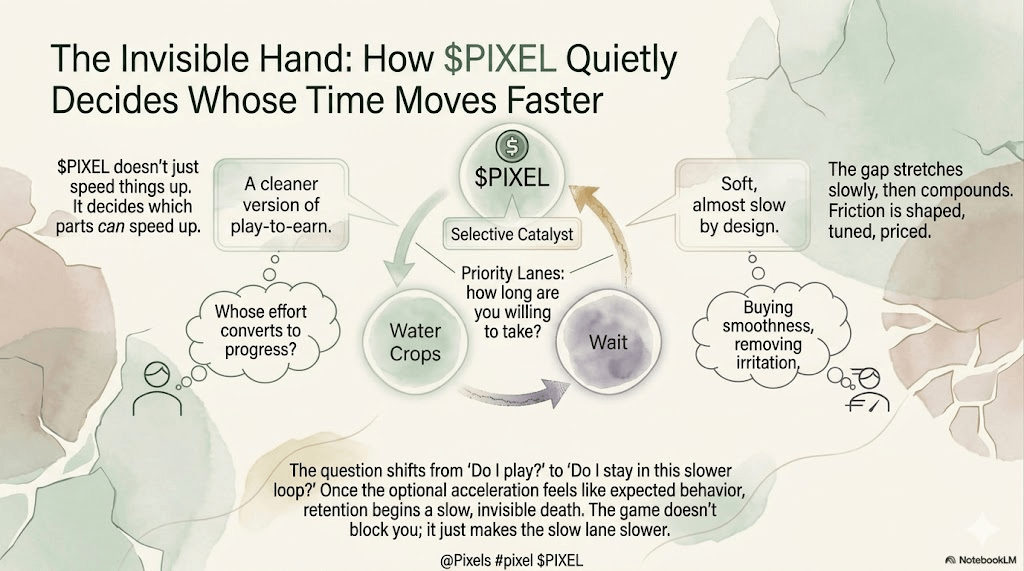
PIXEL isn't a reward token. It's a selective catalyst.
Most people see it as premium currency. Buy upgrades. Skip timers. Standard stuff.
But that misses the deeper architecture.
PIXEL doesn't just speed things up. It decides which parts of the game are allowed to speed up in the first place. It dictates whose effort converts into progress and whose just… waits.
I've seen this before. Not in games. In priority lanes.
Everyone technically has access to the service. But not everyone experiences the same speed. The system doesn't block you or say "you can't do this."
It quietly asks a much more pointed question: how long are you willing to take?
The slow stretch and the compounding gap.
I watched a new player grind through early tasks. Manual everything. Long route. Nothing wrong with that—it's how the game is supposed to feel.
Then I watched someone else introduce small, selective PIXEL interactions. Tiny skips here and there. Nothing aggressive.
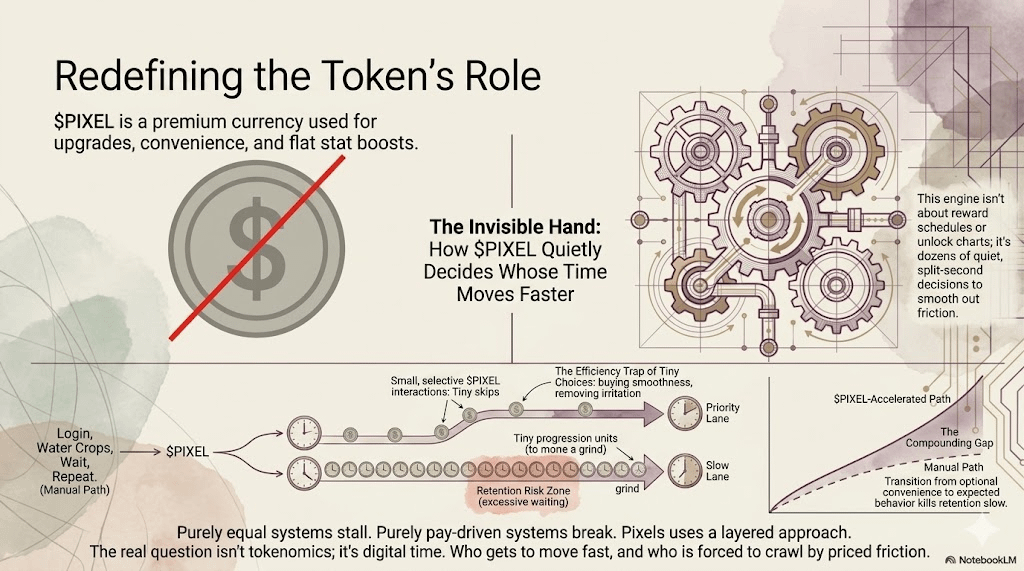
The gap didn't explode instantly. It stretched slowly. Then it stuck. Once it stuck, it compounded.
$BSB had hype. Loud. Chaotic. But hype doesn't compound. $HYPER had ambition. But ambition without a friction filter just burns out.
Pixels is different. The gap isn't about who spends the most. It's about who makes the small, repeated decisions to smooth out inefficiency.
The efficiency trap of tiny choices.
The most powerful behavior change in Pixels doesn't come from big purchases. It comes from the small, repeated decisions to remove irritation.
One adjustment leads to the next. The player isn't buying a win. They're buying smoothness.
The question shifts from "Do I play?" to "Do I stay in this slower loop?"
Once the friction is gone, no one wants it back.
That's the engine. Not reward schedules. Not unlock charts. Just dozens of quiet, split-second decisions to make the game feel less like waiting and more like moving.
But here's the tightrope.
Purely equal systems stall. No momentum. Purely pay-driven systems break. Lose competitive integrity.
Pixels tries a layered approach in between. It's a thin line.
The risk? When a system starts filtering who gets smoother progression, it also shapes who feels comfortable staying long-term.
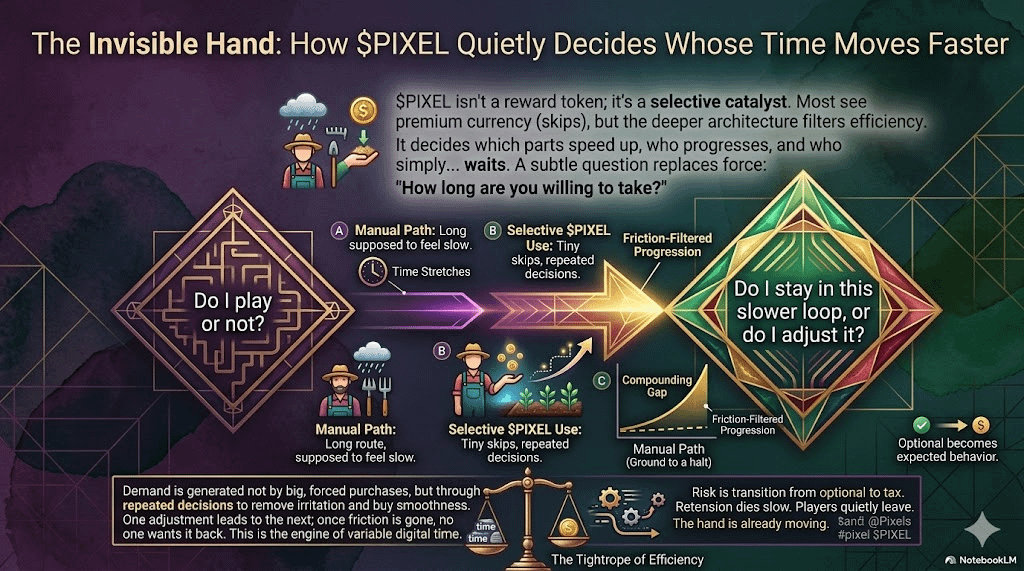
If too many parts of the game lean on PIXEL for efficiency, the whole structure shifts. What began as optional acceleration starts to feel like expected behavior for everyone.
That transition kills retention slow. Doesn't show up on a chart until it's too far gone.
I've seen this movie before.
Most Web3 games start optional. Then the friction gets turned up. Then the token becomes not a convenience but a tax.
Players don't complain. They just leave. Quietly. Forever.
Pixels isn't there yet. But the seeds are planted.
The real question isn't about tokenomics.
It's about digital time. Who gets to move fast and who has to crawl.
The game doesn't block you. It doesn't say "pay or stop." It just makes the slow lane slower. And slower. Until moving at base speed feels like punishment.
That's the invisible hand. Not force. Just friction. Shaped, tuned, and priced.
Once you see this mechanism, you can't unsee it.
Pixels forces us to look past the "calm" of the farm and confront something uncomfortable:
What happens when a game starts deciding whose time should move faster?
And what happens when you realize you're on the slower side?
I'm still watching. But the hand is already moving.