
I Didn’t Expect It to Happen This Fast
There’s always a point where you stop reacting and start predicting.
First few sessions, everything feels open. You’re figuring things out, testing, making small mistakes.
Then something shifts.
You log in and already know what you’re about to do before you even move.
That’s the moment I pay attention to now.
Predictability Kills More Games Than Bad Design
Bad design pushes people away early.
Predictability keeps them just long enough to drain interest.
That’s worse.
Because from the outside, everything still looks active.
Inside, it’s already flat.
I Caught Myself Doing It Again
Opened PIXELS after a few sessions.
Had a rough idea of what I should do. Not perfectly optimized, but close enough.
And for a second, it felt like it might fall into the same pattern.
Find the loop. Clean it up. Repeat.
That’s usually how it goes.
But It Didn’t Fully Lock In
That’s the strange part.
I’d start doing something, then switch. Not because it was better, just felt like it.
Left things halfway. Came back later. Changed direction again.
From an efficiency standpoint, it didn’t make much sense.
And yet, it didn’t feel wrong either.
That Break in Predictability Matters More Than It Sounds
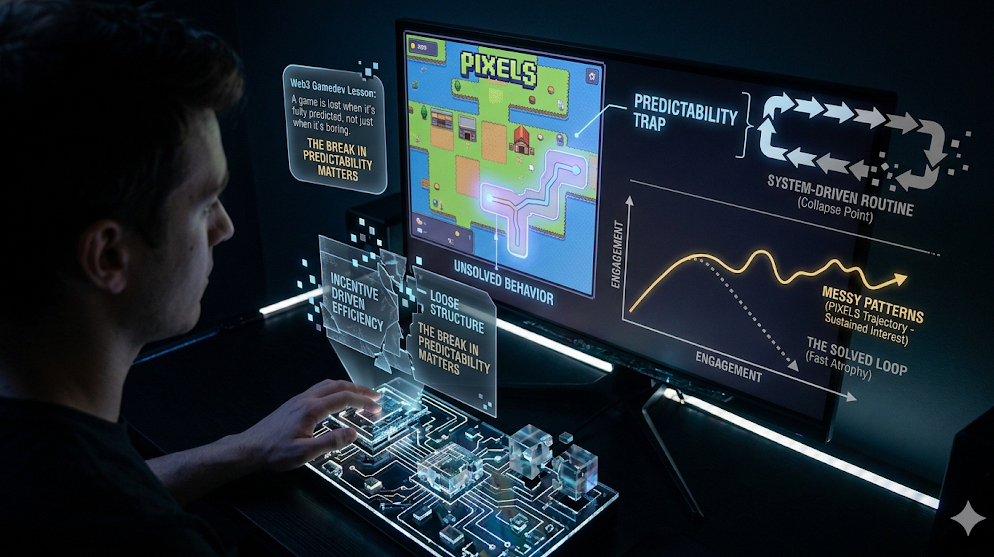
Most Web3 games collapse into a single dominant behavior.
Once players discover it, everything else becomes irrelevant.
You don’t choose what to do anymore.
The system chooses for you.
That’s when sessions get shorter. Decisions disappear. Engagement turns into routine.
I’ve Watched This Play Out Before
There was a phase in 2023 where games were getting “solved” almost instantly.
Communities would map everything out within days.
Best paths, optimal timing, exact sequences.
If you weren’t following that, you were behind.
So everyone followed.
And once everyone played the same way, the experience flattened.
Didn’t take long after that for people to move on.
PIXELS Feels Like It’s Slowing That Down
Not stopping it.
Just slowing it.
You can still optimize parts of it, but the whole system doesn’t collapse into one clean loop right away.
There’s still room for slightly messy behavior.
And messy behavior is harder to kill.
I’m Still Skeptical
Because I know how this usually ends.
All it takes is one strong incentive pushing efficiency, and players will reorganize instantly.
The loose structure tightens.
The game gets solved.
And from there, it’s just a matter of time.
But There’s Something Here Worth Watching
My sessions didn’t get cleaner over time.
That’s unusual.
In most games, the longer you play, the more efficient you become, and the less time you spend.
Here, it stayed uneven.
Some days quick. Some days longer than expected.
No consistent pattern.
I don’t think that’s accidental.
Final Thought
A game doesn’t lose players when they get bored.
It loses them when they can predict everything.
That’s when attention disappears.
PIXELS isn’t fully predictable yet.
And that might be the only reason it still holds interest beyond the first few sessions.
If it stays that way, even partially, it avoids a trap most Web3 games walk into without noticing.
If not, it ends the same way.
Just a bit later.
