
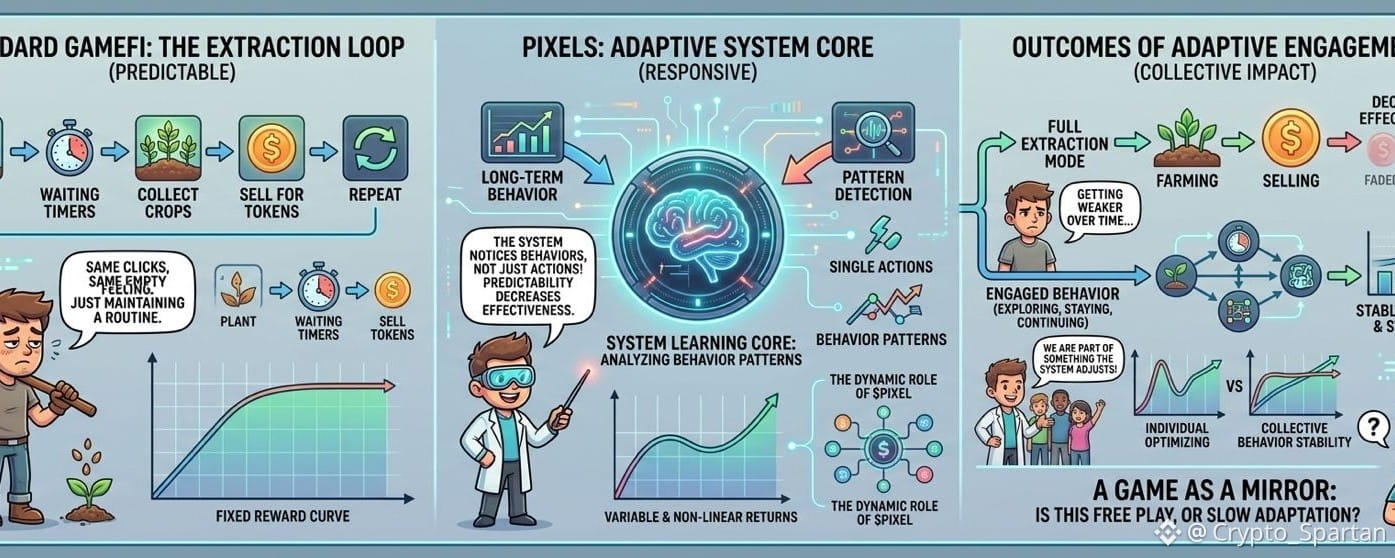
Let me be straight with you. I’ve played enough Web3 games to kinda know how it goes. You start curious, learn the loop, start optimizing, and then one day you realise you’re not really playing anymore you’re just maintaining a routine. Same clicks, same timing, same empty feeling.
I felt that again recently during a farming cycle. Plant, wait, collect, repeat. At some point it stopped feeling like a choice and more like a pattern I just fall into. And funny thing is, the better I got at it, the less connected it felt.
So when I first checked Pixels, I honestly expected the same thing. Just another shinier version of the same cage.
But after spending more time there, something felt off in a good way but also confusing. No big signals or anything, just small moments where results didn’t always match what I expected. Not random, but not fully consistent either. Enough to make repetition feel a bit strange.
And that’s what got me thinking. The system doesn’t just reward actions. It reacts to patterns behind those actions.
Let me explain. Two players can do the exact same farming loop, but it doesn’t always feel the same. If someone goes full extraction mode just farm, sell, leave something slowly changes. Not a punishment. Not a block. Just a quiet drop in how effective that behavior feels over time.
It’s like the system doesn’t like being solved too easily. The more predictable your strategy gets, the less stable it feels. And it’s not just “you earn less”. Sometimes it feels like the value itself shifts depending on how it was generated. Some rewards feel strong, some kinda fade, like they don’t carry the same weight.
That creates a different kind of tension. Most GameFi games push value out until everything breaks. Players farm, extract, leave, repeat. But here, there’s also something pulling the other way. Like the system is checking if people are actually engaging or just draining it.
And $PIXEL sits right in the middle of that. It doesn’t feel like a simple reward token you just earn and dump. It feels more tied to how you move inside the system. Like it affects access, progression, maybe even how your actions build up over time.
From outside, it still looks normal. Price moves, hype comes and goes. Nothing crazy. But that actually makes it easier to see what’s happening underneath.
What I keep wondering is if this balance can even last. Because players always adapt. People test things, find edges, push systems. The difference here is even if you find something that works, it might not stay useful for long.
It reminds me of systems where results aren’t based on single actions, but long term behavior. Small differences don’t show instantly, but they build up. And over time, outcomes start splitting without a clear reason.
At that point, it doesn’t feel individual anymore. It feels collective. You’re not just playing your own loop you’re part of something the system is adjusting constantly.
If too many people extract, things shift. If engagement stays healthy, things stabilise. So the normal loop farm, sell, leave doesn’t disappear. It just gets weaker over time.
And what replaces it is less obvious. Something closer to staying, returning, continuing. Not because you’re forced to, but because the system kinda depends on it.
I don’t think Pixels has fully figured it out yet. Systems like this take time, data, scale. Early stages are always messy. But still, it made me pay attention.
Because for once, it doesn’t feel like I changed how I play. It feels like the system noticed me and adjusted around it.
Let me give a simple example. A while ago, I locked into what I thought was a perfect routine. Same timing, max efficiency, pure extraction. For a few days it worked great. Then slowly, returns felt weaker. Nothing broke, just less impact.
At first I thought it was just coincidence. So I changed my style. Slower, less focused on extraction, more exploring. And weirdly, things started feeling stable again.
That’s when it hit me the game wasn’t punishing me. It was responding to me. And that’s a different thing entirely.
From a design point of view, this is either really smart or really risky. Because adaptive systems create adaptive players. Once people find patterns, they push them. The question is whether the system can keep up without feeling exhausting or unfair.
Economically, it’s interesting too. You’re not just farming anymore you’re part of a live system adjusting itself. Your output depends partly on the whole environment.
That’s not standard GameFi. That’s more like a small economy learning itself in real time.
And socially, it changes things too. You stop asking “how do I win?” and start asking “how do we behave?” That shift is small but big at the same time.
So yeah, I don’t know if Pixels will succeed long term. The space is still early, messy, full of hype and failures.
But I know one thing it made me think. And most Web3 games don’t do that.
It made me question if I’m still playing freely, or slowly adapting to a system that adapts back.
And honestly, that uncertainty feels more real than any promised APY or roadmap ever did.
What do you think? Have you felt this too? That moment where a game stops feeling like a game and starts feeling like a mirror? Or maybe I’m just overthinking a farming loop.
Either way, feels worth talking about. Because if this is where things are going, then we’re not just players anymore… we’re part of the learning too.
