
I noticed it inside Pixels before I had words for it. Not in the whitepaper or any announcement, just in the way a routine day on the farm started to feel predictable in some places and oddly capped in others. You clear tasks faster, optimize routes, shave seconds off harvesting loops… yet the outcome barely shifts. Something holds it in place. Not a bug. More like a boundary you don’t see until you keep hitting it.Pixels doesn’t feel unstable when you’re inside it. That’s the first thing. Crops grow on time. Crafting queues behave. Movement is instant enough that you stop thinking about latency. Most of the economy you interact with daily is smooth to the point of being invisible. That stability is doing real work. It keeps behavior consistent. You can plan a session and actually execute it without randomness getting in the way.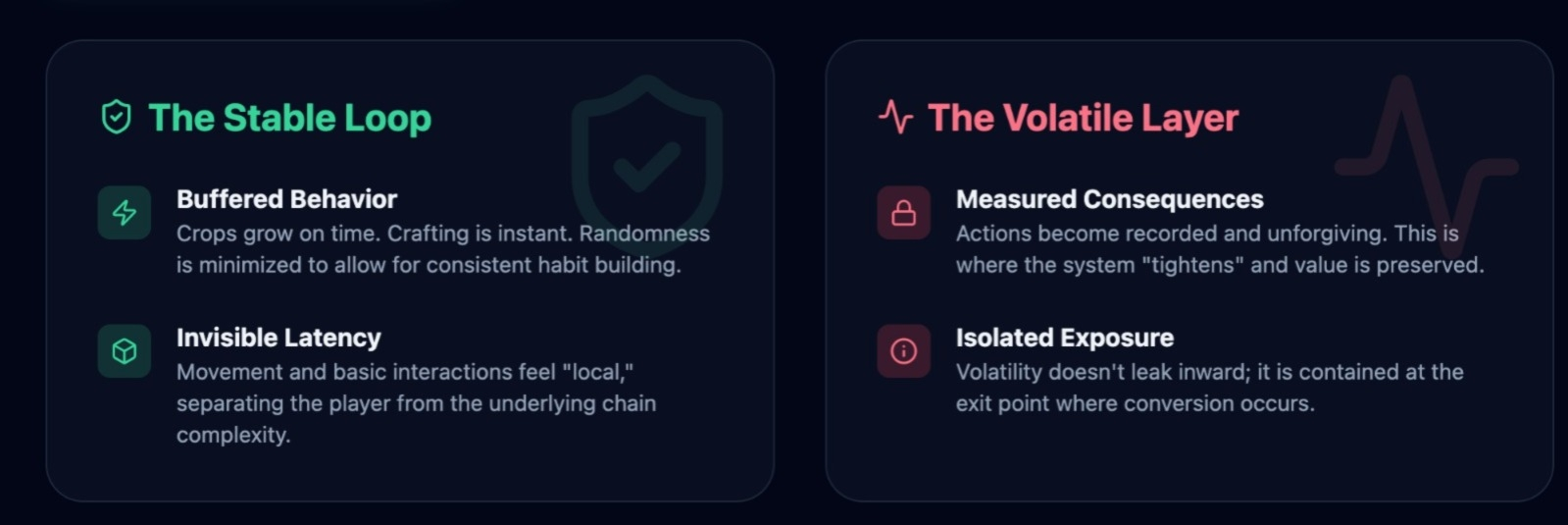
But stability here isn’t just comfort. It quietly decides how far your effort can travel.
There’s a moment where everything changes, and it’s not dramatic. You finish a loop, convert output, and now it touches the external layer. That’s where the system tightens. What felt infinite inside the farm suddenly becomes measured. Slower. Recorded. Less forgiving. It’s the same action on the surface, but the consequences are different. One side absorbs mistakes. The other preserves them.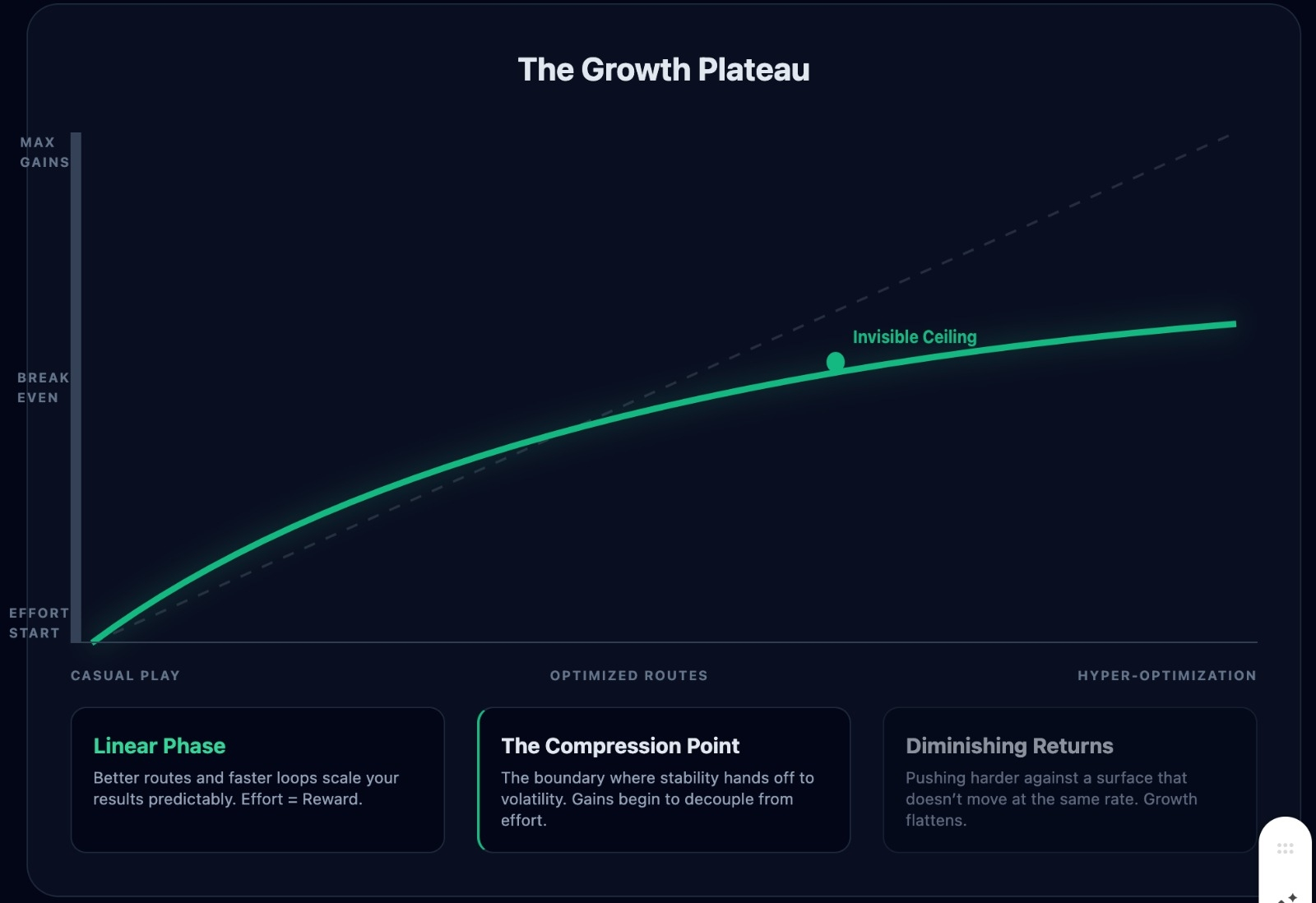
That split is doing something subtle. It protects the system from volatility leaking inward.
Because volatility exists. You can feel it even if you’re not tracking numbers. Timing starts to matter. When you choose to convert, when you hold, when you repeat a loop… those decisions don’t behave the same way every day. And the system doesn’t try to remove that. It just contains it.
One framing that kept coming back to me:
Pixels doesn’t eliminate volatility. It isolates it.
Inside the farm, your actions are buffered. You can run ten loops back to back and get roughly the same outcome each time. No sudden spikes. No collapse. That consistency is what lets players build habits. It’s also what stops bots from easily exploiting randomness, because there isn’t much randomness to exploit at that layer.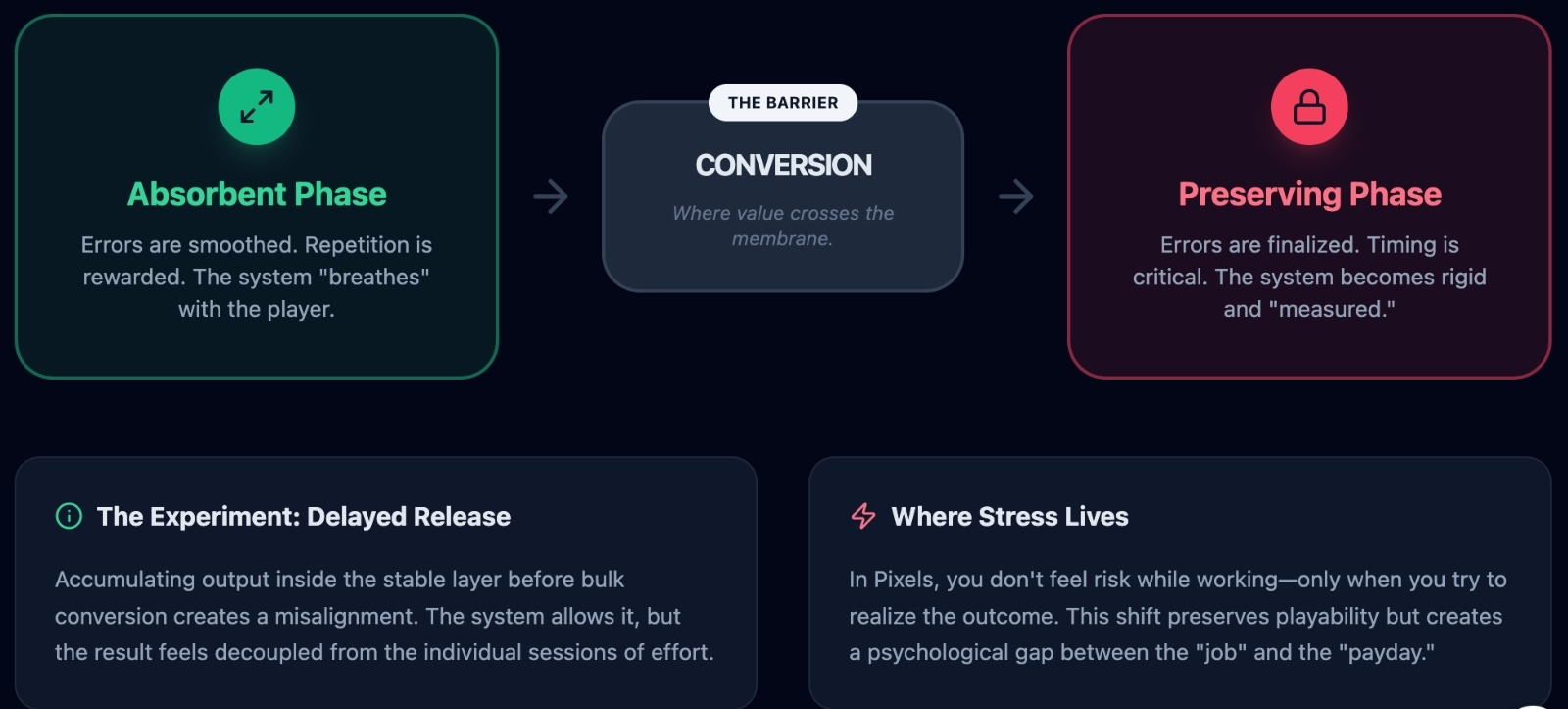
But the moment value crosses outward, the buffer disappears. Now you’re exposed to variability. Not chaotic, but enough that it changes behavior. You start spacing actions differently. You stop thinking in pure repetition and start thinking in timing.
Try this. Run identical farming loops for an hour, then compare what actually translates outward. Not just quantity, but when and how it moves. The difference is not huge in a single session, but it compounds over time. That’s where the friction shows up. Not as a barrier, but as a slow drift between effort and realized output.
Another test. Delay conversion deliberately. Let output accumulate inside the system longer than usual, then release it in one go. The system allows it, but the result feels different. Not broken, just… less aligned with the effort you put in. That’s volatility showing up indirectly.
The tradeoff sits right there in the middle.
Stability inside the game makes it playable. It reduces noise, keeps the experience fair, and prevents the economy from being gamed through randomness. But isolating volatility means that the point where value exits becomes more sensitive. You don’t feel risk while you’re working, only when you try to realize the outcome. That shifts where the stress lives.
It also changes what “improvement” means.
You would think better routes, faster loops, and tighter execution would scale your results linearly. They do, but only up to the boundary where stability hands off to volatility. After that, gains compress. Not disappear, just flatten. It’s like pushing harder against a surface that doesn’t move at the same rate.
I’m not fully convinced this is a good thing. It makes the system durable, yes. Probably necessary to avoid the collapse most play-to-earn setups went through. But it also creates this quiet ceiling where effort feels decoupled from outcome. Not completely, just enough to notice.
When the token layer comes into view, it explains itself without needing to be introduced earlier. It’s the part that carries volatility. The part that can’t be smoothed out without losing its function. And Pixels seems to treat it carefully, almost defensively, by keeping it at a distance from the core loop.
Which raises a question I keep coming back to.
If most of the system is designed to be stable, and the volatile layer is isolated, where does meaningful growth actually happen? Inside the safe loop, or at the edge where things become uncertain?
I don’t have a clean answer. Some days it feels like the stability is the real product and everything else is just a pressure valve. Other days it feels like the volatility is the only place where decisions matter, even if they’re harder to control.
Try one more thing. Play without thinking about conversion at all for a few sessions. Just stay inside the stable layer. Then switch back and pay attention to how different it feels when the system starts caring about finality again.
That shift is small. Easy to miss. But once you see it, it’s hard to ignore.
And I’m not sure whether the system wants you to lean into that boundary or stay comfortably away from it.
