I used to look at ownership in Web3 games in a very simple way.
You own land.
You own assets.
You own something inside the game.
That sounds good on the surface, but after seeing so many Web3 games fail to hold attention, I think ownership alone is not enough anymore.
Because ownership without activity becomes dead weight.
That is the part of Pixels that feels more interesting to me now. The real question is not whether a player can own something. The real question is whether that ownership actually connects back into the daily life of the game.
That difference matters.
A lot of games can sell ownership.
Fewer games can make ownership feel alive.
Pixels does not feel strong to me just because it has land, assets, pets, staking, or Pixel utility. Those things matter, but they are not the full story. What matters more is how these pieces sit inside a player loop where effort, access, timing, and participation keep interacting with each other.
The official Pixels site still presents the game as a world where players can play, build, progress, and own what they create. It also frames Pixels as a platform where communities come to life and users can truly own their progress. That line is important because progress is the real keyword here, not just ownership.
If ownership only sits outside the game, it becomes speculation.
If ownership connects to progress, it becomes part of behavior.
That is where I think Pixels becomes harder to read as just another farming game.
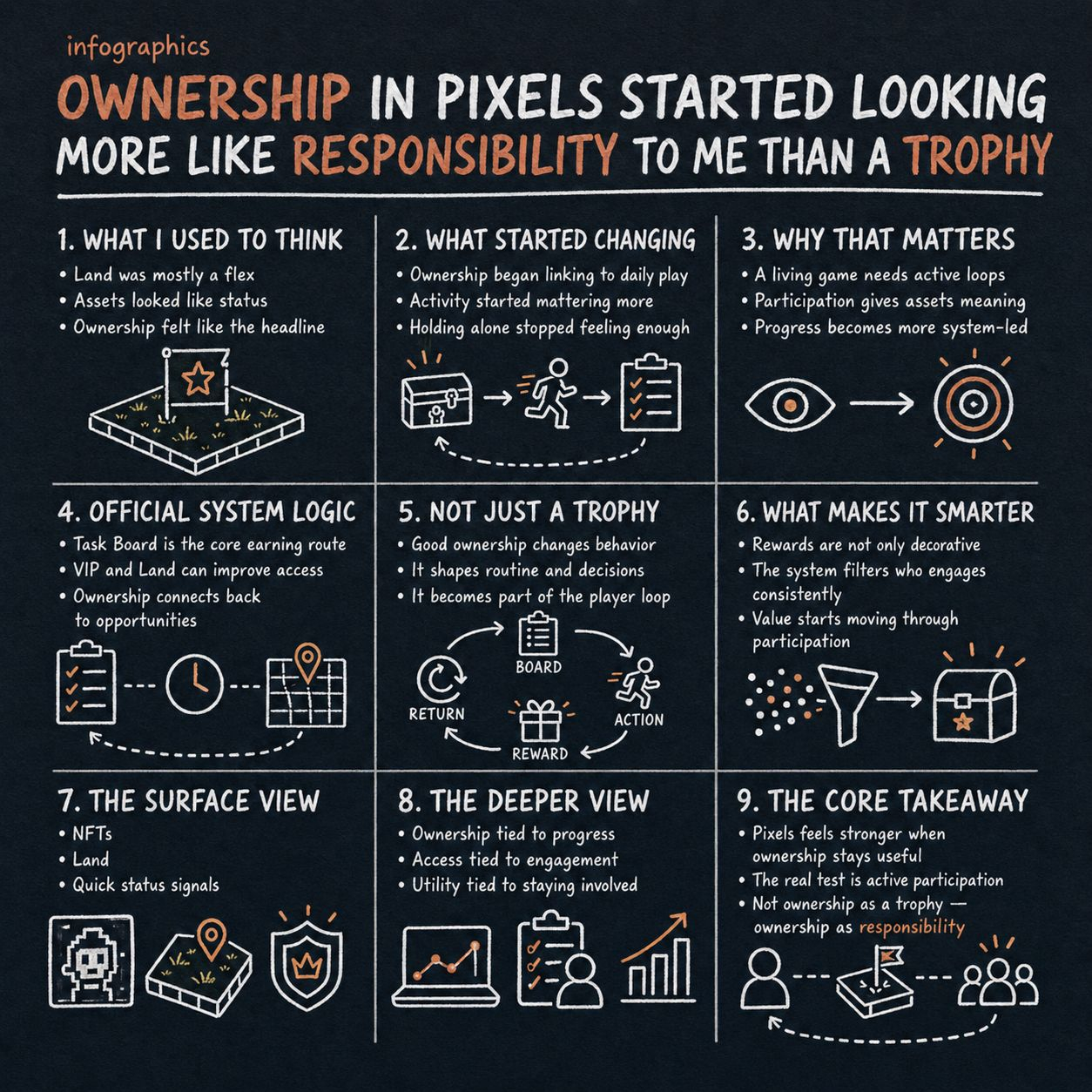
The Task Board makes this clearer. Pixels’ help page describes the Task Board as the primary method used to earn $PIXEL and Coins inside the game. It also says the Task Board is the only way to earn $PIXEL within the game, while VIP and Land Ownership can increase the chance of getting $PIXEL tasks.
That sounds like a small game mechanic, but I do not think it is small.
It changes the meaning of ownership.
Land is not just a badge.
VIP is not just a label.
Activity is not just routine.
They all start becoming part of the same filter.
The system is quietly asking a harder question: are you only holding something, or are you actually participating inside the world?
That is where weaker Web3 games usually expose themselves. They create assets first and gameplay later. They make ownership look important before the world itself has enough reason to keep people coming back. The result is usually predictable. People buy, wait, lose interest, and leave.
Pixels feels more serious because the structure is more connected than that.
It still has the simple farming surface. That is important because games need to feel approachable. But under that simple surface, there is a deeper economic design forming around timing, tasks, land, VIP access, rewards, reputation, skill, and long-term participation.
That is not just “play and earn.”
That is behavior shaping.
And honestly, this is where the project becomes more interesting to me.
Because in a healthy game economy, rewards should not only attract people. They should teach people how the world works. They should make players understand that better positioning, better consistency, and deeper participation can matter over time.
Pixels seems to be moving closer to that kind of design.
Binance Research described Pixels as a social casual Web3 game on Ronin built around farming, exploration, and creation. It also noted Pixel utility around NFT minting, VIP membership, guilds, premium features, and governance, while highlighting land ownership, customization, reputation, and incentive design as major parts of the ecosystem.
That is why I do not think the strongest Pixels story is “players own assets.”
That is too basic now.
The stronger story is that Pixels is trying to make ownership useful inside a living system.
There is a big difference between owning something and having a reason to keep showing up because of what you own.
That difference is where long-term game economies are tested.
If land has no connection to behavior, it becomes decoration.
If VIP has no connection to access, it becomes a subscription label.
If $PIXEL has no connection to utility, it becomes just another token chart.
If tasks have no structure, rewards become random noise.
But when all of these things start connecting, the game begins to feel less like a collection of features and more like an economy with rules.
That is what I think people miss when they only look at Pixels from the outside.
They see farming.
They see pets.
They see land.
They see $PIXEL.
But the more important thing is how these pieces push the player into a different relationship with the game.
You are not only playing for one reward.
You are learning how the system values participation.
That is where Pixels feels sharper to me.
Because the future of Web3 gaming will not be won by games that simply give players something to own. That idea is no longer rare. The harder challenge is building a world where ownership stays active, useful, and connected to real player behavior.
Pixels is interesting because it is not only asking players to own part of the world.
It is asking whether they can stay involved enough for that ownership to actually mean something.
And to me, that is the real test.
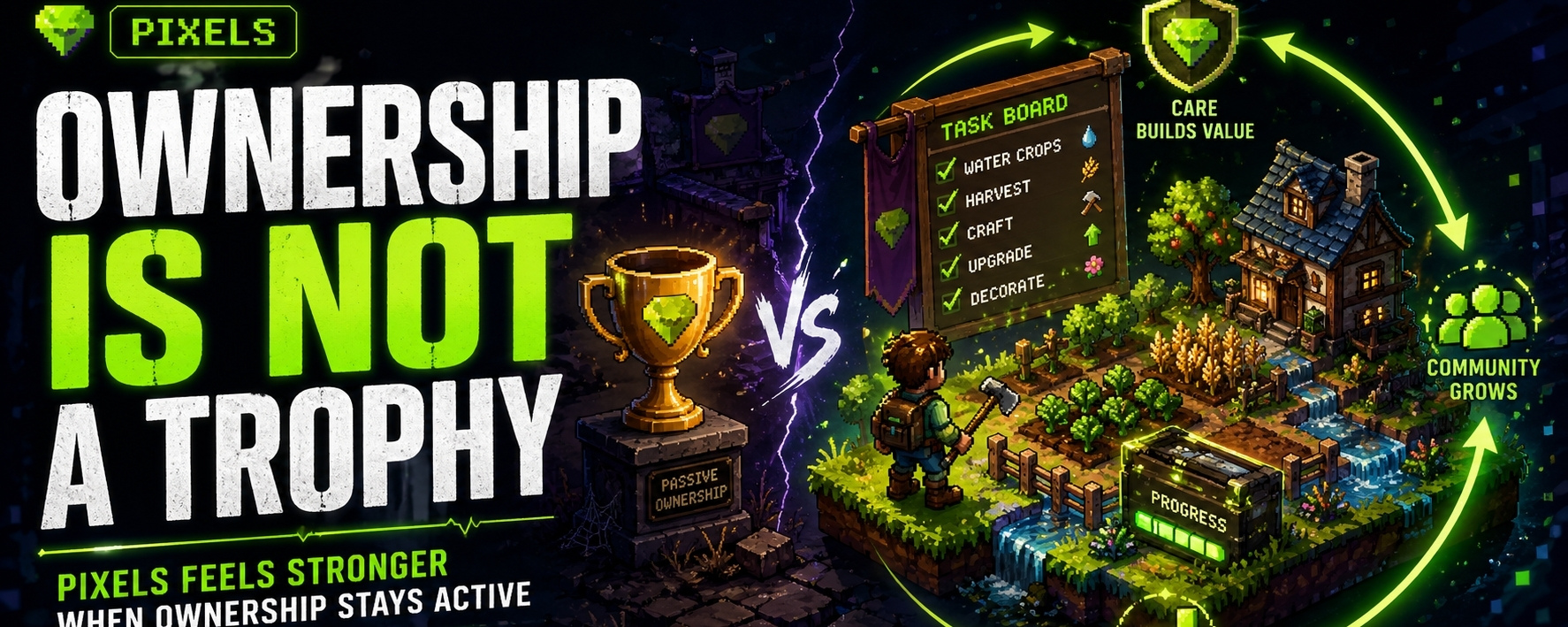
Not ownership as a trophy.
Ownership as responsibility.
Not assets sitting still.
Assets connected to progress.
That is where Pixels starts looking less like a simple game and more like a system that is trying to make player participation matter.