

I didn't think much about it at first. Farming games have a way of doing that. You log in, do the loop, close the tab. Nothing asks too much of you. And Pixels was easy to underestimate that way. Relaxed surface, casual pacing, low-friction entry. I placed it in a comfortable category and didn't revisit that category for a while.
Then I started paying closer attention to what the system was actually measuring.
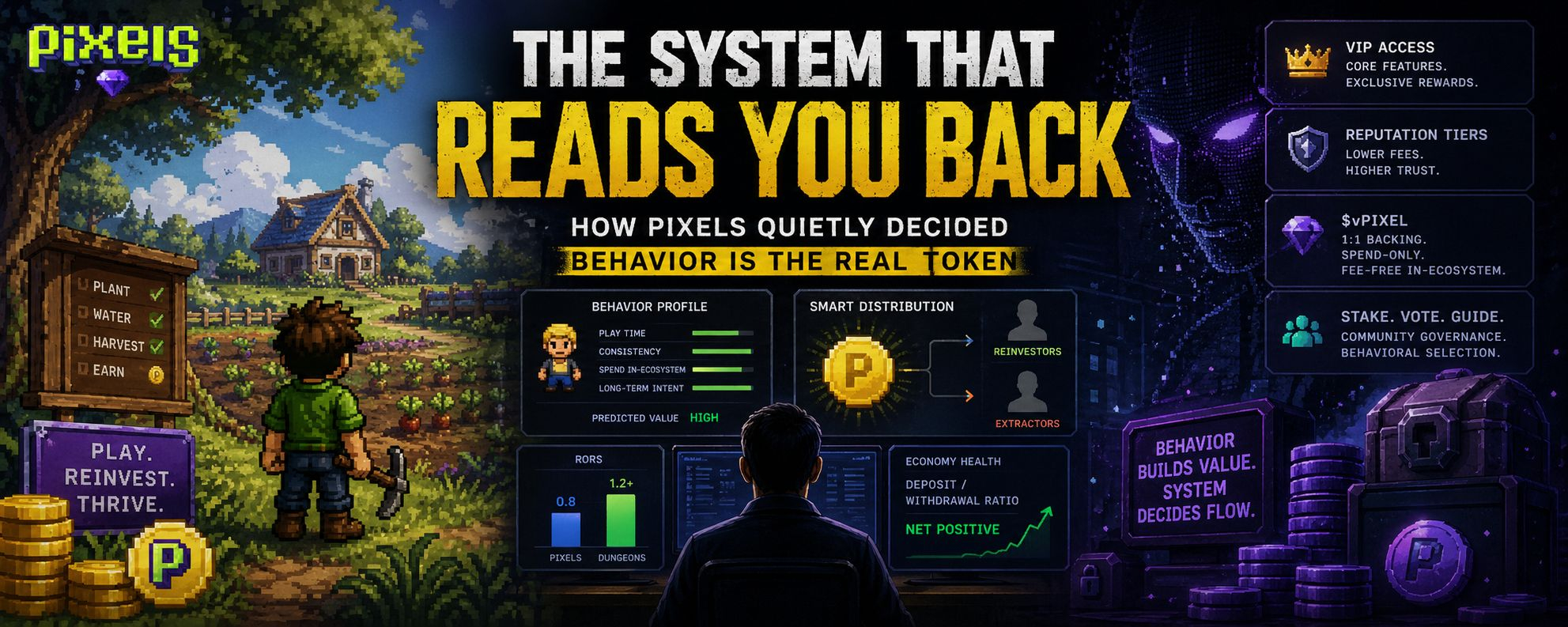
Because it is measuring. That part is not subtle anymore, it's just that most players don't register it that way. When the CEO of Pixels described their reward architecture to BlockchainGamer, he didn't talk about fun or fairness. He talked about data science, predictive modeling, and two years of behavioral data used to identify which players reinvest versus which ones extract. That framing stuck with me. Because it means when you're playing Pixels, the game isn't just running, it's reading.
The official description is smart token distribution. What it actually does is allocate PIXEL based on whether your behavior profile suggests you'll put it back into the ecosystem. Play consistently, spend inside the system, signal long-term intent, and the reward flow bends toward you. Grind through short bursts and withdraw immediately, and over time the flow bends away. Not punished. Just quietly deprioritized.
That distinction matters. It's not a penalty system. It's something more interesting than that.
What it resembles, if you step back, is an underwriting model. You're being assessed not on what you've earned but on what you're likely to do with it. The tokens go to the predicted reinvestors, not simply the active players. And that means two people doing nearly identical actions inside the game can end up with meaningfully different reward trajectories, without either of them fully understanding why.
I've watched this play out in smaller ways. The farming loop feels similar on the surface regardless of player type. Same tasks, same cadence, same basic mechanics. But once you start tracking outcomes across time, a gap appears. And it doesn't come from effort or skill. It comes from how the system has categorized you.
That categorization is getting more precise, not less. The April 2025 strategic shift announced a move away from maximizing daily active adventurers toward prioritizing users with higher lifetime value. A policy term borrowed directly from SaaS and consumer finance. Core features and earning opportunities are now being gated behind VIP access. Withdrawal fees are being assessed by reputation tier, with higher-reputation players paying less to exit. The fees collected flow back to stakers. The system is literally taxing certain behavior to subsidize other behavior.
And then there's $vPIXEL, which is where it gets genuinely interesting to think about.
$vPIXEL is backed 1:1 by PIXEL but cannot be sold. Spend-only. Fee-free to move within the ecosystem. On paper it sounds like a convenience feature. But what it actually does is create two parallel tracks for the same underlying value. Players who accept the spend-only constraint get frictionless movement. Players who want to exit the ecosystem pay friction. That's not just a UX decision. It's a behavioral nudge with economic teeth. The system is structuring the path of least resistance to run through reinvestment.
I find myself thinking about this every time I see someone describe PIXEL as just a premium currency. It isn't. It's closer to a behavioral index. The token's flow reveals which actions the system considers worth supporting, and that signal gets more refined with every update.
The RORS metric complicates this further in a way most people aren't fully tracking yet. Return on Reward Spend measures whether emissions into a game generate more spending back out. The main Pixels game was sitting at 0.8 when the staking system launched, meaning it was returning 80 cents of spending per dollar of rewards distributed. Pixel Dungeons, a smaller title in the ecosystem, was already above 1.2. For stakers deciding where to allocate, that gap is a signal. For the Pixels team, it's a live readout of which parts of the economy are generating sustainable behavior versus which are leaking value.
This is where the multi-game publishing angle stops being a product roadmap and starts being a selection mechanism. As more games enter the ecosystem, stakers will route PIXEL toward the titles showing the best RORS. Games that don't generate reinvestment behavior die slowly from token starvation. Games that do, grow. The community thinks it's governing a platform. What it's actually doing is operating a behavioral selection filter at scale.
I don't say that critically. It might be the only architecture that actually works.
The pure extraction model that defined most early Web3 gaming was always going to collapse. You can't sustain a reward economy if everyone's primary goal is to leave it richer than they arrived. So some form of filtering has to happen. The question is just what values the filter encodes, and who benefits from it.
Right now the filter clearly favors consistent long-term participants over short-cycle extractors. That sounds reasonable. It probably is reasonable. But it also means the system is making a quiet judgment every time you log in: does this behavior belong here? And over enough iterations, that judgment compounds into something that shapes who stays, who progresses, and who slowly drifts out without fully understanding why.
There's a real tension in that. Not a fatal one. Just an unresolved one.
Because if the system works, what you end up with is an ecosystem that's genuinely healthier, more sustainable, and more rewarding for the people most committed to it. The deposit-to-withdrawal ratio hit net positive for the first time in May 2025. That's not noise. That's a signal that something structurally changed. The economy started pulling in more than it was giving out. That's the outcome the smart distribution model was built toward.
But it also means the game isn't really neutral anymore. It never was, but the gap between the surface experience and the underlying logic is widening. Most players will never read the whitepaper. Most players will never understand why their reward flow feels different from someone else's. They'll just feel it, and form a conclusion that may or may not match reality.
That gap is the thing I keep watching. Not the token price. Not the chapter roadmap. The gap between what the system is doing and what players think the system is doing.
If that gap closes through education and transparency, the model becomes something genuinely new in gaming. If it stays hidden, it starts to feel like something older and less interesting. A system that works by keeping you slightly confused about how it works.
I haven't settled where Pixels lands on that line yet.
But I'm paying much closer attention now.