
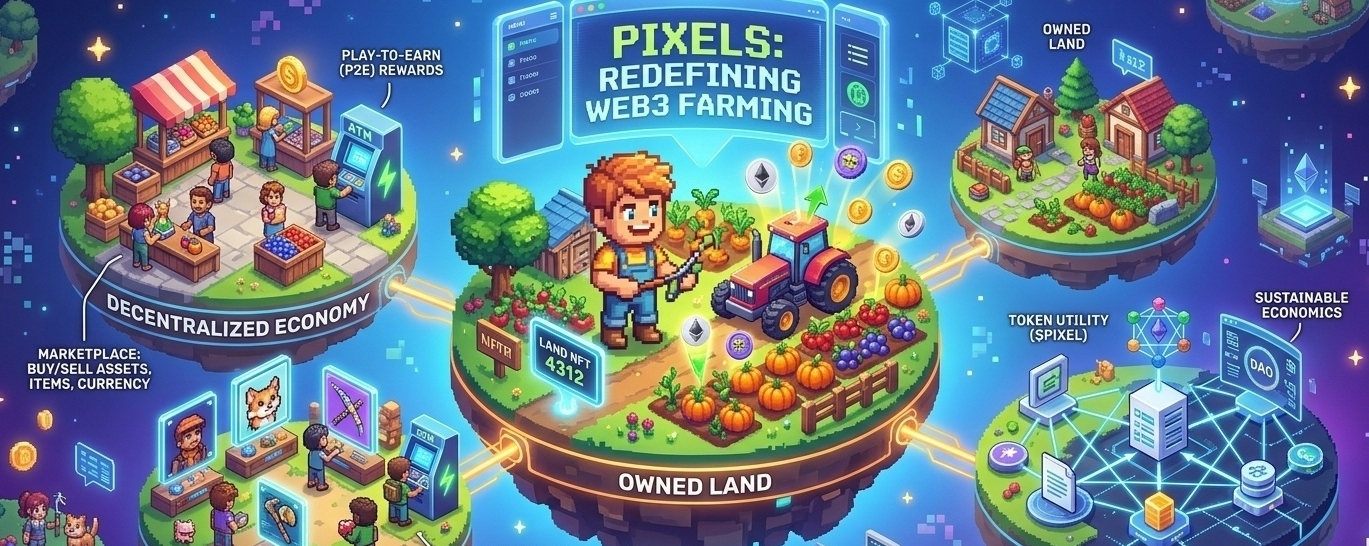
I didn’t fully understand what Pixels was the first time I stepped into it. It looked simple, almost too simple—just another pixel-style farming world where you plant, harvest, and wander around. At first, it felt like something I had already seen before, just wrapped in a Web3 label. But the longer I stayed inside it, the more I started to notice that what it was doing ran deeper than its surface.
I don’t really see Pixels as just a game anymore. I see it as a system that’s quietly trying to redefine how digital worlds operate, especially when it comes to ownership and value. Built on the Ronin Network, it doesn’t just simulate progress—it records it in a way that can exist beyond the game itself. When I farm, craft, or collect something, it doesn’t feel like a temporary action tied to a save file. It feels like I’m contributing to something persistent, something that has structure outside of my session.
At the beginning, I played it like anyone else would. I planted crops, waited for them to grow, harvested them, and repeated the cycle. It was calm, almost relaxing. But after a while, I realized that the loop wasn’t as innocent as it seemed. Every action had weight. Energy limited what I could do, resources carried different levels of importance, and decisions started to matter more than I expected. I wasn’t just playing—I was managing effort, even if I didn’t consciously frame it that way at first.
What really changed my perspective was understanding land. In Pixels, land isn’t just a decorative space—it’s ownership in a very literal sense. When I thought about it, I realized that some players aren’t just participating in the system; they’re hosting parts of it. Activity flows through their land, and they benefit from it. That’s when it clicked for me that Pixels isn’t just about interaction—it’s about positioning. Where you stand in the system can shape what you get out of it.
The social layer pushed this even further. I noticed that I wasn’t really meant to exist alone in this world. Guilds, shared goals, and cooperative systems made it clear that Pixels leans toward collective behavior rather than isolated gameplay. It felt less like a single-player loop and more like stepping into a small, evolving society. People weren’t just playing side by side—they were aligning, organizing, and sometimes even optimizing together.
Then there’s the PIXEL token, which I didn’t fully pay attention to at first. It seemed like just another reward mechanism, something you earn and spend. But over time, I started seeing it differently. It wasn’t just a reward—it was a connector. It linked different parts of the system together. Whether I was progressing faster, unlocking something new, or trading, the token sat quietly in the background, giving structure to how value moved inside the game.
What I find interesting is that Pixels doesn’t force the economic side on me. It doesn’t feel like I’m constantly being pushed to “earn.” Instead, it lets me settle into the gameplay first, and only later do I start to notice that what I’m doing has economic implications. That subtlety is rare. I’ve seen other Web3 games where the financial layer dominates everything, and it often ends up breaking the experience. Pixels takes a slower approach, almost like it’s trying to earn my attention before revealing its deeper mechanics.
As I spent more time in it, I started to feel something slightly unusual. It didn’t feel like I was initiating everything. It felt like I was stepping into a system that was already in motion. Tasks were waiting, economies were already functioning, and my role was to fit into that flow rather than control it. That shift is hard to explain, but it changes how I think about the experience. I’m not the center of the world—I’m a participant in something that continues with or without me.