
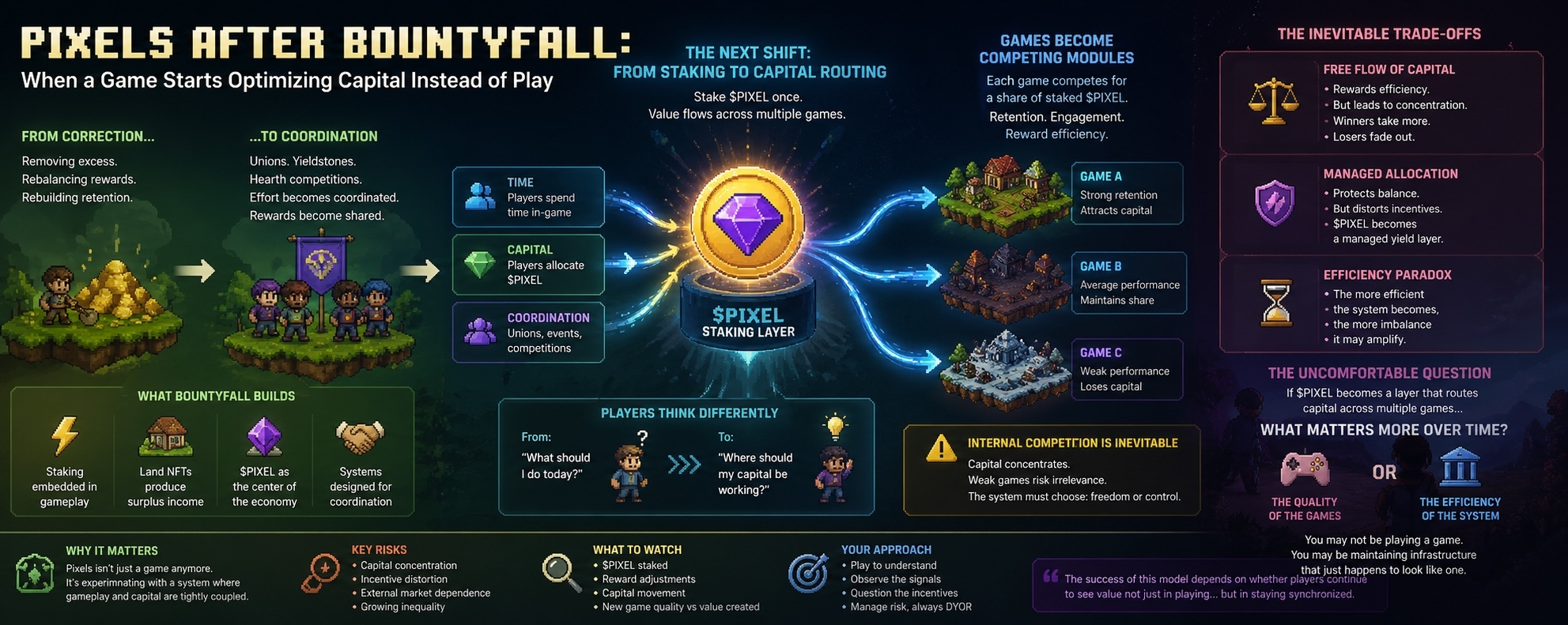
I used to think of Pixels as a typical GameFi correction cycle.
You take a system that inflated too quickly, remove the excess, rebalance rewards, and rebuild retention through better gameplay loops. From the outside, Chapter 3 Bountyfall fits that narrative quite well. Cleaner sinks. Stronger coordination. More deliberate reward distribution.
For a while, that explanation feels sufficient.
PIXEL becomes the center of gravity. Older inflationary mechanics fade out. Staking is no longer a passive “click and earn” feature, but something embedded directly into how you play, affecting energy, farming efficiency, even how land contributes to output.
It feels tighter. More intentional.
But the longer you stay inside the system, the harder it is to believe that this is just a refinement.
Because even if Bountyfall succeeds on its own terms, a more structural question starts to surface:
What exactly is being optimized here?
At first glance, the answer seems obvious: better gameplay, better retention.
But Bountyfall introduces something slightly different.
Unions, Yieldstones, Hearth competitions are not just features designed to make the game more engaging. They reorganize how players interact with each other. Effort becomes coordinated. Rewards become shared. Individual play starts to blur into collective execution.
And that creates a subtle shift.
The system is no longer optimizing for player enjoyment alone.
It is optimizing for synchronized behavior.
Time, capital, and coordination begin to align.
This is where multi-game staking starts to feel less like a feature and more like a direction.
On the surface, it is simple: stake $PIXEL once, receive rewards across multiple games in the future ecosystem.
But that description hides the real transformation.
Because if staking spans multiple games, then PIXEL is no longer tied to a single gameplay loop.
It becomes a shared layer that sits above them.
Not quite a currency. Not quite equity.
Something closer to a capital routing layer, a place where value waits, then gets deployed into whichever experiences are active, relevant, or efficient.
And if that framing is correct, then Bountyfall is not just improving a game.
It is conditioning behavior.
Players are not just playing anymore.
They are being trained, gradually, to think in terms of allocation.
You do not just ask:
“What should I do today?”
You start asking:
“Where should my capital be working?”
At first, that shift is almost invisible.
But it compounds.
Once that shift happens, the system starts behaving differently.
Multi-game staking does not just aggregate rewards.
It introduces internal competition between games.
If multiple games draw from the same staked PIXEL base, then each one must justify why it deserves capital.
Not through marketing.
Through retention, engagement, and reward efficiency.
Games are no longer independent products.
They become competing modules inside a shared economic system.
And that creates a new kind of pressure.
If one game consistently delivers better returns, capital will tend to concentrate there.
If others underperform, they risk becoming irrelevant, regardless of how well-designed they are as experiences.
Unless the system intervenes.
Which leads to an uncomfortable fork:
If capital flows freely, strong games dominate and weaker ones decay.
If allocation is managed, incentives are distorted, and $PIXEL stops behaving like a true index.
There is no clean version of this system.
Only trade-offs.
And this is where the model starts to feel less stable than it first appears.
Because the more efficient the capital layer becomes, the more it encourages concentration.
And the more concentration increases, the more fragile the ecosystem may become.
Multi-game staking is supposed to stabilize the system.
But it may also be the mechanism that amplifies imbalance.
From a design perspective, this creates a deeper tension.
Each new game does not just need to be fun.
It needs to be economically competitive within the network.
Otherwise, it risks becoming dead weight attached to shared liquidity.
But optimizing for capital efficiency introduces another problem.
Because the systems that retain capital best are not always the ones that create the richest experiences.
Over time, gameplay itself may begin to drift toward whatever structure maximizes retention of capital, not attention.
And those two are not always aligned.
From a player perspective, this shift is even more ambiguous.
Multi-game staking promises continuity. Your capital remains productive across new content.
But it also changes your relationship with the game.
If your primary concern becomes yield across systems, then gameplay becomes a means, not an end.
And if that continues, something subtle begins to erode.
Not participation.
But intent.
Players may still log in.
But for different reasons.
Economically, the model looks more resilient than traditional GameFi loops.
A shared capital layer should, in theory, outlive any single game.
But that resilience depends on something external.
Because this entire structure still sits inside the broader crypto market.
If liquidity contracts, the staking layer shrinks.
If expectations break, coordination unravels.
No internal design can fully isolate it from macro conditions.
Which means:
Gameplay may define the floor.
But capital still defines the ceiling.
There are also asymmetries that do not disappear, they compound.
Land ownership already introduces structural advantages such as passive income, stronger integration with staking, and better positioning.
If multi-game staking extends those advantages across multiple titles, then inequality does not just persist.
It scales.
At that point, the system is not just coordinating players.
It is stratifying them.
And underneath all of this sits a quieter question that is not fully visible yet:
Who actually controls the flow of capital?
Is reward allocation across games emergent, driven by player behavior?
Or is it actively tuned by the team?
Because the answer changes everything.
If it is market-driven, the system risks accelerating toward concentration.
If it is controlled, then PIXEL is not really an index, it is a managed yield layer.
Either way, neutrality is an illusion.
From an investor’s perspective, this makes Pixels difficult to evaluate.
You are not just assessing a game.
You are assessing whether a system can sustain shared liquidity, competing modules, and coordinated behavior without collapsing into imbalance.
And many of those components do not fully exist yet.
There is also a less discussed failure mode.
If capital becomes too fluid, it may rotate faster than any game can retain it.
If rewards become too diluted, staking loses meaning.
If players optimize purely for extraction, the system may continue running, but feel increasingly hollow.
Not broken.
Just empty.
So the usual advice still applies, but it carries more weight.
Play long enough to feel whether the loops actually hold.
Observe how PIXEL is used, not just earned.
Watch how coordination affects outcomes.
Then step outside and look at what is harder to fake:
How capital moves
How often incentives are adjusted
Whether new systems create value or redistribute it
Because those signals tend to reveal whether the system is evolving or compensating.
It would be easy to frame Pixels as a breakthrough.
It would be just as easy to dismiss it as another cycle.
But neither feels accurate.
What is happening is less certain and more structural.
Pixels is not just building a game.
It is experimenting with a system where gameplay and capital are tightly coupled.
And that system may not be able to optimize both at the same time.
Because in the end, there may be a trade-off that cannot be resolved.
If the model succeeds, players increasingly behave like investors.
If it fails, it collapses back into a game.
But if it truly works as designed, then the question quietly changes.
Not whether Pixels is fun.
Not whether $PIXEL has utility.
But whether the system still needs gameplay to justify itself at all.

