

Most Web3 games try to solve the same problem in the loudest way possible: how do you keep players active, engaged, and spending time inside the system?
Pixels takes a different route. It doesn’t push for constant attention. It doesn’t demand long sessions. It doesn’t even try to convince you that you should be playing more.
Instead, it builds something subtler — a structure where staying connected feels optional, but returning feels natural.
At first glance, it looks like a simple farming loop. You plant, you craft, you upgrade. Nothing unusual. But the real design isn’t in the actions themselves — it’s in what happens when you stop doing them.
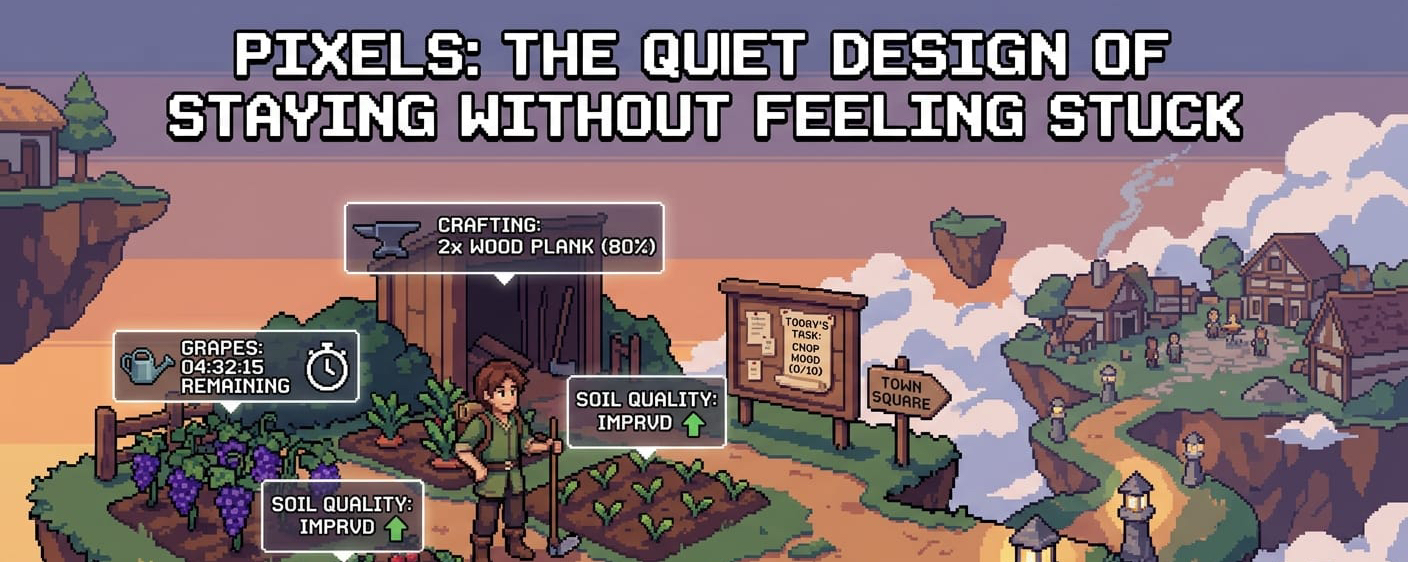
Most games go dormant when you leave. Pixels doesn’t fully shut off. It leaves behind small, unfinished states: timers, progress bars, ongoing tasks, gradual changes. Nothing dramatic. Just enough motion that the world doesn’t feel paused.
That small detail changes how you think about it.
You stop asking, “What can I do right now?”
and start asking, “What did I already set in motion?”
That shift sounds minor, but it repositions the entire experience.
You’re no longer interacting with a game as a series of sessions. You’re interacting with it as a continuing system.
And in that system, absence isn’t empty. It has structure.
You log out, but the game doesn’t reset your narrative. It keeps it gently moving forward.
This is where Pixels diverges from most traditional game design logic.
Conventional systems rely on presence:
log in → act → reward → repeat
Pixels leans toward continuity:
act → leave → things continue → return → observe → adjust
The difference is subtle, but important. One is built around effort. The other is built around return loops.
And return loops behave differently psychologically.
There’s no pressure to optimize every moment. No urgency spikes telling you you’re falling behind. Instead, the system creates a low-level awareness that something is always in progress.
That awareness is powerful because it doesn’t demand action — it invites curiosity.
You don’t return because you’re forced to.
You return because you want to resolve small unknowns.
What changed?
What finished?
What’s now ready?
Economically and structurally, this creates a different type of engagement curve.
Instead of sharp spikes of activity followed by drop-off, the system encourages steady, quiet revisits. Not long sessions, but repeated check-ins. Not intensity, but rhythm.
That rhythm is what most people underestimate.
Because retention doesn’t always come from excitement. Sometimes it comes from unfinished continuity that feels harmless to ignore, but interesting to revisit.
Another important layer is how progression feels distributed.
In many games, progress is concentrated into visible milestones — big upgrades, dramatic unlocks, clear leaps forward. Pixels spreads progression into smaller increments. You don’t always feel growth happening in real time, but you notice it over longer spans.
That creates a delayed recognition effect:
nothing feels urgent in the moment
but over time, the system quietly compounds
It’s not designed for instant gratification. It’s designed for accumulation without pressure.
This also changes how players relate to time.
Instead of treating time as something to optimize per session, it becomes something the system partially handles on its own. You’re not constantly “spending” time in exchange for progress. You’re occasionally adjusting a system that keeps evolving in the background.
That reduces friction. And reduced friction increases return probability.
What makes Pixels interesting isn’t that it is more complex or more rewarding than other systems.
It’s that it avoids forcing engagement through intensity.
It operates in a different range:
low pressure
persistent motion
optional interaction
continuous state awareness
That combination creates a very specific behavioral pattern: players don’t feel pulled in aggressively, but they also don’t feel fully disconnected.
So the real design outcome is not addiction in the traditional sense. It’s something softer and more sustainable: re-entry familiarity.
You don’t return because you left something urgent behind.
You return because the system makes it easy to pick up where your attention last touched it.
And over time, that becomes its own kind of gravity.
Not loud. Not demanding. Just steady enough to keep you aware that the world is still moving, even when you’re not.
