
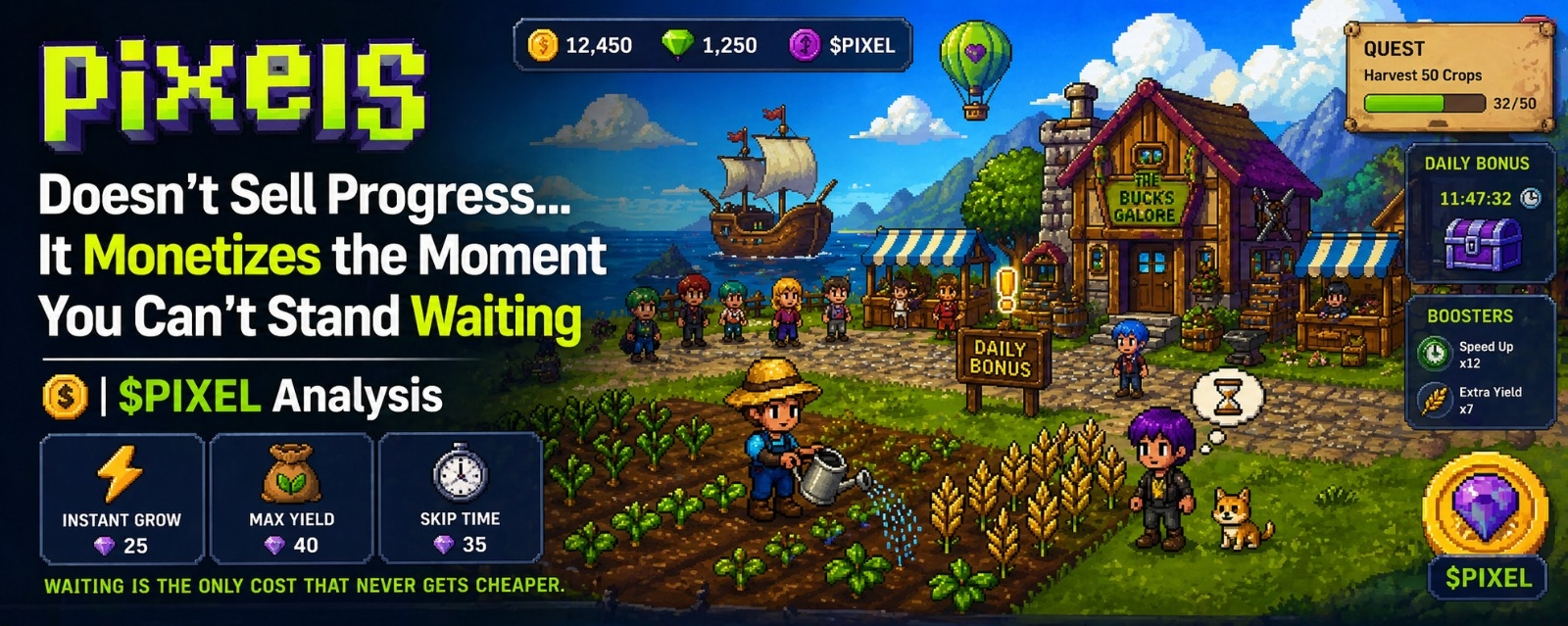

Games don’t sell fun. They sell impatience. In Pixels, that’s $PIXEL.
You’re looking at a carrot patch with nine minutes left. You don’t need to harvest it now. The game won’t punish you. But you’ve got seeds in your inventory, a crafting queue that unlocks in twelve minutes, and a window of free time before you go do something else.
You tap the button. You spend a little $PIXEL. The carrot finishes. You move on. That tiny moment of skipping a timer multiplied across thousands of players every day is the entire demand engine behind $PIXEL. Not chart patterns. Not roadmap hype. Just players choosing to bypass a wait because the friction is real enough to justify it.
If you took $PIXEL out of Pixels tomorrow, the game would still run. You could still plant, harvest, craft, and explore. The core loop stays intact. But one specific option disappears: the ability to turn a few minutes of standing around into immediate action. The system wouldn’t crash.
The damage would be quieter. Players who had built a rhythm around fast-tracking tasks would find that rhythm broken. Behaviorally, the game would start to feel heavier. That’s what $PIXEL actually is inside Pixels not a generic reward token for playing, but a friction-response tool that lives exactly where delay and impatience meet.
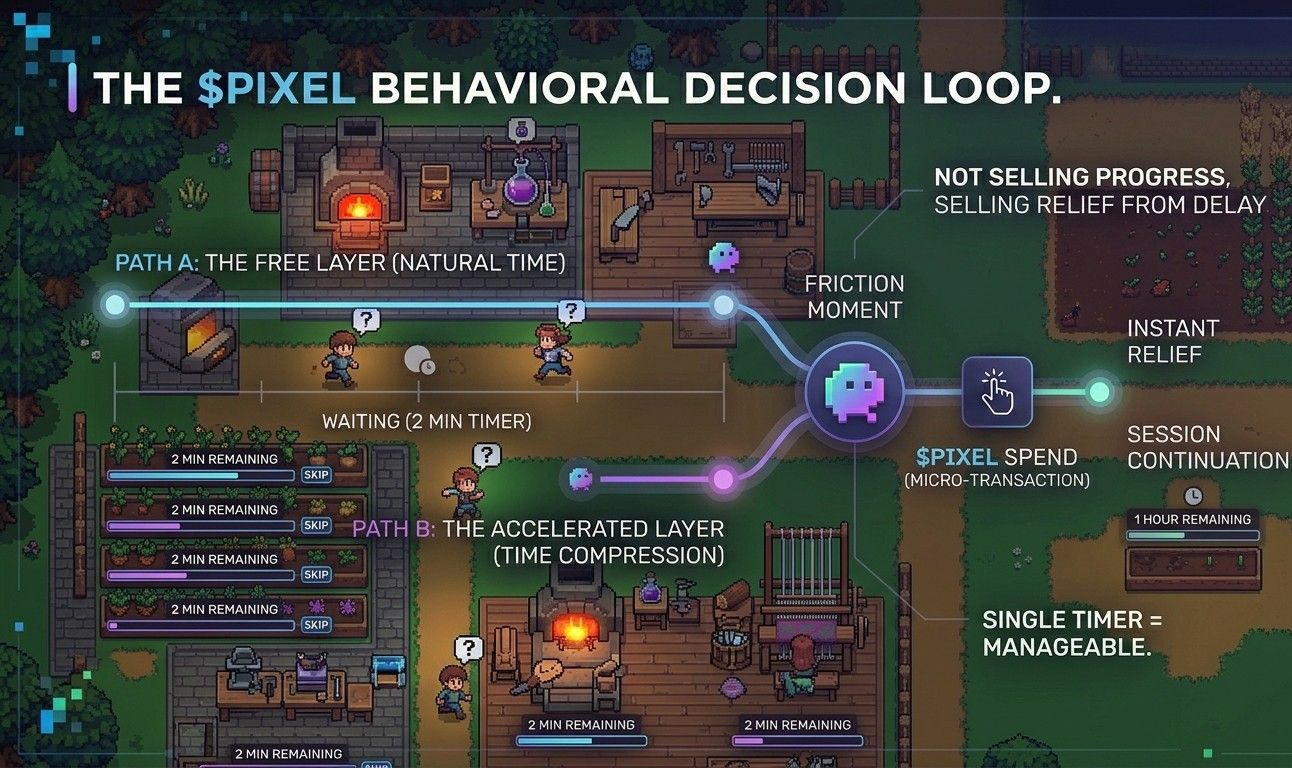
For a player on a typical day, this isn’t a rare event. Your land plots have staggered timers. Your crafting station is backed up with a high-demand recipe. Your energy bar is trickling back. One wait is manageable.
Three simultaneous waits become friction accumulation. At that moment, spending $PIXEL stops being a calculated economic choice and becomes a decision shortcut to keep your session flowing. You’re not evaluating the token’s market cap. You’re just trying to finish your farming loop before the next task in real life kicks in.
That’s the behavioral layer $PIXEL occupies. It doesn’t make the game faster your crops still need the same base duration, your crafting cycles still have the same structure. It just compresses the part where you’re staring at a countdown.
In doing so, it naturally splits Pixels players into two groups: those who let the game breathe and wait through the timers, and those who pay small amounts of $PIXEL to slide past them. The game never enforces that separation. It simply emerges from how different people value those spare minutes.
Once a player starts skipping, something familiar tends to happen. They encounter a wait, they pay a bit of $PIXEL, the tension releases. Then it happens again later in the session, and again the next day.
Over time, the use of $PIXEL becomes less of a conscious purchase and more of a learned rhythm an expected part of moving through the game. Demand stops coming from spikes of attention or trading volume.
It comes from the player who logs in, runs into multiple active timers, and automatically reaches for the skip. That’s not trading. That’s conditioning. And it’s what gives $PIXEL a structural demand layer that most gaming tokens never build.
But this only works in a very narrow band. The waiting has to be noticeable enough that skipping feels like relief, but not so heavy that the game starts feeling like a slot machine designed to frustrate you. For Pixels specifically, that means crop timers, crafting delays, and resource regeneration have to stay visible and meaningful. If a game update shortens base grow times too much, the need to skip shrinks.
If features like passive VIP bonuses or automated helper NPCs make timers disappear into the background, the urge to accelerate fades. And if the friction ever feels like it was dialed up just to push token spending like a cabbage that takes an absurdly long time for no in-game reason trust deteriorates quickly. $PIXEL demand exists only where waiting is felt, but not resented.
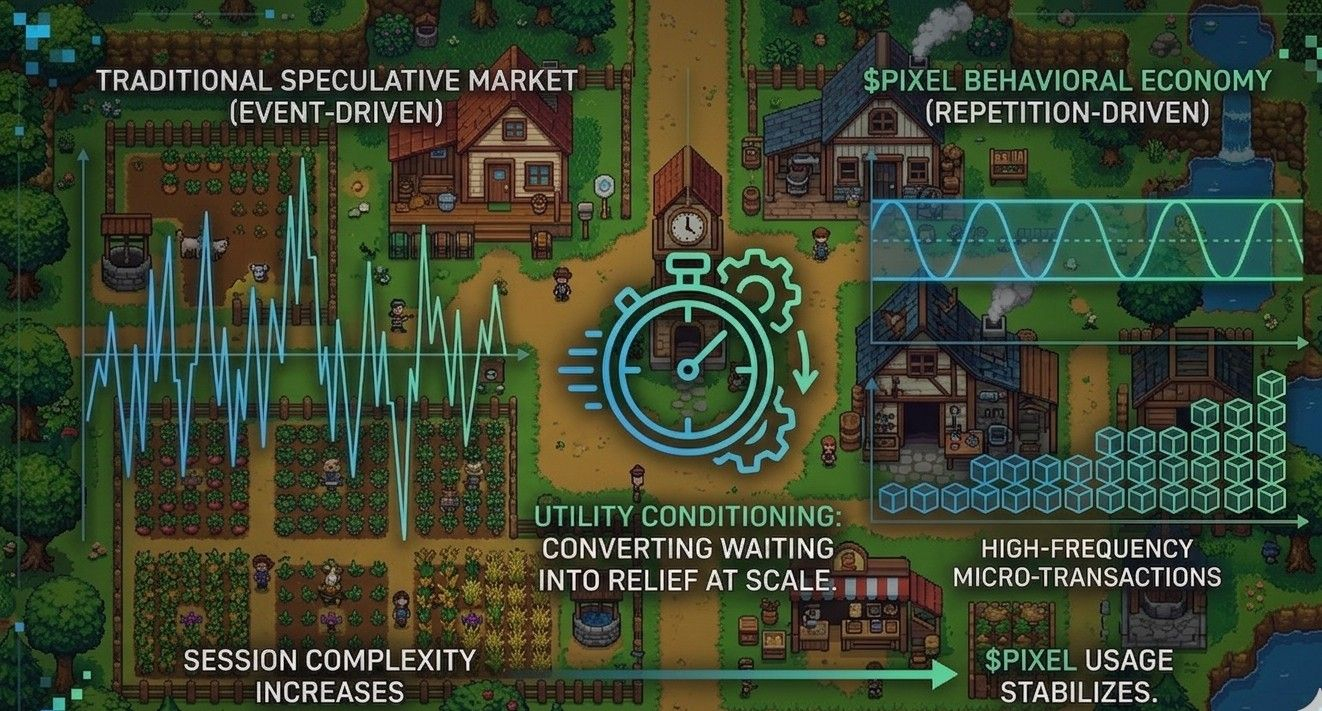
There are a few ways that middle ground can collapse. One, if the developers smooth out progression so much that timers lose their edge say, by making all basic crops instant or letting you queue endless crafts without slowdown. Two, if the friction starts to feel engineered, where it’s obvious that a timer is long only because there’s a token tied to skipping it.
Three, if the game moves timers so far into the UI background that players barely register them anymore. In any of these cases, the reason to spend $PIXEL doesn’t drop because players are unhappy, it drops because the behavior of skipping simply loses its trigger. The game can still look healthy. The token can quietly lose its function.
And even when skips keep happening, the link between that activity and $PIXEL’s value can fray in subtle ways. Bots running automated farm loops could generate skip transactions without any human behind the decision, which means the consumption exists but the meaning doesn’t.
A few high-rolling players could fund most of the skipping, masking the fact that average users are barely touching the token. Or the game could introduce alternative bypass mechanics boost potions, guild perks, special items, that let players accelerate without spending $PIXEL at all. If that happens, the behavior of skipping continues, but the token relevance drains out the side door.
There’s also the slow cultural shift: what if, months from now, Pixels players stop treating time compression as valuable and just see skipping as a cosmetic tap, something you do without caring? What if a major update reworks progression so thoroughly that waiting is no longer a meaningful part of the loop? In that world, $PIXEL could still be in circulation, but the impatience it once monetized would be gone.
That’s why watching actual player behavior inside Pixels matters much more than watching the price chart of $PIXEL. Three signals are especially useful. First, the size distribution of skips: if the number of small, everyday skips starts shrinking while a few very large spenders carry the volume, it’s a sign that habitual use is thinning out. Second, the sentiment around timers in the Pixels community, if players start saying the game feels like a waiting simulator designed to milk them, the friction has crossed from acceptable to resented.
Third, the relationship between skip rate and user growth: if more people are playing but each person is skipping less often, the habit is weakening before any drop in total users shows up. Those signals tell you about the health of the behavior that $PIXEL depends on.
So what does $PIXEL actually sell inside Pixels? Not land. Not resources. Not character progression. It sells relief from waiting. The product isn’t faster crops, it’s removing the mental weight of seeing a timer when you’re ready to act.
That relief only has value as long as the waiting is real, present, and consistently encountered in daily play. So the real question isn’t about the token’s supply schedule or its listing status.
It’s this: right now, inside Pixels, are thousands of players still encountering that moment of friction, still making the micro-decision to skip, still building the habit that turns a token into a behavioral necessity? Because in systems like this, price doesn’t lead the behavior. It lags behind, eventually reflecting whether that repetitive skip is still happening at scale.
#pixel @Pixels