What stood out to me about Pixels was not the size of the ambition.
Big ambition is everywhere in Web3 gaming now. Every project eventually starts talking about ecosystems, partner titles, publishing arms, shared economies, and bigger token utility. We have heard that language so often that it almost passes by without much impact.
So when Pixels talks about becoming more than one game, that alone is not the interesting part.
The more interesting part is what happens underneath it.
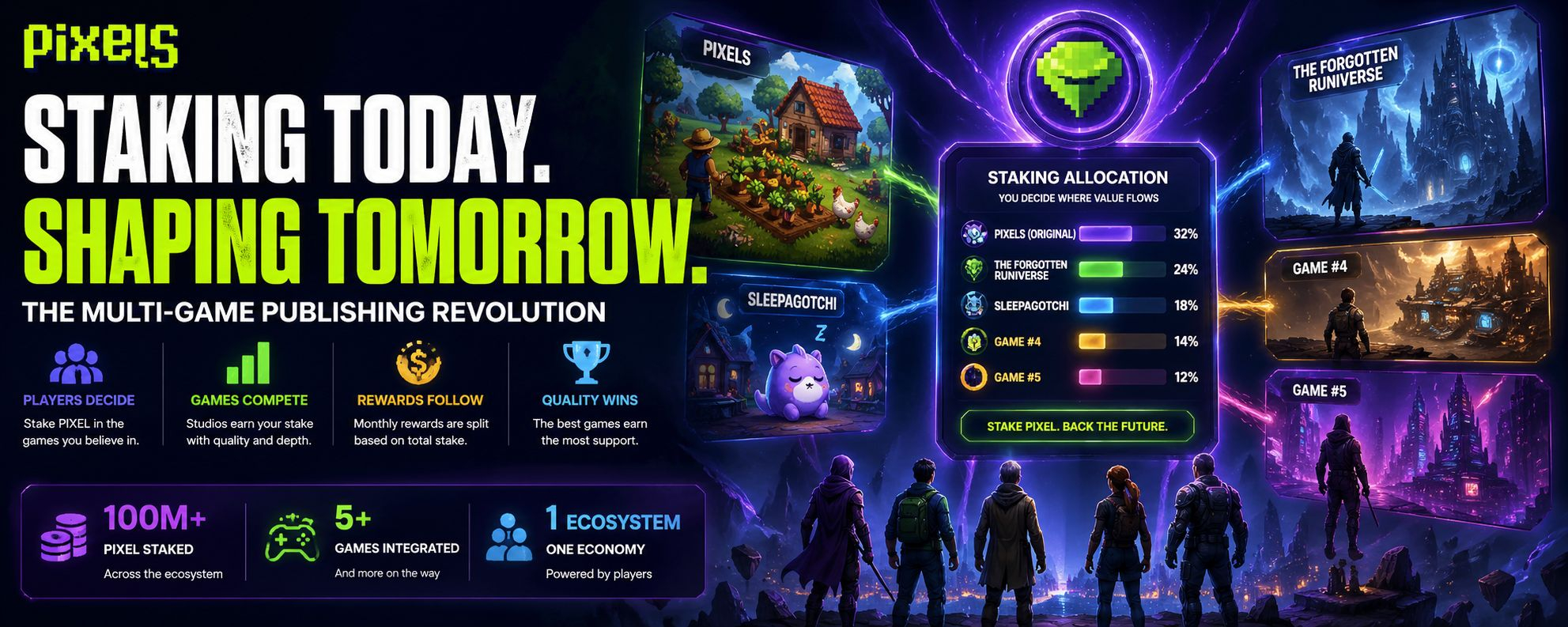
PIXEL is not just being added to more games so people can say the token has more use cases. The staking system is starting to act like something more meaningful. It is becoming a way for players to show which games they actually believe in.
That is a small difference on the surface, but a big one once you think about it.
Usually, when a gaming token expands across multiple titles, the story is simple. More games means more places to spend the token. More places to spend it means more demand. More demand should help the economy. That argument makes sense, but it also feels incomplete.
Pixels seems to be doing something more specific.
Instead of treating every game in the ecosystem as equal, it lets players choose where their staked PIXEL goes. Each game has to attract that stake. Each studio has to give players a reason to put economic weight behind its title.
That changes the player’s role.
A staker is not just saying, “I believe in Pixels.” They are saying, “I believe this game deserves my PIXEL more than the others right now.”
That is a much more serious decision.
By March 2026, this was already happening in practice. Pixels had brought games like The Forgotten Runiverse and Sleepagotchi into the PIXEL ecosystem. PIXEL could be used for in-game purchases and staking across different titles. More than 100 million PIXEL tokens were reportedly staked across the wider ecosystem.
So this is not just an idea waiting to be tested later. The system is already alive.
And once it is alive, the real question becomes: are players treating it with enough attention?
In a single-game model, staking is simpler. You either believe in the game or you do not. You like the team, you trust the direction, you think the economy has room to grow, so you stake.
But when there are multiple games, the decision changes.
Now the question is not only, “Do I believe in Pixels?”
It becomes, “Which game inside Pixels deserves my stake today?”
That is where things get more interesting.
Players have to compare. They have to notice which game is holding attention, which one is losing momentum, which one has real updates, which one has a community that still feels alive after the first wave of excitement fades.
That is not passive staking anymore.
A player who stakes once and then forgets about it may still earn rewards. But they are probably not seeing the whole picture. They may miss when one game starts becoming stronger. They may miss when another game is only surviving on hype. They may only react after rewards change, which is usually later than the best moment to act.
The players who keep watching have a better chance.
Not because they have secret information. Not because they are insiders. But because they are paying attention before everyone else is forced to.
That is what makes the model feel different.
Pixels is not only giving studios access to a larger audience. It is also putting them in front of player judgment. A game cannot simply join the platform and expect support forever. It has to keep earning it.
If a game feels shallow, players can move their stake somewhere else. If another game starts showing better retention, stronger community energy, or deeper economic activity, PIXEL can move toward it.
That creates pressure.
And honestly, that pressure might be healthy.
O course, the market will not always be perfectly smart. Hype can still pull people in. Short-term rewards can still distort behavior. A weaker game can still look stronger for a while if the incentives are loud enough.
But over time, weak attention usually fades.
A game that cannot keep players interested will struggle against one that can. A studio that builds only for quick extraction will have to compete with studios building games people actually want to return to.
That is where the publishing vision becomes more real.
Pixels is not just saying, “We will bring more games.”
It is building a place where games compete for belief.
And belief matters more when it is tied to capital.
This also makes Luke Barwikowski’s broader view of Web3 gaming feel more practical. He has talked about Web3 as a space where regular players can still find upside, instead of every early opportunity being captured by big investors or insiders.
In this model, that idea has a real shape.
A player who studies the ecosystem carefully might notice a game before most stakers understand its value. They might see that one title has stronger activity than people realize. They might notice another game is getting too much attention for reasons that will not last.
That kind of edge is possible.
But it is not automatic.
Players have to earn it by watching, comparing, and thinking.
That may be the part many people overlook. Pixels’ staking model does not just ask players to lock tokens. It asks them to keep paying attention. It asks them to rethink their allocation as the games change.
And that is not how many people treat staking.
Many people stake once, leave it there, and only come back when rewards drop enough to bother them. But in a multi-game system, that approach may leave a lot on the table.
Because staking across games is not just a background feature. It is one of the places where the future of the ecosystem gets shaped.
The platform can add games. The studios can build. The token can move across titles. But the players decide where confidence collects.
That is the quiet power of the model.
The real test for Pixels is not only whether it can keep adding more games. It probably can.
The harder test is whether the community learns to think like it is inside a publishing economy, not just a single-game economy.
Those are very different things.
A single-game economy asks for loyalty.
A publishing economy asks for judgment.
It asks players to tell the difference between a game that is loud and a game that is lasting. Between a short-term reward boost and a real player base. Between token utility and actual economic depth.
That is why Pixels is worth watching.
Not because the model is guaranteed to work perfectly.
But because it is trying to make player judgment part of the system itself.
And if enough stakers begin to treat allocation as something they keep studying, not something they set once and forget, then PIXEL staking becomes more than a reward tool.
It becomes the quiet scoreboard of the ecosystem.
The games that earn real belief will rise.
The games that only borrow attention will eventually be exposed.