

I remember I didn’t even plan to read anything serious that day. I was just drifting through updates, half-paying attention, the way you do when everything starts sounding the same after a while. New game, new token, new “ecosystem.” Most of it blends together if you’ve been around crypto long enough.
But Pixels caught me in a slightly different mood.
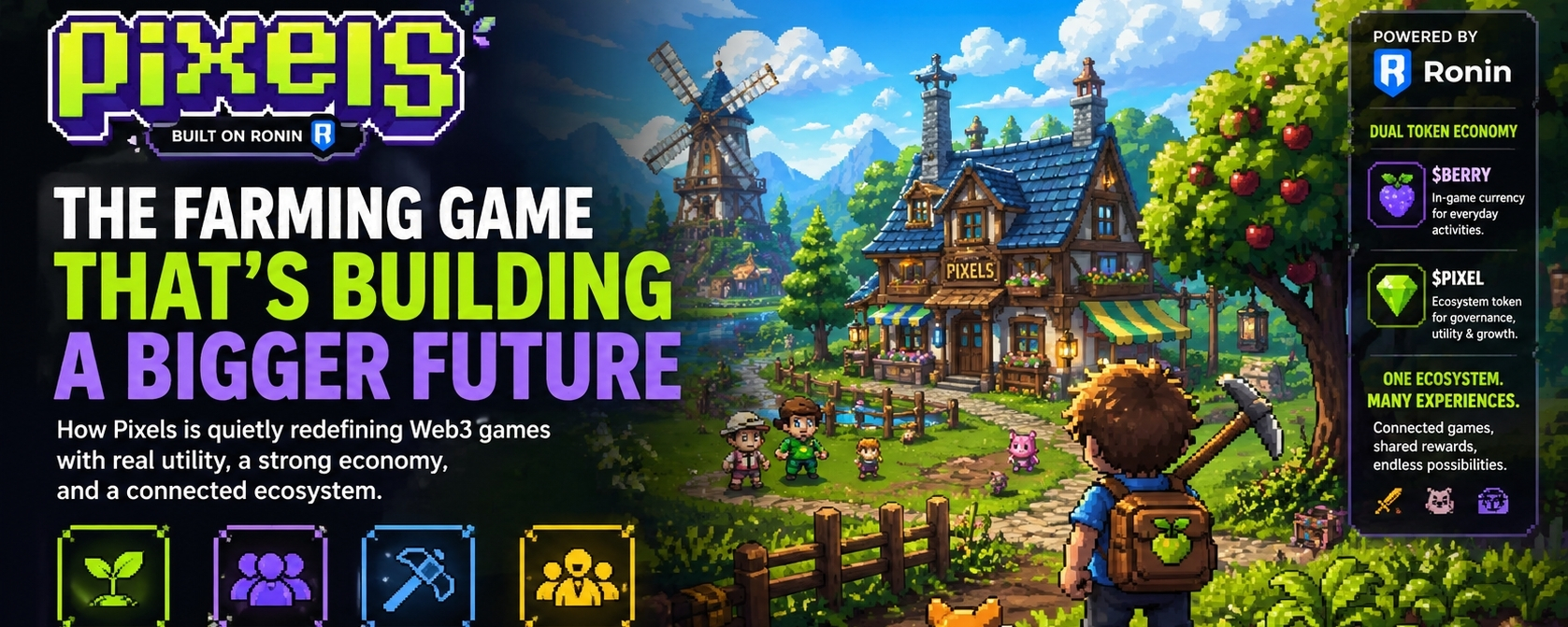
It wasn’t loud about itself. No dramatic claims, no “this will change gaming forever” kind of energy. Just a social, open-world farming game quietly building on the Ronin Network. At first, I almost skipped it. Farming games in Web3 usually follow a pattern I already know too well: early excitement, heavy incentives, then a slow quiet phase where only the most committed—or the most incentivized—stay.
Still, I stayed on it longer than I expected.
Maybe because I’ve started noticing something that bothers me more than I used to admit. A lot of crypto games don’t fail loudly. They just fade. Not because the idea was completely wrong, but because the structure underneath was never meant to carry real human behavior for long periods. It’s like they’re optimized for arrival, not staying.
And that’s where my thinking started to shift a bit with Pixels.
On the surface, it really is what it looks like. You farm, you explore, you build. You interact with other players in a world that feels intentionally light, almost simple. But simplicity can be misleading. The more I looked into it, the more I realized there’s a deeper attempt here to separate what the game feels like from what the system is actually doing underneath.
Pixels runs on a dual-token setup, with $BERRY tied more closely to in-game activity and $PIXEL positioned as the broader ecosystem token. I’ve seen dual-token systems before, and honestly, my first reaction is usually skepticism. It often feels like complexity for the sake of control. But here, it seemed more like an attempt—imperfect, but intentional—to stop one token from carrying too many conflicting expectations.
Because that’s one of the quiet problems in Web3 gaming no one really solves properly. If one token is both the reward, the governance signal, the economic engine, and the speculative asset, it eventually starts collapsing under its own weight. Players stop seeing the game and start seeing the price. Developers start reacting to markets instead of behavior. And slowly, the game becomes something else entirely.
Pixels feels like it’s at least aware of that tension.
What surprised me more, though, wasn’t the token structure itself. It was the direction the ecosystem seems to be moving toward. There’s this idea forming around shared systems—multiple experiences connected through a broader layer of rewards and progression, instead of each game being its own isolated economy.
It sounds small when you say it quickly, but it actually changes how you think about everything around it.
Instead of one game trying to hold your attention forever, you have multiple entry points feeding into something larger. Instead of rewards being locked to one loop, they start to move across experiences. And instead of everything depending on a single emotional attachment to one game world, the system spreads that weight out.
That’s when I started thinking less like someone looking at a game, and more like someone looking at a structure.
And I’ll be honest—I’m not fully comfortable with how much sense it starts to make.
Because it quietly challenges something I’ve taken for granted in crypto gaming: that most projects are trying to be the game. One place where everything happens. But maybe the more realistic future is not one dominant world, but connected fragments that share value, identity, and progression in ways that feel less fragile.
Still, I can’t ignore the doubts either.
Systems like this are hard. Really hard. Coordination sounds clean in theory, but in practice, it gets messy fast. Players don’t behave like models. They chase incentives, drift between ecosystems, burn out, come back, leave again. And any system built around them has to survive all of that without breaking its own internal logic.
I also wonder about motivation. Even if the structure is more sustainable, people might still arrive for the same reason they always do: rewards first, curiosity second. And if that imbalance gets too strong, even the most thoughtful design ends up being pulled back into the same cycle it was trying to escape.
I’ve seen enough cycles in crypto to know optimism doesn’t protect you from repetition.
But at the same time, I don’t think everything here is just repetition.
There’s something subtle happening in projects like this—less about reinventing gaming, and more about quietly trying to fix the economics underneath it. Not in a flashy way. Not in a way that gets immediate attention. Just small structural decisions that suggest people are learning from what didn’t work before.
And maybe that’s what stayed with me after I closed the tab.
Not the idea that Pixels is “the future of gaming” or anything like that. I don’t really believe in those kinds of statements anymore. It was more the feeling that the project is trying to deal with a problem that most people only notice after things start breaking.
How do you build something that doesn’t collapse when attention shifts?
I don’t think Pixels has answered that. Not even close. But it feels like it’s asking the right version of the question.
And in this space, that alone is rare enough to make me pause.