
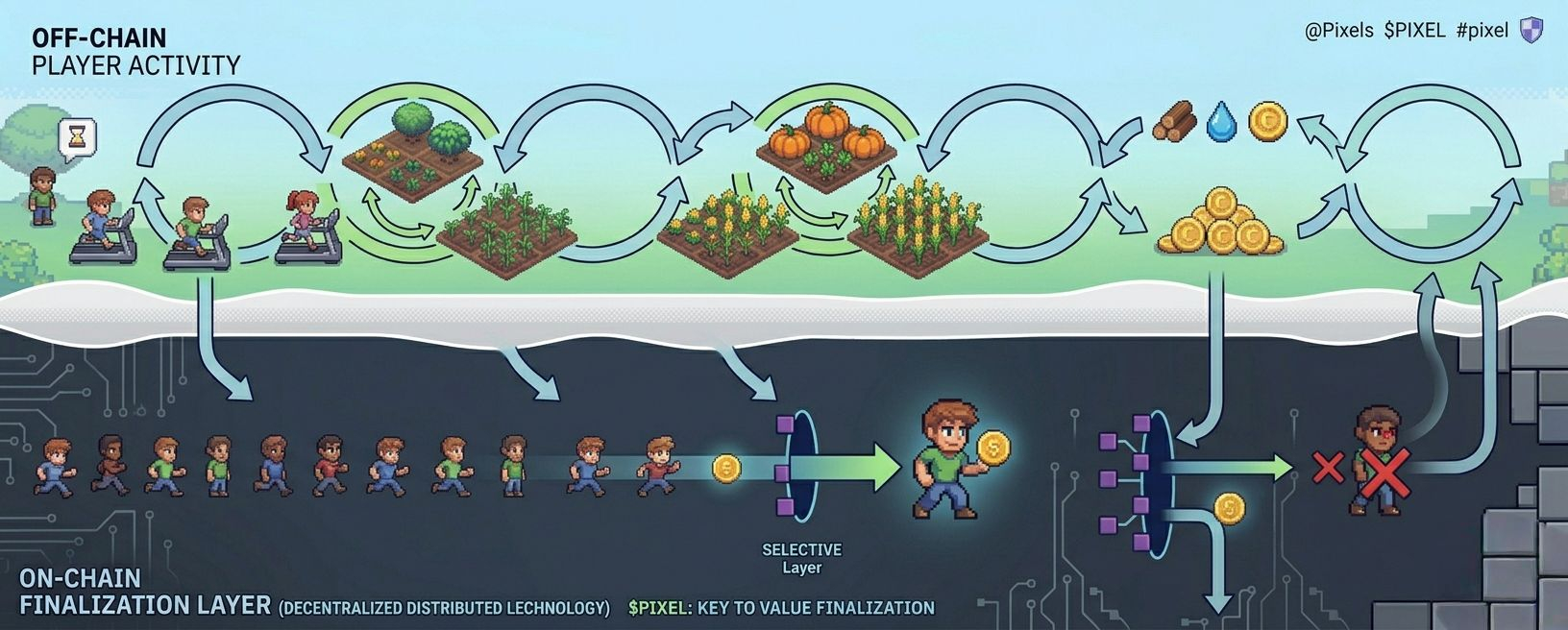
Pixels doesn’t feel interrupted when you first start playing it.
Everything moves in a steady rhythm. You open the board, run through tasks, collect resources, and repeat. There’s no visible friction, no obvious barrier. It feels like a system where time naturally converts into progress.
And because of that, it’s easy to assume the loop is continuous.
That as long as you stay inside it, something is always building.
But that assumption doesn’t hold for long.
Not because the system breaks.
But because the outcomes don’t follow the same rhythm as the activity.
The loops inside Pixels never really stop. Coins circulate, tasks refresh, resources move endlessly. It’s constant, almost uninterrupted motion.
But the moments where that motion turns into something that actually matters…
don’t feel constant at all.
They feel spaced.
Not randomly.
Just… unevenly.
That’s where the system starts to feel different.
Because if activity is continuous, but outcomes are not, then something else is controlling the transition between the two.
This is where $PIXEL begins to behave differently from everything else in the system.
Most of what you do inside Pixels happens without it.
You can spend entire sessions moving through loops without needing to think about the token at all. The system allows that. It keeps everything fluid, responsive, and open.
But the moment something needs to finalize, an upgrade, an asset, a meaningful conversion, the flow changes.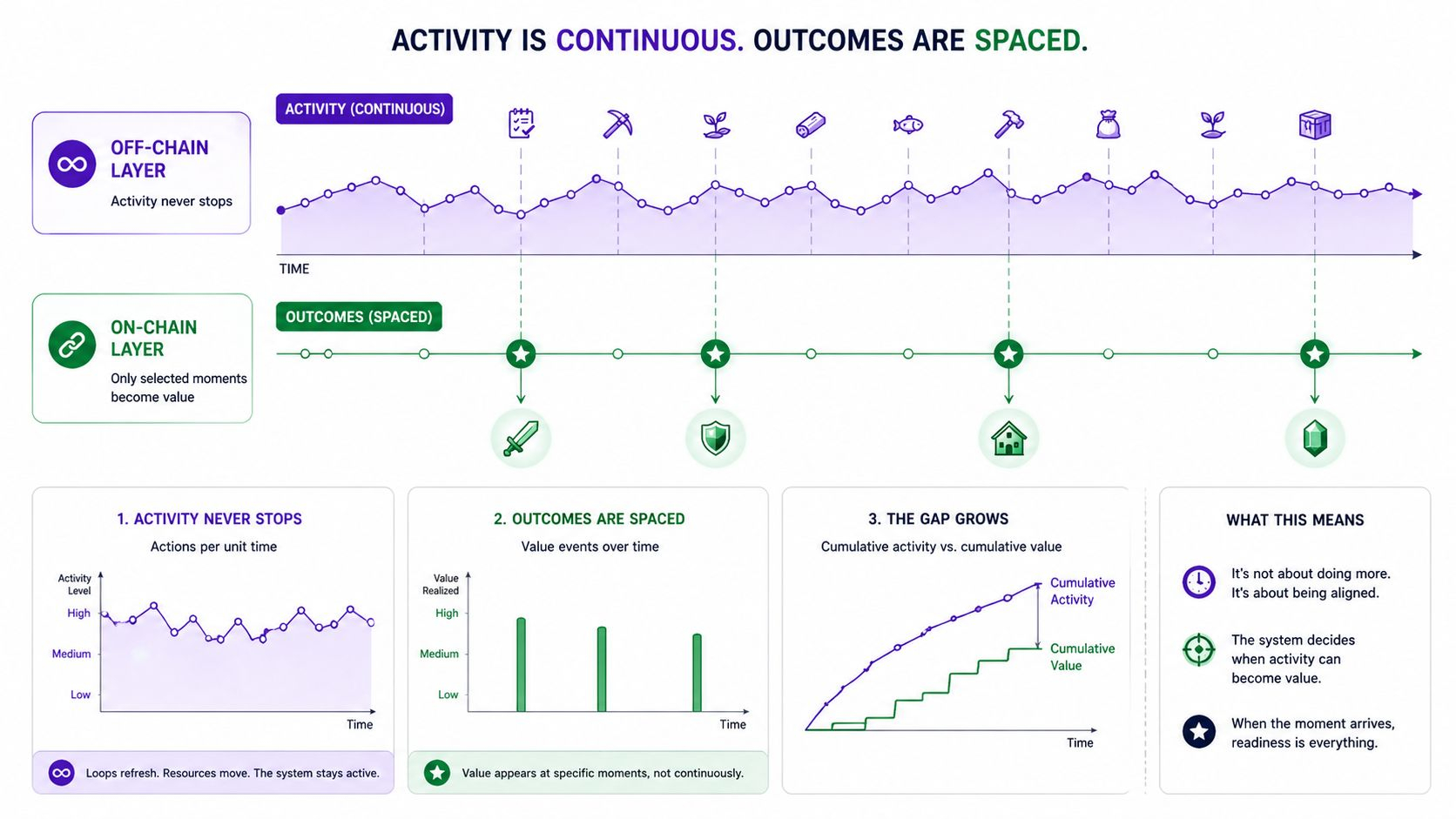
It tightens.
And suddenly, it’s not about how much you’ve done.
It’s about whether you’re ready at that specific moment.
If $PIXEL is already in place, the action completes.
If it’s not, the moment doesn’t hold.
And that moment doesn’t wait.
That difference is subtle at first.
Because everything still looks active.
The system keeps moving, the loops keep running, and it feels like progress is still happening. But over time, the gap between movement and outcome becomes harder to ignore.
Some actions pass through.
Others don’t.
Not because they’re invalid.
But because they never reached the point where they could become visible as value.
That’s where the structure underneath Pixels starts to show itself.
The system isn’t just generating activity.
It’s filtering it.
The off-chain layer allows everything to exist.
The on-chain layer selects what gets finalized.
And those two layers don’t operate the same way.
One is continuous.
The other is selective.
That separation changes how the system behaves over time.
Because players don’t just optimize what they do.
They start adjusting to when it matters.
Less focus on running loops.
More focus on being aligned with those conversion points.
That shift is quiet.
But it compounds.
Because once the system starts spacing out when activity becomes value, the idea of constant progress begins to fade.
It’s no longer just about staying active.
It’s about whether your activity ever reaches the layer where it can resolve into something final.
From the outside, everything still looks the same.
The world moves, players engage, loops continue.
But underneath, the system isn’t treating every action equally.
It’s deciding when actions are allowed to matter.
And that decision doesn’t feel like it happens in the moment.
It feels like it exists before you get there.
Which makes the loop harder to read.
Because now it’s not just about what you do.
It’s about whether what you do ever intersects with the points where the system is actually willing to convert it.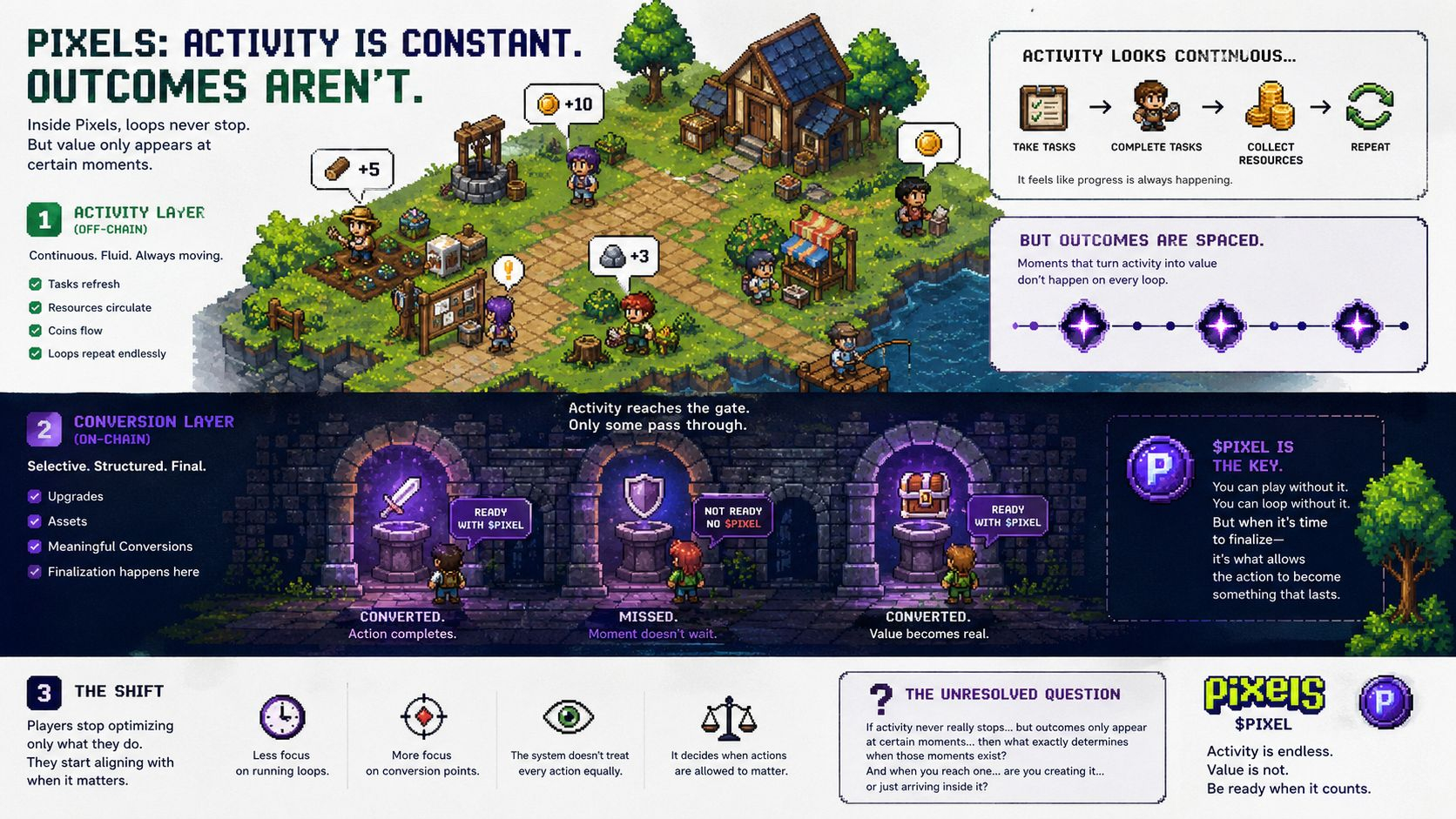
And if those points are already spaced, already structured, already limited…
then the loop was never continuous to begin with.
It just felt that way from the inside.
Which leaves something unresolved.
If activity never really stops…
but outcomes only appear at certain moments…
then what exactly determines when those moments exist.
And when you reach one…
are you creating it…
or just arriving inside it.