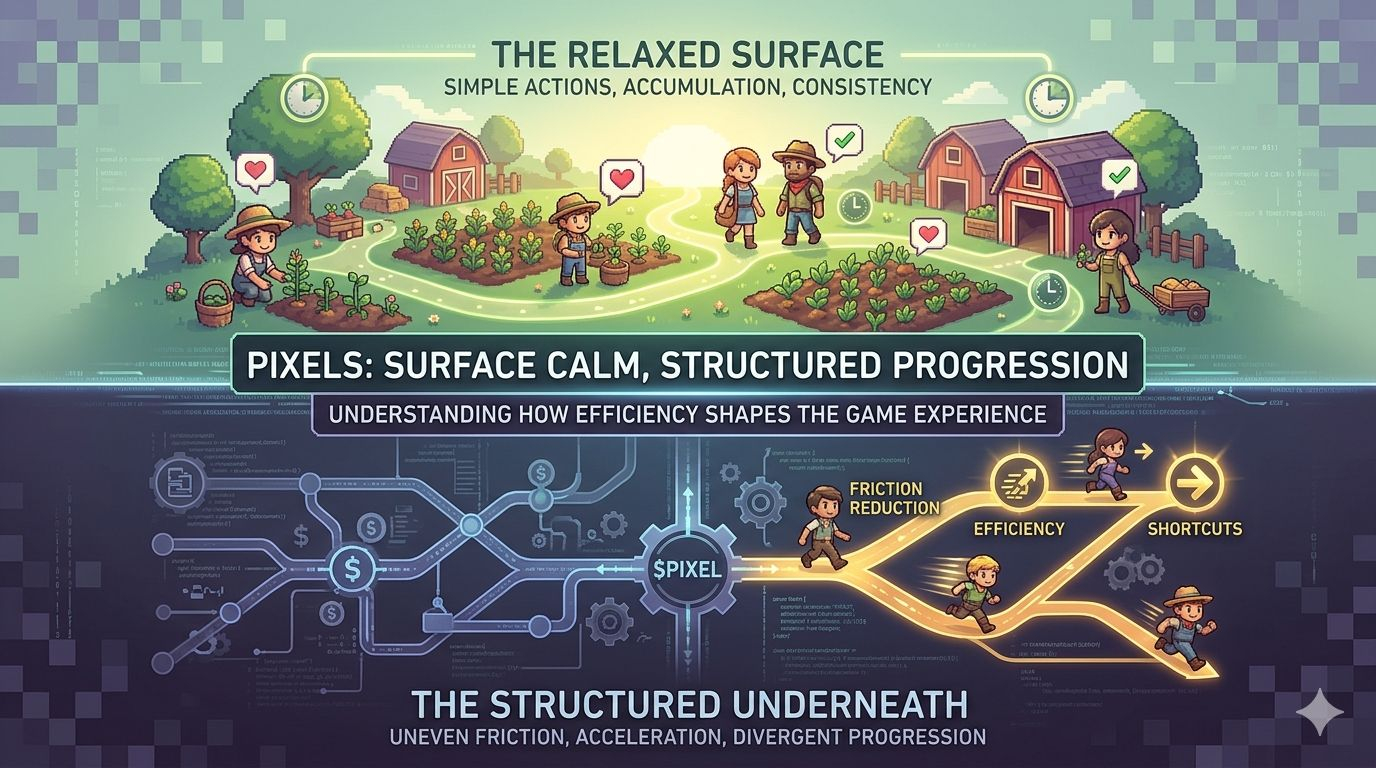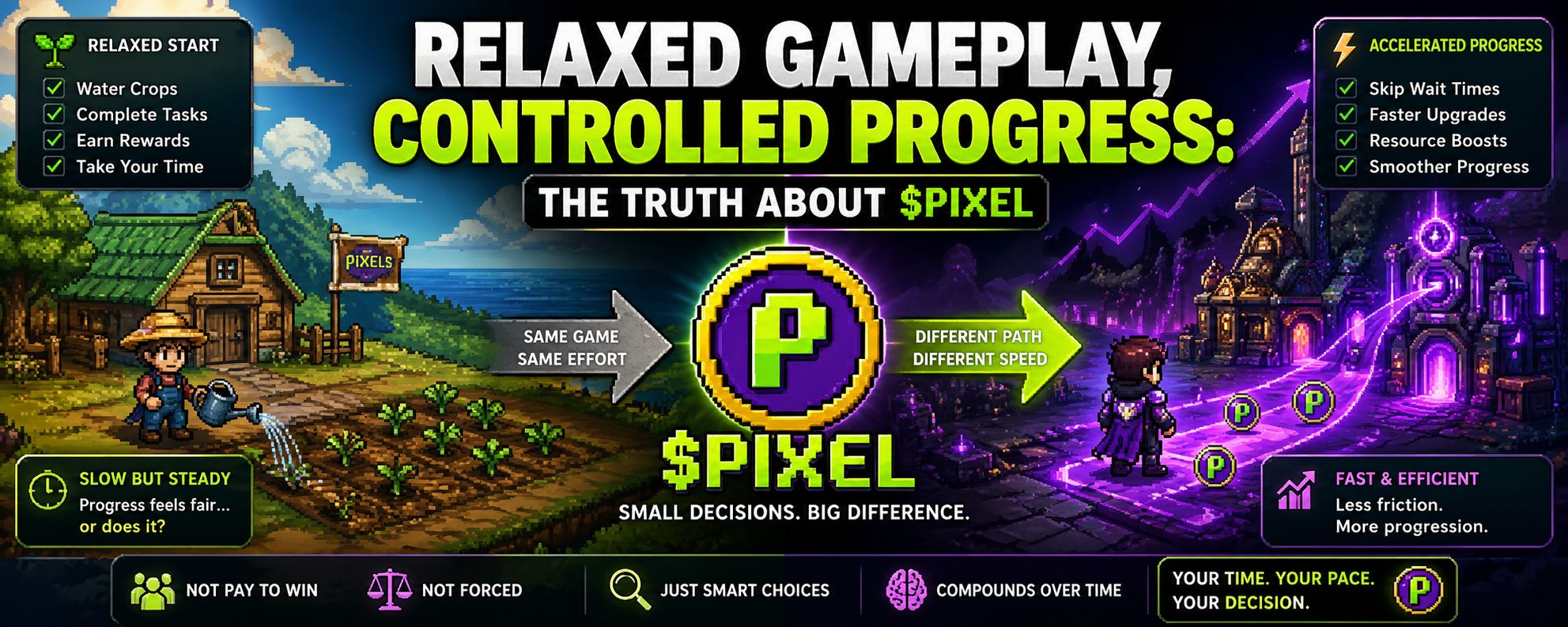
There’s a pattern in a lot of modern games that’s easy to miss at first. The surface is calm. Systems feel relaxed. Nothing feels forced. You log in, do simple actions, and the experience gives you space to breathe.
Pixels fits into that category very naturally.
It doesn’t rush you. It doesn’t pressure you. The early experience feels almost neutral — like progress is something that simply happens as long as you stay consistent.
But that’s only the surface layer.
Because when you start observing closely, you notice something subtle: not every player is actually moving through the same pace of progression.
The game feels shared, but the experience of speed is not always equal.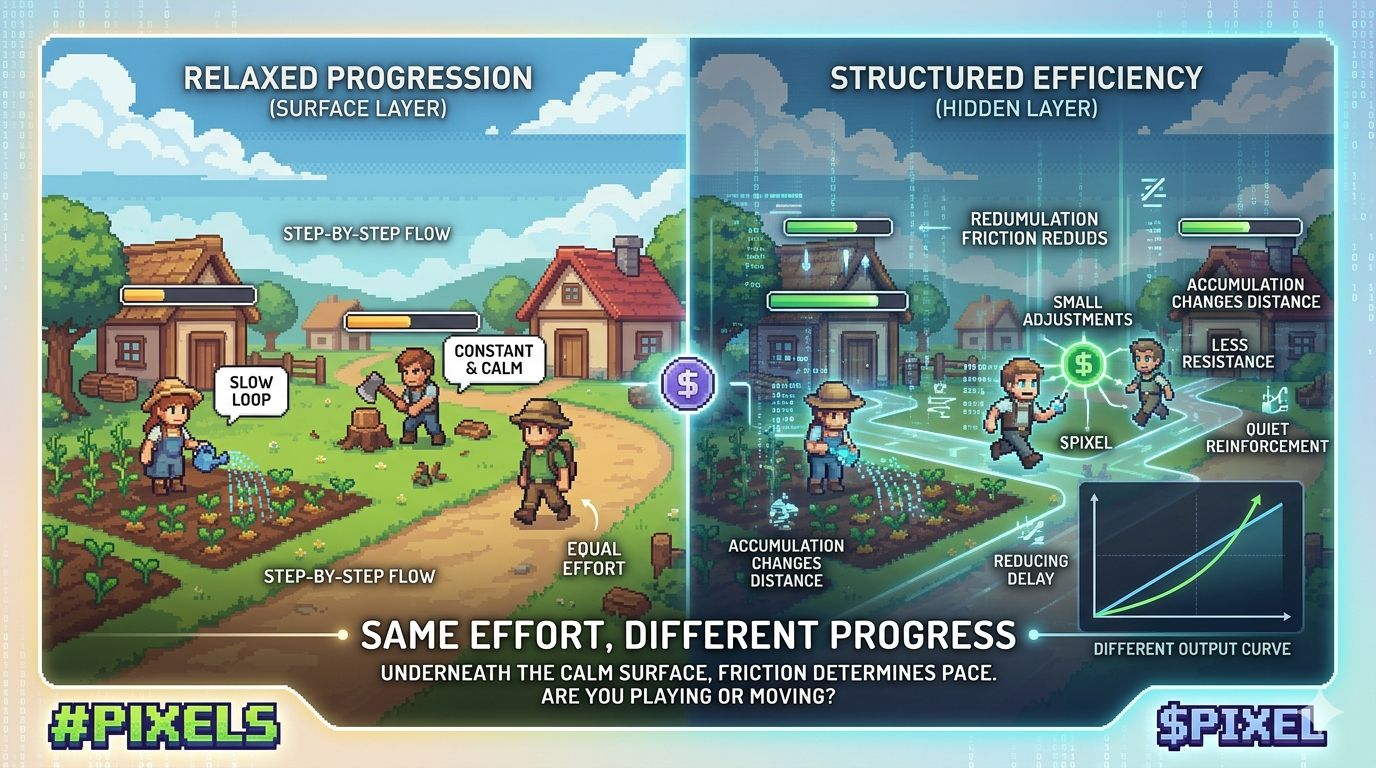
Some players stay inside the slow loop. They follow the natural flow — step by step, without changing anything. Others, without breaking the rules or changing the core gameplay, begin to shift how they move through it. Not by skipping the system, but by interacting with it differently in small ways.
That’s where $PIXEL quietly becomes relevant.
It doesn’t behave like a loud mechanic. It doesn’t sit at the center of attention. It appears in specific moments — almost like a lever that only matters when you decide to use it. And those moments are rarely framed as “important” while you’re playing.
But over time, they stack.
A few seconds saved here.
A small friction removed there.
A shortcut that doesn’t feel like a shortcut in the moment.
Individually, none of it looks meaningful. But progression systems don’t measure single actions. They measure accumulation.
And accumulation changes distance.
This is where the experience shifts from “relaxed gameplay” into something more structured underneath. Because the system is no longer just rewarding activity — it’s quietly shaping how efficiently that activity turns into progress.
Same effort. Different output curve.
Not because the game is unfair in an obvious way, but because friction is not distributed equally across every path.
And friction is the real control layer.
At first, this doesn’t register. The game still feels playable at every level. Nothing is blocked. Nothing is explicitly locked behind participation. But players are not only reacting to what is possible — they are reacting to what feels efficient.
And efficiency changes behavior.
You start seeing small adjustments: Not dramatic spending. Not full optimization. Just minor decisions to reduce delay. To smooth repetition. To remove waiting where it feels unnecessary.
That’s usually where the system becomes self-reinforcing.
Because once a player starts optimizing around friction, they rarely stop at one adjustment. They refine slowly. Step by step. Not out of pressure, but out of preference.
And that preference creates separation.
Over time, two players can end up in completely different positions while technically playing the same content. Not because one is grinding harder, but because one is moving through the system with less resistance.
That gap doesn’t announce itself.
It builds quietly in the background.
This is also why the design feels intentionally “soft.” If everything looked competitive from the beginning, the behavior would change immediately. But when the system feels relaxed, players don’t question the structure — they adapt inside it instead.
And adaptation is where progression starts to diverge.
There’s also a deeper tension here that’s easy to overlook.
If progression becomes too dependent on optimization, the game risks turning relaxation into pressure. And if everything becomes equally slow, engagement drops. So the system has to sit between two extremes:
Not fully equal.
Not fully competitive.
Just layered enough that different players experience different speeds without breaking the visible rules.
That balance is delicate.
Because what players ultimately feel is not the system itself, but time inside the system.
And time behaves differently when friction is uneven.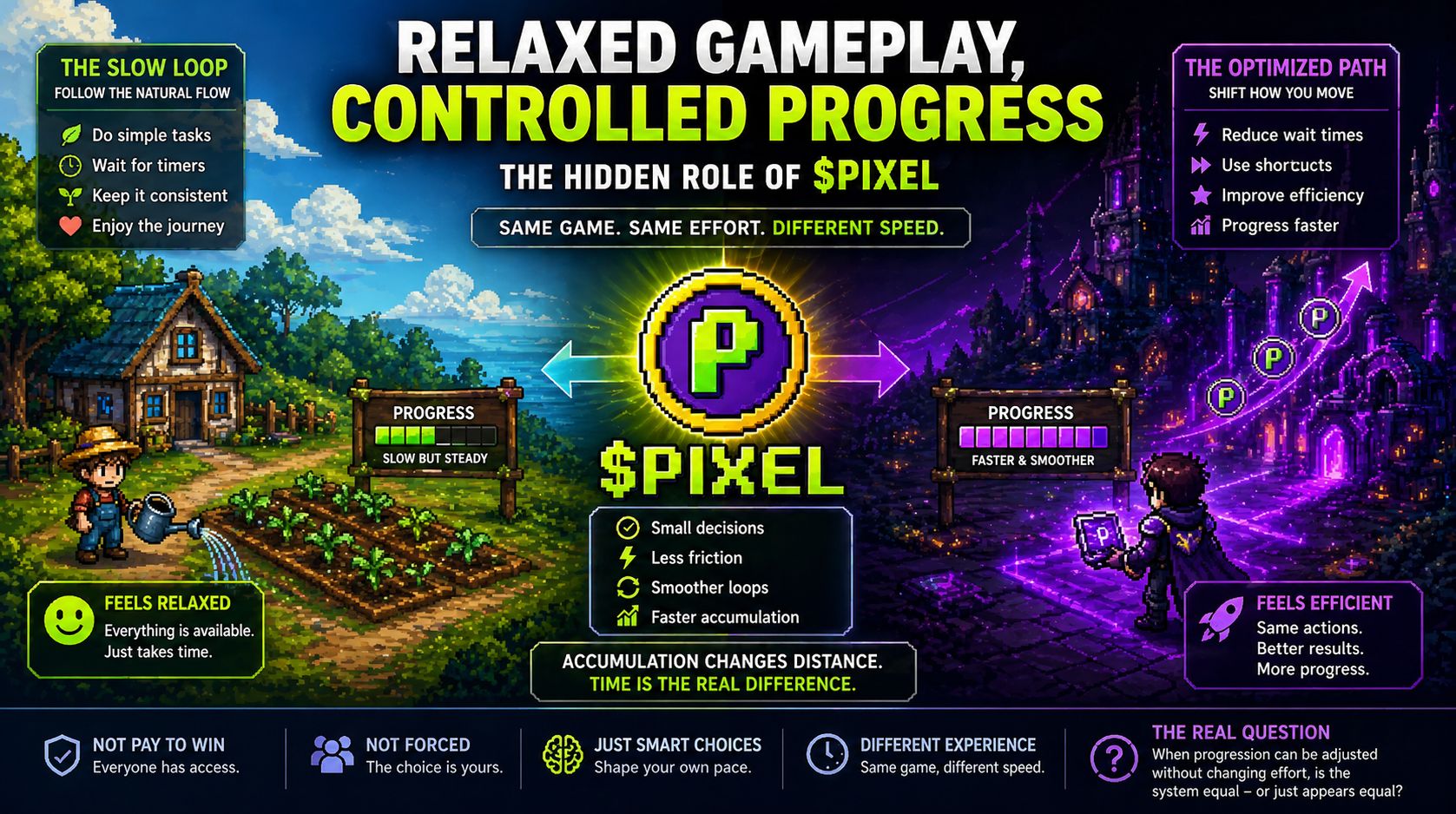
Some players will never notice this layer. They’ll experience Pixels as intended: a slow, relaxed loop. Others will gradually recognize that their pace is not fixed — it can be shaped, adjusted, and in some cases accelerated without changing the core gameplay itself.
That recognition changes how the game is perceived.
Not as something you simply play… but as something you move through at different speeds depending on how you interact with it.
So the real point isn’t whether $PIXEL gives advantage or not.
The real question is more subtle:
When progression can be adjusted without changing effort, does the system remain equal — or just appear equal from the outside?
And once you see that question, the “relaxed gameplay” doesn’t feel fully relaxed anymore.
It feels structured.