

I did not start thinking about Pixels this way.
At first, I only noticed the obvious parts. The world looked active. People were farming, moving around, building, and doing their usual routines. From the outside, that kind of activity always looks like a good sign. When a game feels full, it is easy to assume it is doing well.
But after spending more time with it, I started looking at that activity in a different way.
A world can be busy and still feel shallow.
That is probably the simplest way to explain what I mean. A lot of movement does not always mean a lot of depth. Sometimes a game can look lively for a while, but the activity inside it does not really build into anything stronger. It just keeps the screen full.
What makes Pixels more interesting to me is that I do not think the story ends at “people are active.”
The more I think about it, the more I feel that the better question is this: what kind of participation is actually staying inside the world? That matters more than raw movement on its own.
For me, there is a difference between people showing up and people becoming part of the game.
Some players log in, do a few things, and leave. That still counts as activity, of course. But there is another kind of participation that feels more meaningful. It happens when players keep coming back, start understanding the world better, and slowly become part of the rhythm of the game. That kind of presence feels more valuable because it adds stability, not just noise.
That is where Pixels starts feeling stronger to me.
It is not only about attracting attention. A lot of projects can do that for a little while. The harder part is giving people enough reason to remain connected to the world in a steady way. That is where real depth starts showing.
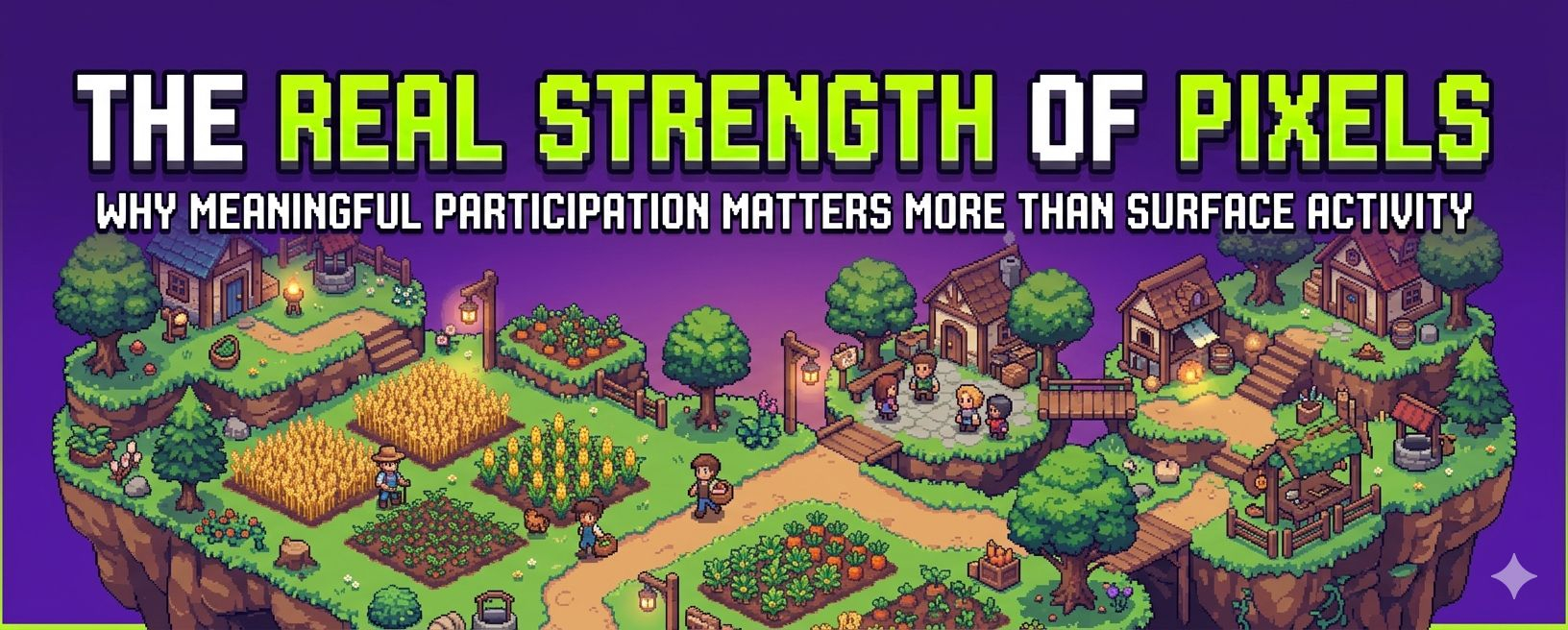
Pixels seems to have that kind of potential because the world does not feel built around one single action. It has farming, progression, building, exploration, and social elements. That variety matters. It gives different players different reasons to stay. Not everyone connects to a game in the same way, so having more than one path into the world gives the platform more depth.
And depth usually creates better participation.
Some people stay because they enjoy the routine. Some stay because they like making progress over time. Some stay because the world feels calm and easy to return to. Others get interested because the ecosystem feels like it has room to grow beyond one simple loop. When different kinds of players can all find a place in the same world, the platform starts feeling healthier.
That is what stands out to me here.
I do not think the real strength of a platform is just how many people it can pull in at once. I think it is whether those people start behaving in ways that make the world better over time. That could mean consistency. It could mean more thoughtful participation. It could mean players who understand the systems better and engage with them in a way that adds something back to the ecosystem.
That kind of participation is quieter, but it matters more.
It is easy to get distracted by numbers because numbers are visible. A busy world, a lot of movement, rising attention - all of that looks impressive from the outside. But numbers alone do not tell you whether the world is actually getting stronger underneath.
A healthier platform usually depends on something more basic.
It depends on whether the players inside it are becoming more connected to it.
That is why I keep coming back to this idea. In Pixels, it feels more important to watch the quality of participation, not just the amount of it. A world becomes more valuable when the people inside it are not only present, but engaged in a way that supports the game’s depth.
That does not mean every player has to do the same thing. Actually, it is better if they do not. A world feels healthier when different forms of participation can all matter. What matters is that the activity feels real, repeatable, and connected to the system itself.
Pixels feels promising to me for that reason.
It already has the kind of structure where player participation can mean more than just quick activity. The world has enough layers that returning players can slowly become part of something deeper. And when that happens, the platform stops feeling like a place people visit once in a while. It starts feeling like a place people actually belong in.
For me, that is a much stronger sign.
Because in the end, the real strength of a game world is not simply that people arrive.
It is that the world gives them a reason to stay, return, and matter.
