
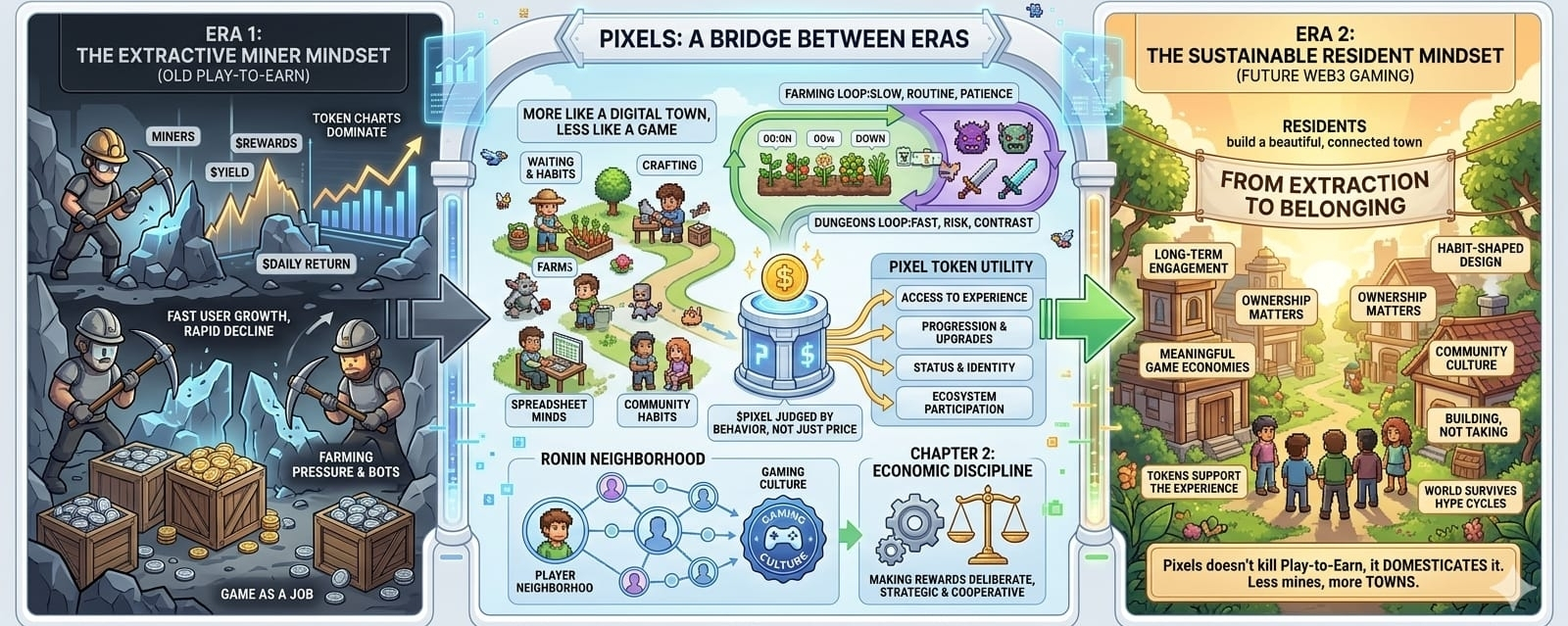
I see Pixels as one of those Web3 games that is quietly sitting between two eras.
On one side, there is the old play-to-earn world: loud rewards, fast user growth, farming pressure, token charts, and players who often treated the game like a job. On the other side, there is the version of Web3 gaming that still has not fully arrived yet: games where ownership, tokens, and on-chain activity support the experience instead of swallowing it.
Pixels is interesting because it is not pretending the first era never happened. It comes from that same Web3 gaming universe. It has a token. It has rewards. It has on-chain assets. It has economic loops.
But the way I look at it, Pixels is trying to turn the volume down on extraction and turn the volume up on belonging.
That is what makes it worth studying.
My honest read: Pixels is less like a game and more like a small digital town
When I think about Pixels, I do not think of it as just a farming game.
I think of it as a town.
Not a perfect town. Not a utopia. More like a busy little digital village where everyone is doing something slightly repetitive but somehow meaningful. Someone is farming. Someone is crafting. Someone is optimizing. Someone is just wandering around. Someone is probably treating the whole thing like a spreadsheet. And someone else is there because they actually like the rhythm.
That is the part many people miss.
A lot of Web3 analysis focuses too much on token price and not enough on player behavior. But games do not survive only because a token exists. They survive because people build habits around them.
Pixels has that habit-shaped design.
You do not enter Pixels and immediately feel like you are being pushed into some giant dramatic battle. The game works in smaller motions. Plant this. Harvest that. Complete a task. Improve something. Come back later. Talk to someone. Check what changed.
That may sound simple, but simple loops are often the strongest ones.
The best games are not always the ones that shock you. Sometimes they are the ones that quietly become part of your day.
Why farming fits Web3 better than people think
Crypto is impatient.
Everyone wants the next candle, the next listing, the next airdrop, the next narrative. The whole market trains people to think in short bursts of attention.
Farming games are the opposite.
They are built around waiting.
That is why I think Pixels picked a smarter format than it may first appear. Farming slows the player down. It creates a natural delay between action and reward. You do not just press one button and instantly feel finished. You prepare, wait, collect, upgrade, and repeat.
That rhythm is important for Web3 because the biggest weakness of play-to-earn was always speed.
Too many games gave rewards too quickly, attracted extractive players too easily, and then struggled when the economy could not support everyone taking value out at the same time.
Pixels has a better foundation because farming already teaches players that progress should take time.
In a strange way, Pixels is using a slow game genre to fight one of crypto’s worst habits: wanting everything immediately.
The old play-to-earn model treated players like miners
This is my biggest issue with early GameFi.
It often treated players like miners, not players.
The goal was to perform repeated actions, extract rewards, and move on. The “game” became a wrapper around economic activity. People were not asking, “Is this fun?” They were asking, “What is the daily return?”
That question poisons game design.
Once a player starts seeing every action as a return calculation, the world loses its charm. A crop is no longer a crop. It becomes yield. A quest is no longer a quest. It becomes output. A community is no longer a community. It becomes a coordination layer for earning.
Pixels is not completely free from that risk. No tokenized game is. But I think it is trying to move away from the miner mindset.
The project seems to be pushing toward a model where participation matters more than simple extraction. That difference is important.
A miner asks, “What can I take out?”
A resident asks, “What can I build here?”
For Pixels to survive long term, it needs more residents than miners.
PIXEL should be judged by behavior, not only price
Most people will look at PIXEL and immediately open the chart.
That is normal. This is crypto. Price matters.
But with a gaming token, price is only one layer of the story. The deeper question is whether the token creates meaningful behavior inside the game.
A good game token should not feel like a random coin attached to a product. It should feel like something that belongs inside the world. It should connect to access, progress, identity, status, rewards, and long-term participation.
That is why PIXEL’s utility matters.
If PIXEL is only something people earn and sell, then it becomes a pressure point. But if PIXEL becomes something players use to access better experiences, support ecosystem features, participate in staking, unlock benefits, or move across connected game loops, then it starts acting more like a real economic layer.
The difference is huge.
A token that only exits the game weakens the world.
A token that circulates inside the game can strengthen it.
This is where Pixels has to keep proving itself. The token has to feel useful without making the game feel paywalled. It has to create demand without making casual players feel punished. It has to reward commitment without turning the game into a financial chore.
That balance is difficult, but it is also where the future of Web3 gaming will be decided.
Ronin gave Pixels a real neighborhood
I do not think Pixels would feel the same on every chain.
That might sound obvious, but it matters.
Ronin is not just infrastructure. It already has a gaming memory because of Axie Infinity. Users there understand Web3 games. They understand wallets, NFTs, assets, token rewards, and the emotional cycle that comes with blockchain gaming.
So when Pixels grew on Ronin, it was not dropping into an empty field. It was moving into a neighborhood where people already knew what this kind of game was trying to do.
That gave Pixels a major advantage.
A blockchain is not only a technical base. It is also a culture. Some chains feel like trading floors. Some feel like NFT galleries. Some feel like developer labs. Ronin feels more like a gaming district.
Pixels fits that environment.
To me, this is one reason its growth felt more natural than some Web3 games that launch on chains where users are only hunting incentives. Ronin users already had a reason to care about games. Pixels gave them something calmer, more social, and more routine-based.
Chapter 2 felt like Pixels choosing discipline over easy noise
The most important thing about Pixels’ Chapter 2 direction, in my view, is that it showed a willingness to make the economy less loose.
That is not always popular.
Players like rewards. Communities like growth. Markets like big numbers. It is always tempting for a Web3 game to keep the reward faucet open because it creates activity.
But easy activity can be fake health.
If rewards are too easy, users arrive for the wrong reason. Bots arrive. Farmers arrive. People optimize the fun out of the system. Eventually, the game has to pay more and more just to keep attention.
That is not sustainable.
Chapter 2 looked like an attempt to make earning more deliberate. More strategy. More cooperation. More structure. Less mindless extraction.
I respect that direction because sustainable design usually feels uncomfortable at first. It asks players to adjust. It asks the economy to breathe. It may reduce some short-term excitement, but it gives the project a better chance of lasting.
In Web3 gaming, sometimes the bravest thing a team can do is make rewards harder.
Pixel Dungeons is important because one loop is never enough
A farming game can create routine, but routine alone can become stale.
That is why Pixel Dungeons is an interesting move.
It gives the Pixels ecosystem another emotional speed.
Farming is slow. Dungeons are faster.
Farming is routine. Dungeons add pressure.
Farming feels like building a home. Dungeons feel like taking a risk.
That contrast matters because different players want different forms of engagement. Some people want calm progress. Others want competition, danger, and quicker sessions. If PIXEL can move across both types of experiences naturally, the token becomes more than a farming reward.
But this is also where Pixels has to be careful.
“Ecosystem” is one of the most abused words in crypto. Many projects use it when they really mean, “We added another place for the token to appear.”
That is not enough.
Pixel Dungeons should not feel like a utility patch. It should feel like a real extension of the Pixels world. The best outcome is when players do not think, “I am using PIXEL because the tokenomics need demand.” They think, “This is part of how the world works.”
That is when utility becomes organic.
The real battle is against spreadsheet gameplay
If I had to name the biggest threat to Pixels, I would not say competition.
I would say over-optimization.
The danger is that players start turning every part of the game into math. What is the best crop? What is the best route? What gives the highest return? What is the fastest way to earn? What can be automated? What can be repeated?
Some optimization is normal. Every game has it.
But in Web3, optimization becomes more aggressive because rewards can have market value. The moment money enters the loop, players behave differently.
This is where Pixels has to protect the soul of the game.
A farming game should not feel like unpaid labor with token rewards attached. It should feel like a place where progress is satisfying even when the token is not pumping.
That is the real test.
Will people still log in when PIXEL is quiet?
Will they still care about their land when rewards are lower?
Will the world still feel alive when the market is boring?
If the answer is yes, Pixels has something strong.
If the answer is no, then it is just another reward machine with better art.
Why I think Pixels matters
Pixels matters because it represents a more realistic version of Web3 gaming.
Not the fantasy version where every player earns forever.
Not the cynical version where every game is just a token scheme.
Something in between.
A game where ownership can matter.
A game where tokens can support progression.
A game where rewards exist, but do not completely define the experience.
A game where players are slowly encouraged to become part of a world instead of simply passing through it.
That is the direction Web3 gaming needs.
The industry has spent years asking, “How do we bring money into games?”
Pixels points toward a better question:
“How do we bring meaning into game economies?”
Because without meaning, rewards are temporary. Without culture, communities are fragile. Without routine, activity disappears. And without fun, no token model can save a game forever.
Final thought
My personal view is that Pixels is not trying to kill play-to-earn.
It is trying to domesticate it.
The wild version of play-to-earn was fast, exciting, unstable, and often destructive. Pixels is attempting something calmer: a system where earning is still present, but shaped by participation, patience, and community.
That is why the village analogy fits so well.
Old GameFi wanted players to enter the mine.
Pixels wants them to move into the town.
And if Web3 gaming is going to survive beyond hype cycles, it needs more towns and fewer mines.
