
@Pixels i remember checking PIXEL during one of those little green candles where the chart looked alive for a few hours, and my first reaction wasn’t excitement. It was irritation. Because with gaming tokens, the candle always tries to tell you the story before the game has earned the right to keep people there. That’s where Pixels feels different, but also where I’m still cautious. The project seems to understand something a lot of play to earn experiments learned too late: the game has to work before the token matters. As of today, PIXEL is trading around $0.0081 to $0.0083, with Binance showing about $27.6 million in market cap, roughly $27 million in 24 hour volume, and around 3.4 billion PIXEL circulating. CoinMarketCap shows a similar picture, with about $27.9 million market cap, $27.5 million in 24 hour volume, 3.38 billion circulating supply, and a 5 billion max supply.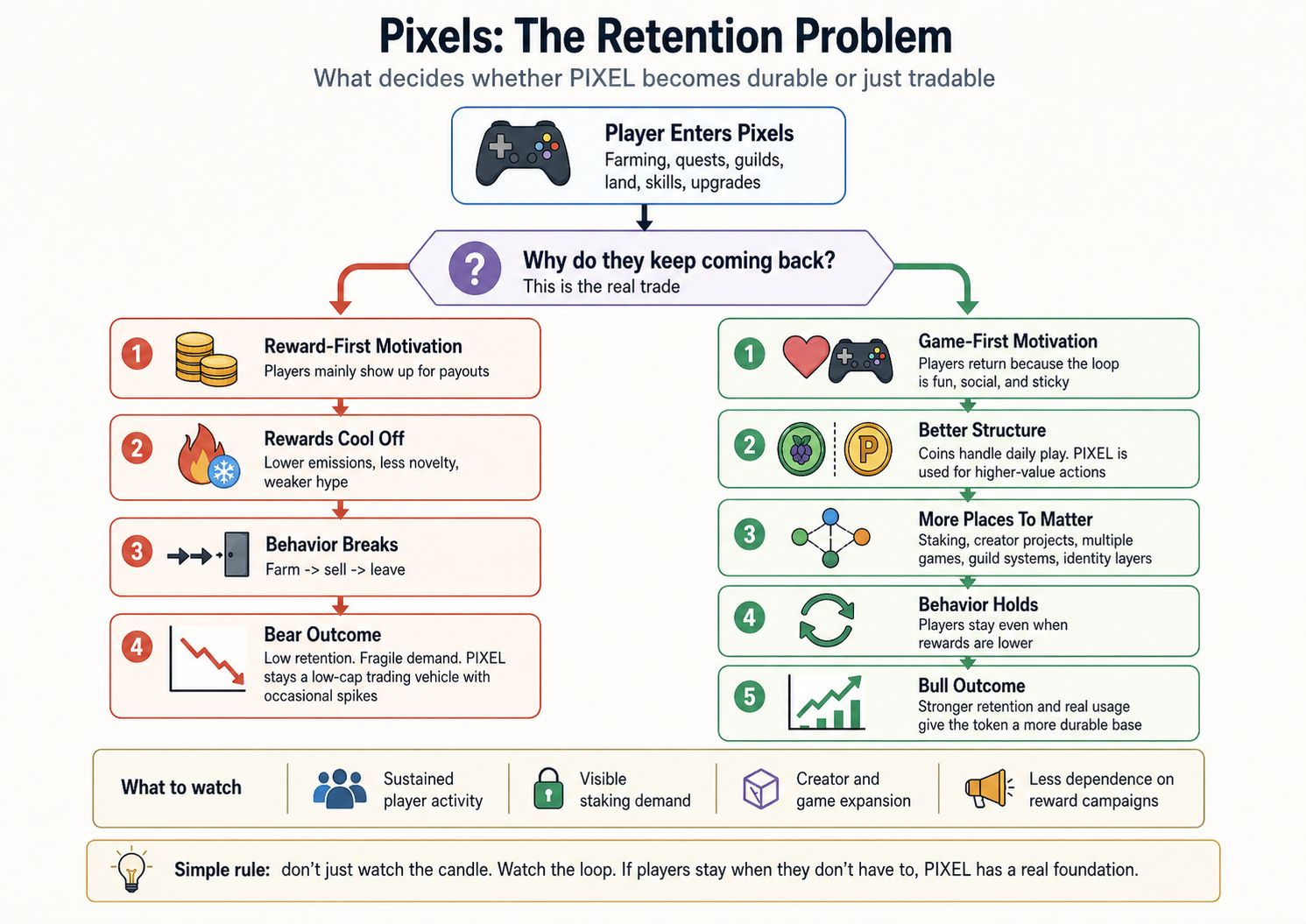 That volume matters. It means traders are still willing to touch the name. But the market cap also tells you something uncomfortable. PIXEL is liquid enough to trade, but still small enough that conviction is fragile. A few days of attention can move it. A few days of boredom can crush it. Now here’s the thing. Pixels is not trying to make the token the whole game anymore. The official FAQ says Chapter 2 was designed to protect PIXEL by making token rewards more strategic and cooperative, while moving BERRY toward an off-chain in-game coin model to reduce sell pressure and simplify the economy. That sounds boring until you’ve watched enough gaming tokens bleed from their own reward loops. A token tied to every daily grind becomes a faucet. Players farm, sell, leave, and repeat. That’s fine for early activity, but terrible for long-term pricing. Pixels seems to be trying to separate fun from extraction. Let players play with Coins. Keep PIXEL closer to higher value actions, staking, access, and the wider network. I like that direction. I’m also not fully sold yet. The bull case is pretty clean. Pixels already has the kind of simple, social game loop that people understand: farming, skills, land, quests, guilds, upgrades, and identity inside a shared world. Its own site now frames Pixels not only as a game, but as a platform where users can build games that integrate digital collectibles. The staking docs push the same idea from another angle, saying users can stake PIXEL into different game projects to support development and expansion while getting possible project specific benefits. That matters because a single game token usually has one major weakness: once the core loop gets old, demand fades. If PIXEL becomes useful across multiple games, staking pools, creator projects, guild systems, and player identity layers, then the token has more places to matter. That’s the realistic bull case. Not “number go up because gaming.” More like this: if Pixels can keep 3.38 billion circulating tokens supported by actual usage, while expanding beyond one farming world, then a $27 million market cap starts to look small relative to the ambition. But ambition doesn’t pay holders by itself. The Retention Problem is the whole trade for me. Can Pixels make people come back when rewards are lower, when the novelty fades, and when the chart isn’t helping morale? That’s what I’m watching. A game economy can look smart on paper, but if users only show up for payouts, every economic redesign just delays the same problem. Think of it like a cafe with a loyalty card. If people only come because the tenth coffee is free, the business is weak. If people come because they actually like the place, the loyalty card becomes a bonus. Pixels needs to be the second version. The game has to be worth playing before PIXEL becomes worth holding for reasons beyond speculation. The honest tradeoff is that protecting the token can make rewards feel less exciting. Moving activity off-chain, gating stronger rewards behind strategy, and making players cooperate may help sustainability, but it can also frustrate users who came for quick earnings. Some players don’t want a balanced economy. They want easy extraction. Pixels is basically choosing slower survival over easy dopamine. I respect that. Traders may not. The bear case is also simple. PIXEL is still down massively from its old highs, and current prices near $0.008 show that the market hasn’t rewarded the rebuild yet. Supply is large, attention is inconsistent, and gaming tokens often struggle once the reward narrative cools. If staking doesn’t create real allocation behavior, if new games don’t pull users in, or if players treat Pixels like a task machine instead of a world, then the token remains a low-cap trading vehicle with occasional spikes and weak retention. What would change my mind? Sustained player activity, visible demand for staking into different games, stronger creator output, and less dependence on short-term reward campaigns. I don’t need perfect numbers. I need signs that people are staying when they don’t have to. So my call to action is simple: don’t just watch the PIXEL candle. Watch the loop. Watch whether players return after the reward. Watch whether staking becomes behavior, not just farming. Because if Pixels proves the game can stand on its own, the token finally has something real to lean on. If it doesn’t, the market will keep treating every pump like another exit door.

Article
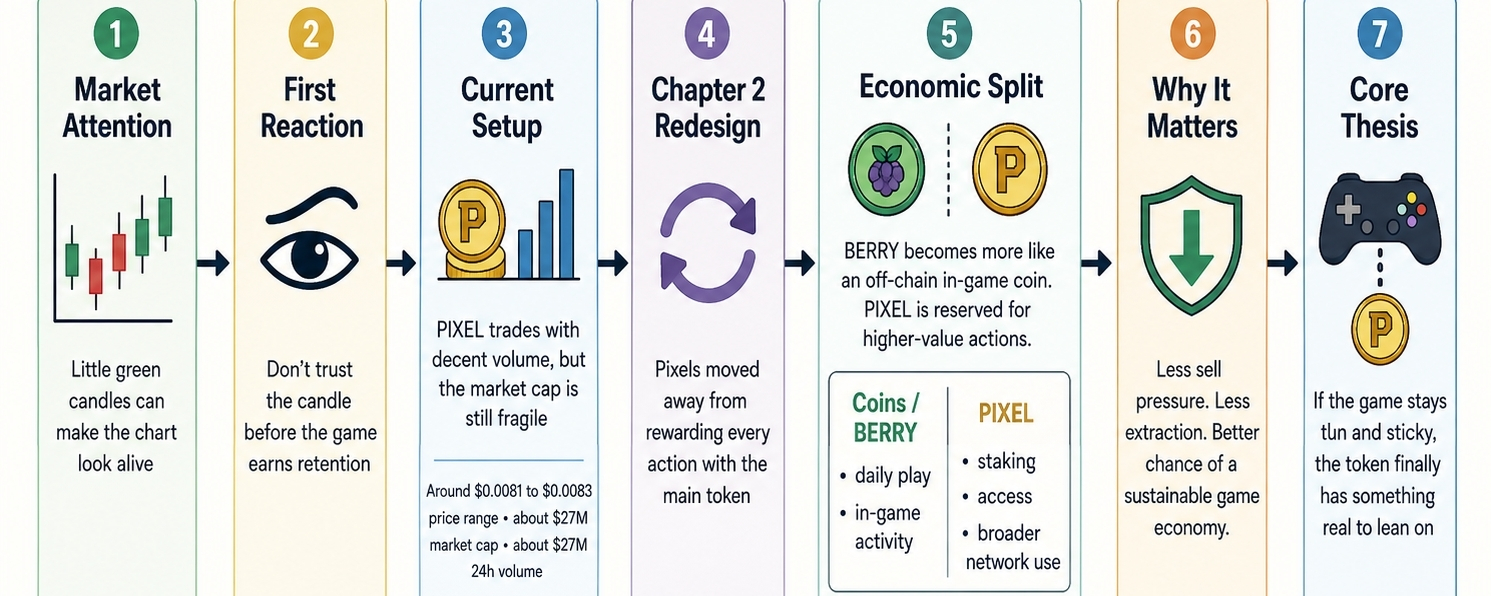
Pixels Knows The Game Has To Work Before The Token Matters
Disclaimer: Includes third-party opinions. No financial advice. May include sponsored content. See T&Cs.