
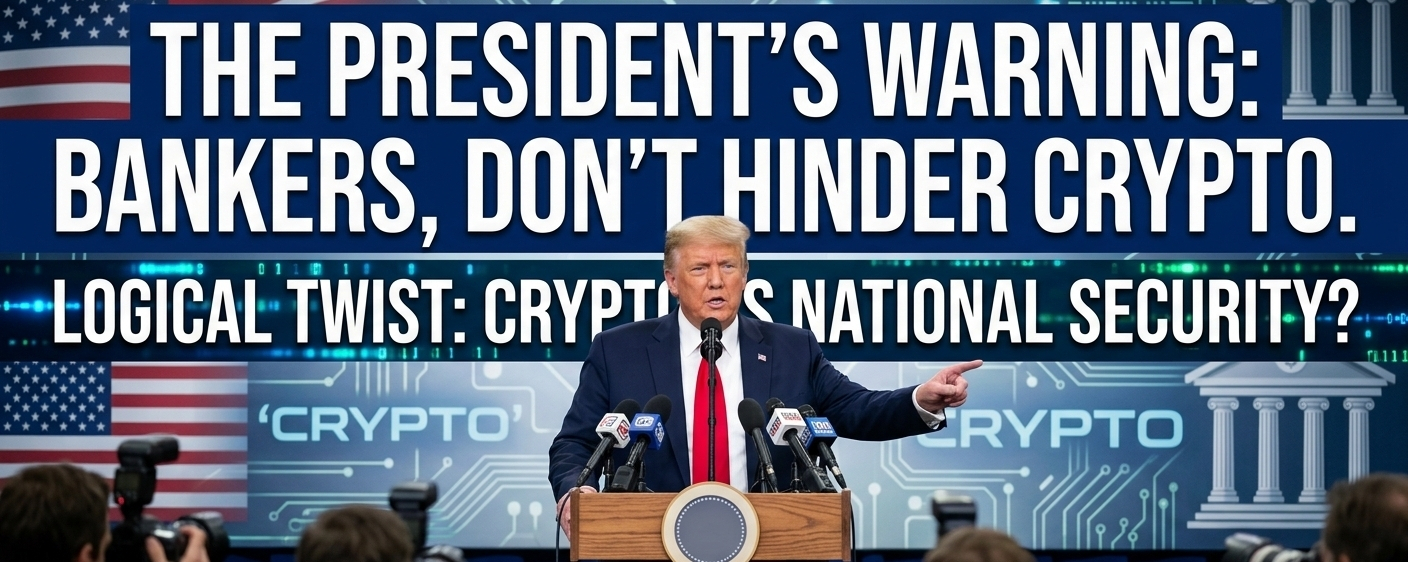
When President Donald Trump, a historic skeptic of cryptocurrency, issued a direct warning to the banking establishment, he did more than just signal a policy shift. He created a moment that demands a logical twist to understand the true motivations. The easy analysis is to see this as "Trump embraces crypto." But the more profound perspective, the twist, is to see this not as an embrace of the technology, but as a potential co-option of it to serve a traditional, nationalistic agenda.
The Warning: A Direct Volley
The core event is clear: Trump warned bankers that any attempt to stifle or block cryptocurrency legislation would face consequences. The language was direct, characteristic, and immediately set the financial and crypto worlds abuzz. Traditional institutions, which have long enjoyed a symbiotic, if occasionally strained, relationship with regulators, suddenly found themselves on the defensive.
This wasn’t just about "supporting innovation," a phrase political figures use frequently and with little meaning. It was a targeted demand, issued by a figure who understands the mechanics of leverage.
The Twist: It's Not About the Tech, It's About the Leverage
Here is the logical twist: Donald Trump's warning to bankers is less about his faith in the decentralized, libertarian dream of crypto, and more about identifying a new tool for exerting American economic power.
Crypto, in its pure form, is a system designed to operate without central authority. For a figure defined by strong central leadership and a focus on national sovereignty, this is an inherent contradiction. So, how can we make logical sense of this?
The twist argues that the long game is not a decentralized utopia, but the opposite: a centralized, co-opted crypto that works for, and under, the U.S. government. A truly powerful crypto asset, recognized by the state, would allow for:
Direct Economic Control: Bypass the complex, slow intermediary system of private banks. A government could, theoretically, issue "patriotic" digital assets or directly influence capital flows in a way that traditional monetary policy, filtered through private entities, cannot.
A Weapon of Financial Warfare: Just as the SWIFT system has been a tool for U.S. foreign policy, a U.S.-regulated, dominant crypto-asset would be an even more potent economic weapon. Imagine a scenario where a state-sanctioned digital dollar, operating on a transparent but controlled ledger, becomes the definitive global standard, rendering private alternatives or competitor nation-state digital currencies irrelevant.
Trump, in this logical framework, isn't telling bankers to get out of the way of crypto. He is telling them to get out of the way of the government's plans to control crypto. Bankers, who have slow-rolled integration and pushed for draconian, limiting regulations, are seen as hindering the creation of this new, powerful lever of national power.
The Logical Take: A New Type of Battle
This logical twist re-contextuates the entire crypto regulatory debate. It's no longer just Crypto vs. Banks. The new, true battle is likely to be: State-Controlled Crypto vs. Decentralized/Private Crypto.
The warning to bankers is the first shot in this new war. Trump is signaling that he will not allow traditional finance (TradFi) to maintain a bottleneck on a technology that can be weaponized for national strategy. If the banks won't build the infrastructure to give the state the control it desires, then the state will move them out of the way.
For the pure crypto community, this is a dangerous proposition. The warning to the bankers is, ironically, also a warning to them. The government is coming, and it's not looking to join the revolution. It’s looking to put on the crown.