
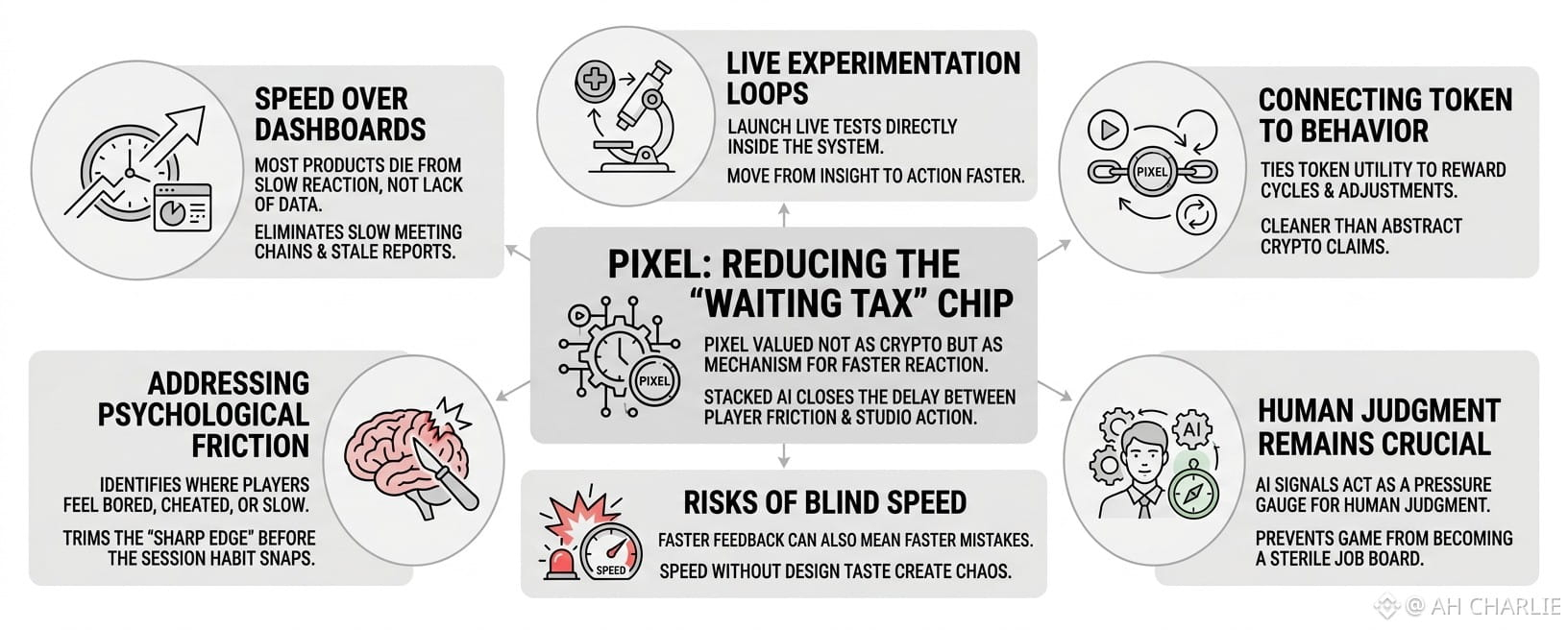
Player drop-off is not a dashboard problem. It’s a speed problem. By the time most studios understand why players are leaving, the mood has already gone cold, the session habit has snapped, and the player has moved on to some other shiny trap designed to eat their evening. That’s where PIXEL gets interesting to me, not as a slogan, not as some shiny token wrapper, but as what I’d call The Waiting Tax Chip.
That name sounds ugly because the machine underneath is ugly. Players don’t leave games in clean, polite ways. They fade. They hit a wall, feel bored, feel cheated, feel slow, feel unseen, then vanish without writing a breakup letter because, well... this is gaming, not couples therapy. The real cost for a studio is not just losing one user. It’s losing the signal before anyone knows what broke.
The Stacked AI angle matters because it attacks that dead space between “we noticed a problem” and “we changed something.” Studios can ask why a certain group of players is dropping off, then launch an experiment inside the same system without waiting for a slow meeting chain, a stale report, or a patch cycle that moves like a drunk forklift. That sounds small until you’ve watched teams drown in data and still make late decisions. Actually... most products don’t die from lack of data. They die from slow reaction.
The cold value of PIXEL sits in that pressure zone. If the system helps games move from insight to action faster, the token starts to sit near behavior, not theory. It becomes tied to loops: play, notice, adjust, test, reward, repeat. That’s cleaner than the usual crypto word soup humans keep ladling onto everything until even the servers feel embarrassed. A player doesn’t care about abstract design claims. A player feels pace, drag, reward timing, fairness, status, and whether the game respects their time.
Wait a sec... this doesn’t mean every AI tweak is smart. Fast changes can also create chaos. A studio can overfit to noisy behavior, reward the wrong crowd, punish quiet loyal users, or turn the game into a twitchy machine that keeps poking players for engagement like a desperate app begging for relevance. Speed is only useful when the team has taste. Without taste, faster feedback just means faster mistakes.
That’s the part market people often miss. Retention is psychological. If a player quits after day three, maybe the grind got dull. Maybe rewards felt too far away. Maybe the early win was too easy and the next task felt like walking through wet cement. Maybe the token layer created stress instead of pull. Truth is... the best systems don’t just throw rewards at users. They study where the user feels friction, then trim the sharp edge before it cuts the habit.
I’ve seen this pattern outside gaming too. A product team will stare at a clean chart and still miss the human reason behind the drop. The chart says “cohort decline.” The user says, “This felt annoying, so I left.” Huge difference. PIXEL’s stronger case is not that AI exists. Everyone has AI now, apparently including toasters and people who still can’t name their files properly. The better case is that Stacked could let studios turn user pain into a test before that pain becomes silence.
There’s a market logic here, but it’s not the loud kind. Games that can adjust live have a better chance of holding attention because they don’t treat player behavior like old news. A weak quest can be changed. A bad reward curve can be tested. A group that keeps leaving after the same moment can be studied without waiting for a committee to build a shrine to delay. ...you see? The edge is not magic. The edge is lower reaction time.
Still, the loop can break. If players feel watched too closely, trust drops. If every mechanic starts feeling tuned by a machine, the game can lose soul. If token rewards become the main reason to play, then the studio has built a job board with colors, not a game. Hmm... that’s the quiet danger with any reward system. It can pull real play forward, or it can train users to farm the machine until meaning leaks out.
The best version of this setup is not AI controls the game. That would be sterile and probably awful. The better version is a studio using real-time signals like a pressure gauge. Not worshiping the data. Reading it. A designer still needs judgment, because players are messy creatures with strange moods and the attention span of a candle in wind. The machine can show the crack. It can’t always tell you what kind of house you’re building.
I don’t know... maybe that’s why PIXEL deserves a colder lens than most people give it. The token’s real identity is not a badge, not a promise, not a shiny access key. It’s closer to a payment rail around reduced waiting, tighter feedback, and faster correction. That’s not romantic. That’s useful, if the system holds under real usage and doesn’t turn into another reward maze pretending to be product depth.
Execution is the only chart that doesn’t lie. I’m watching whether studios using Stacked can keep players inside better loops without making the experience feel engineered to death. If PIXEL keeps sitting near fast testing, real player pain, and cleaner reward timing, I’ll respect the machine. If it turns into noise, the player will feel it before the market admits it.
