i was watching the pixels chart at 2 AM while my crafting queues were still running… and i realized i couldn't tell anymore whether i was looking at a game or a trade.
that feeling sat longer than i expected.
because both things were true at the same time… the task board was refreshing on one screen, price action moving on the other… and the person sitting between them couldn't fully explain either one to the other side.
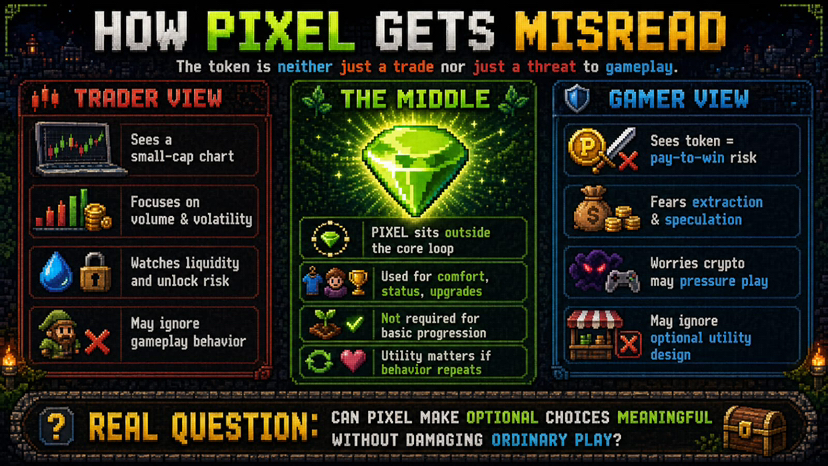
traders look at pixels and see a small-cap chart with volatility attached. gamers look at the same token and immediately feel the old fear… another game slowly becoming a market, another loop quietly turning into work.
both reactions make sense.
both are incomplete.
because the shallow assumption is that pixels must be either a trade or a threat to gameplay. that framing misses the middle… where the token is not the whole game, but also not separate from it.
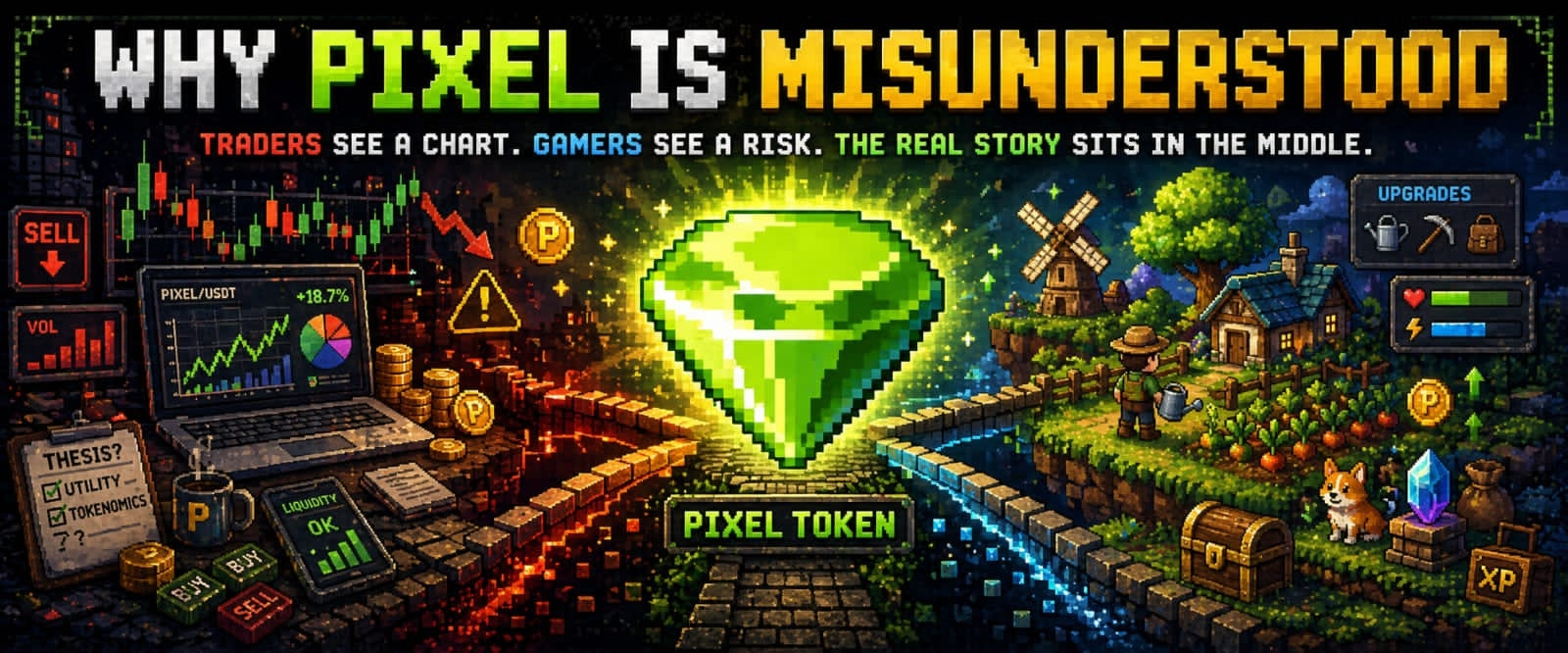
pixels sits outside the core loop by design. it prices comfort, status, optional acceleration… not the farming loop itself. you can plant, craft, run task board cycles, drain and refill energy, complete resets all of it without ever touching the token.
but the moment you want control over time… the moment waiting stops feeling like gameplay and starts feeling like friction… that's where pixels quietly enters.
not forced. not required.
just… suddenly worth it.
and that's where traders get it wrong first.
CoinGecko recently showed pixels with about $23 million in 24-hour trading volume, a market cap near $6.2 million, and a fully diluted valuation around $40.4 million.
those numbers tell a strange story.
volume sitting that far above market cap doesn't look like a game being valued… it looks like a rumor being traded. a small asset with active turnover can move sharply before the product story has time to explain itself. traders see the volatility and price the chart. they miss what's running underneath it RORS balancing reward spend, Stacked reading behavioral depth across millions of sessions, trust score quietly deciding who exits cheaply and who doesn't.
the chart doesn't know any of that exists.
but the system does.
and then gamers misread it from the other side.
they see the word token and immediately assume pay-to-win, extraction, speculation dressed up as design. i understand that reaction… Web3 gaming has earned some of that suspicion across enough failed cycles that the category itself carries damage.
but if pixels stays outside the core loop… if the farming session runs the same whether you hold it or not… then the question shifts. it's no longer "does crypto invade the game?" it becomes something quieter and more uncomfortable.
"does the token make optional choices feel meaningful without pressuring ordinary play?"
and that's a harder question to answer from the outside.
the broader market isn't being gentle about any of this either.
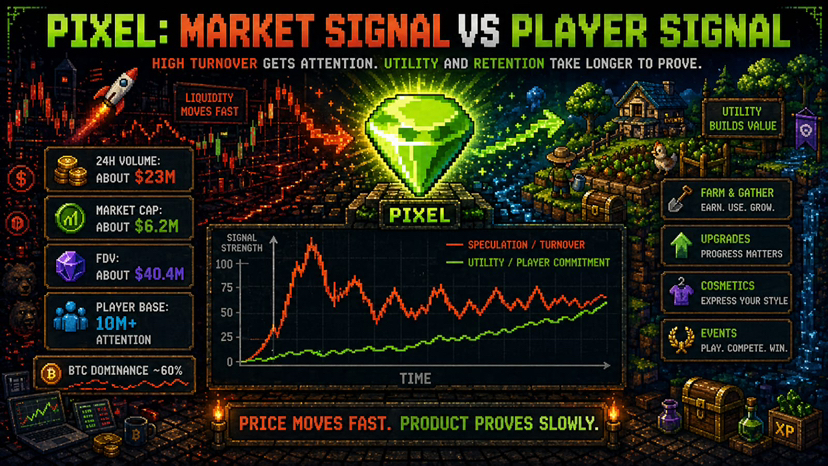
Bitcoin dominance recently moved near 60%… capital hiding in the asset it trusts most instead of spreading freely. spot Bitcoin ETFs logged roughly $2.1 billion of inflows across eight straight days through April 23… institutional money still selecting regulated, liquid exposure first.
in that environment, $PIXEL's job gets harder.
it has to prove utility while attention is being pulled toward safer, larger narratives. AI infrastructure, compute, agents, data… capital keeps rotating toward things that sound like the future. a game token can disappear in that noise unless people understand what's actually being built underneath the surface.
and what's being built isn't just a game.
it's a system that turns player behavior into economic signal.
that's the part neither side is pricing correctly.
traders are watching volume and unlock schedules. gamers are watching whether the token pressures progression. both are measuring the surface.
underneath it, Stacked is reading session depth across millions of players, building behavioral profiles that determine reward routing, exit costs, trust score, which loops receive budget and which ones quietly thin out. pixels isn't just sitting at the center of a farming game… it's sitting at the center of a reputation economy that most participants don't know they're already inside.
the trader is pricing a chart.
the gamer is avoiding a token.
neither of them noticed the system already decided what kind of participant they are.
so the misunderstanding isn't really about language… traders speak charts, gamers speak mechanics. the misunderstanding is about what pixels actually is.
it's not the engine.
it's not the reward.
it's the layer where the system's opinion of you becomes visible… where everything Stacked learned about your behavior finally has a price attached to it.
and that price isn't the same for everyone.
the trader is watching a chart that doesn't know it's a game… the gamer is avoiding a token that doesn't know it's already inside them.