
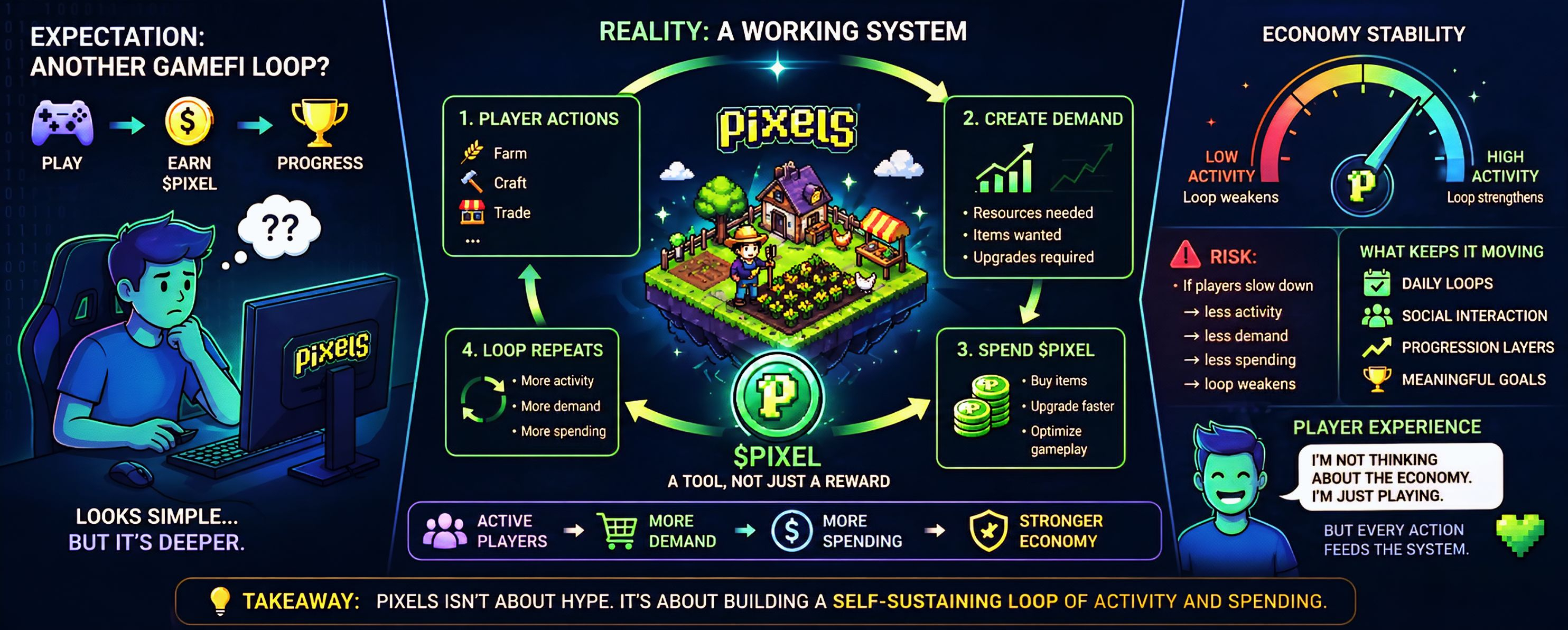
I opened @Pixels expecting another GameFi loop… but what I found felt more like a working system 👇
At first, everything looks familiar:
👉 you play
👉 you earn PIXEL
👉 you progress
Nothing new.
But I didn’t understand it сразу.
Only after spending time inside the game… I started noticing how things actually connect.
📊 Let me break it down simply:
👉 player performs actions (farm, craft, trade)
👉 system creates demand for those actions
👉 players spend $PIXEL to move faster or optimize
So it’s not just:
play → earn
It’s:
play → create demand → spend → repeat
🧠 And that changes the whole picture.
Because the economy doesn’t depend on hype.
It depends on whether players keep participating
👉 more actions → more need for resources
👉 more need → more spending
👉 more spending → stronger token utility
This is where it started making sense to me.
$PIXEL isn’t just a reward.
It’s a tool inside the system
⚖️ But I also looked at the weak point.
If players slow down:
👉 less activity
👉 less demand
👉 less spending
And the entire loop weakens.
So the system is stable…
but only while behavior stays active.
😈 That’s why Pixels focuses so much on:
👉 daily loops
👉 social interaction
👉 progression layers
Not to increase rewards…
but to keep the system moving.
📊 And here’s the interesting part:
you don’t feel like you’re supporting an economy
you just feel like you’re playing
But in reality:
every action feeds the system
My takeaway:
Pixels is not trying to build a “profitable game”
it’s trying to build a self-sustaining loop of activity and spending
And that’s a much harder problem.
I’m not watching $PIXEL just as a token
I’m watching whether this loop keeps working over time
What do you think —
is this a real sustainable model…
or just a system that still depends on constant activity? 👀