What Pixels stands to me is an intriguing balance of the familiar and the unknown. It’s a game about land, energy, and expansion, yes, but beneath its pixelated surface, it presents something more profound .... a philosophical exploration of ownership, responsibility, and consequence.
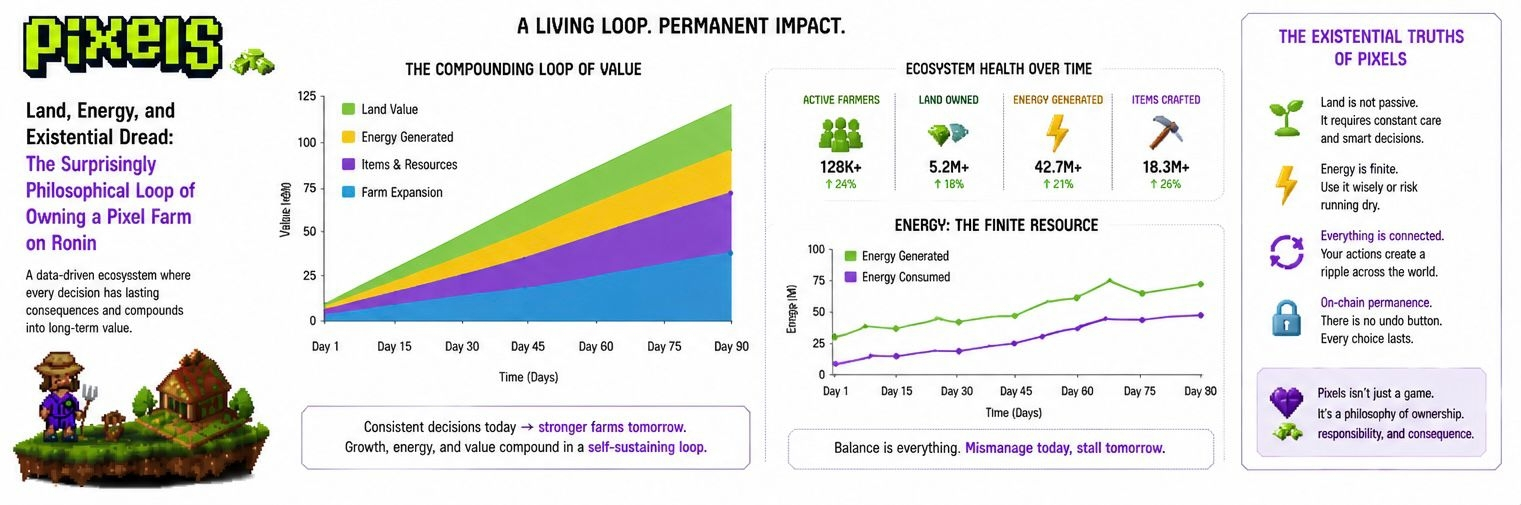
The more I dive into the mechanics of Pixels on the Ronin blockchain, the more I realize it’s not just another play-to-earn farming game. It’s an experience that makes you reflect on the very nature of ownership and what it means to build and maintain something, even in a digital world.
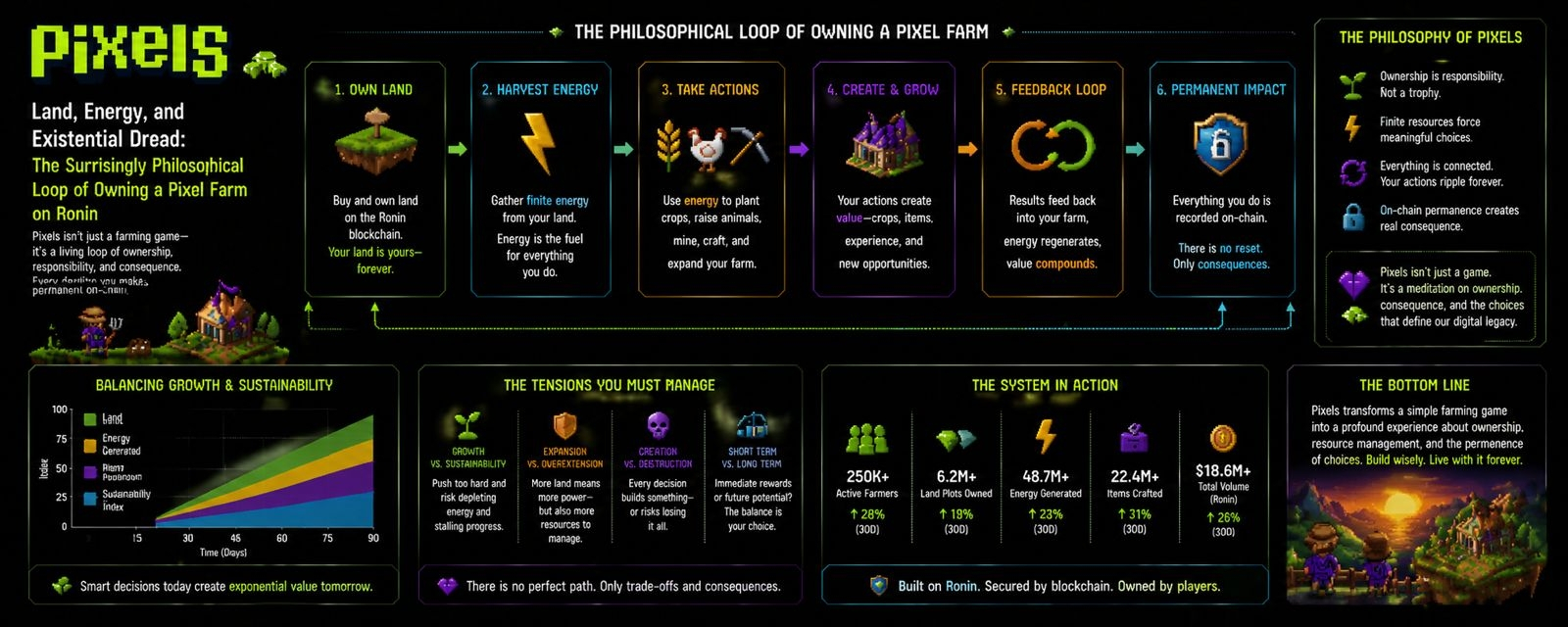
When I first think of land ownership in Pixels, I can’t help but draw a parallel to the real world. We often think of land as something passive, something we possess and control. In Pixels, though, land is far from passive. It’s alive, interconnected with everything you do in the game. Whether it’s planting crops, managing animals, or gathering energy, the land responds to your decisions, and the results are permanent. This is where the first philosophical tension arises: ownership is not static in Pixels. It’s a dynamic, ever-evolving responsibility that you must nurture. The game’s mechanics force you to think about ownership as a process of continuous engagement rather than a one-time acquisition.
What strikes me as particularly interesting is the energy system. Energy is not just a resource in Pixels; it is the fuel that powers everything you do. You harvest energy to grow crops, raise animals, and expand your land. But energy is finite, and the more you use, the less you have available for future growth. This forces you to make deliberate choices, balancing immediate rewards with long-term sustainability. I keep coming back to the idea that Pixels mirrors the real-world challenge of managing finite resources. Whether in business, in life, or even in personal relationships, the choices we make today affect our future potential. In Pixels, that future potential is represented by the energy you generate and how you choose to spend it.
The closed-loop system in Pixels is where the game’s true depth emerges. Your land, your energy, and your decisions are all interconnected in a feedback loop. If you misuse your energy, you risk exhausting your resources and stalling your progress. If you’re too conservative with your energy, you might miss out on opportunities for expansion. There’s a constant tension between growth and sustainability, creation and destruction. And it’s this tension that makes Pixels feel so deeply philosophical. It’s a game about more than just expanding your farm — it’s about managing your digital ecosystem in a way that ensures long-term success.
Here’s the kicker.... everything you do is permanent. Unlike traditional games, where you can easily restart or undo your progress, Pixels ensures that your decisions are recorded on the blockchain. The permanence of this system adds a layer of existential weight to every action. It’s not just about planting crops or expanding land; it’s about building something that will endure — or fail — based on the choices you make. There’s no going back, and that’s what makes the game both thrilling and terrifying. The possibility of failure looms large because, once you commit to a path, there’s no reset button.
This is where the game’s philosophical core shines through. The permanence of blockchain technology forces you to confront the consequences of your actions in a way that most games don’t. There’s no soft reset, no easy way to avoid the fallout from poor decisions. Pixels reminds me of a simple but powerful truth: ownership is about responsibility. It’s not enough to claim something as yours; you must manage it, care for it, and ensure its sustainability. In the real world, we face this challenge daily. Whether we’re managing our time, our relationships, or our resources, the key to success lies in our ability to balance short-term needs with long-term goals. Pixels brings that reality to life in a way that’s both engaging and thought-provoking.
But, of course, this doesn’t mean the game is without risk. The energy system creates a constant tension between ambition and caution. The more you expand, the more you need to manage. The more land you claim, the more vulnerable you become to overextension.
And while there’s a certain satisfaction in growing your empire, there’s also the looming possibility of losing it all. The constant need to balance growth with resource management mirrors real-world business decisions. In life, we constantly face this dilemma...should we push for more, or should we focus on maintaining what we have? Pixels forces you to face this dilemma head-on, knowing that your decisions will have lasting consequences.
In my opinion, this is where Pixels truly excels. It’s not just a game about land and crops; it’s about understanding the nature of ownership and responsibility in a way that feels real, even in a digital context. Ownership in Pixels isn’t a passive activity; it’s an ongoing, active process that requires constant attention and strategic decision-making
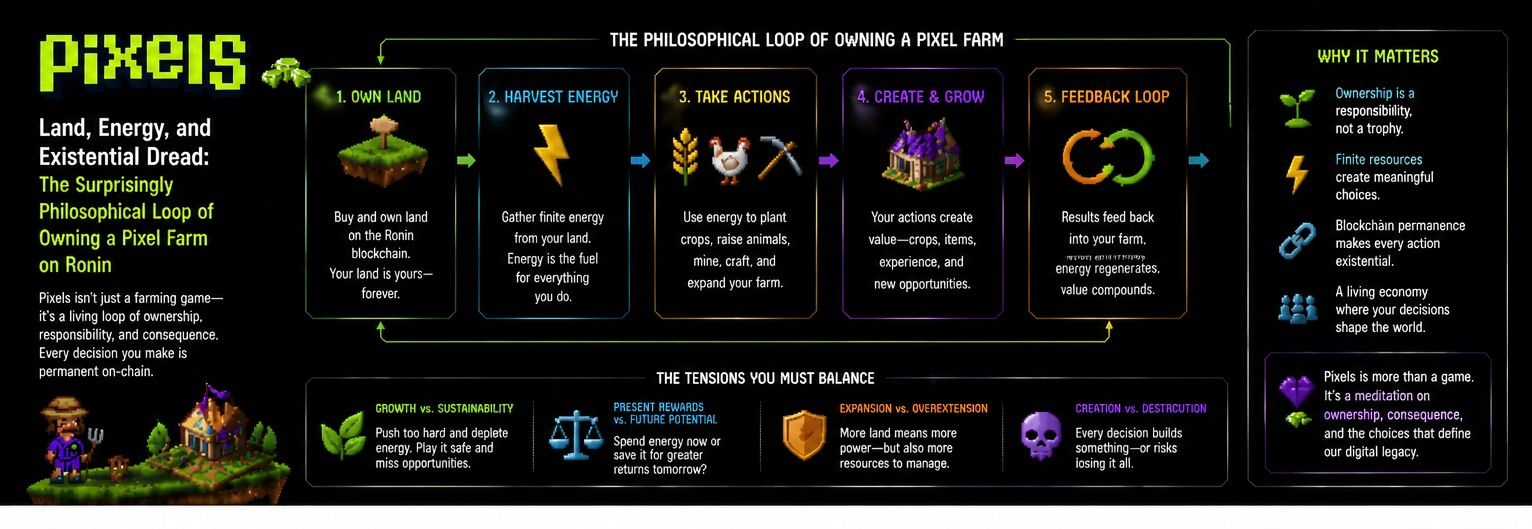
. There’s no room for complacency, and there’s no hiding from the consequences of your choices. Whether you succeed or fail, your actions are permanent. And I think that’s what makes Pixels so captivating. It is a game that demands engagement and reflection, and it does so in a way that mirrors the complexities of real-life resource management and ownership.
To me, Pixels is more than just a game. It’s a meditation on the nature of ownership and what it means to truly create and sustain something in a digital world. It forces you to think about resources, energy, and the long-term impact of your decisions. It challenges you to confront the existential reality that ownership comes with responsibility .... a responsibility that’s recorded, permanent, and unchangeable.
There’s no reset button, and that’s what makes the experience so deeply reflective. In the end, Pixels isn’t just about farming or owning land; it’s about understanding the delicate balance of growth and sustainability, creation and destruction, and the permanence of every choice you make.