
Market was doing that thing again today where nothing really moves but everyone acts like something is about to. I closed the charts and ended up just… playing around in Pixels for a while. Not for any specific reason. Just to see what it actually felt like after a few weeks away.
And somewhere between replanting crops and checking my guild contributions, I started thinking about the comparison everyone keeps making. $PIXEL as the Stardew Valley of Web3. I've seen it in threads, in spaces, in creator posts. It's become almost the default shorthand for what the project is trying to be.
But I think it's the wrong comparison. And not in a small way.
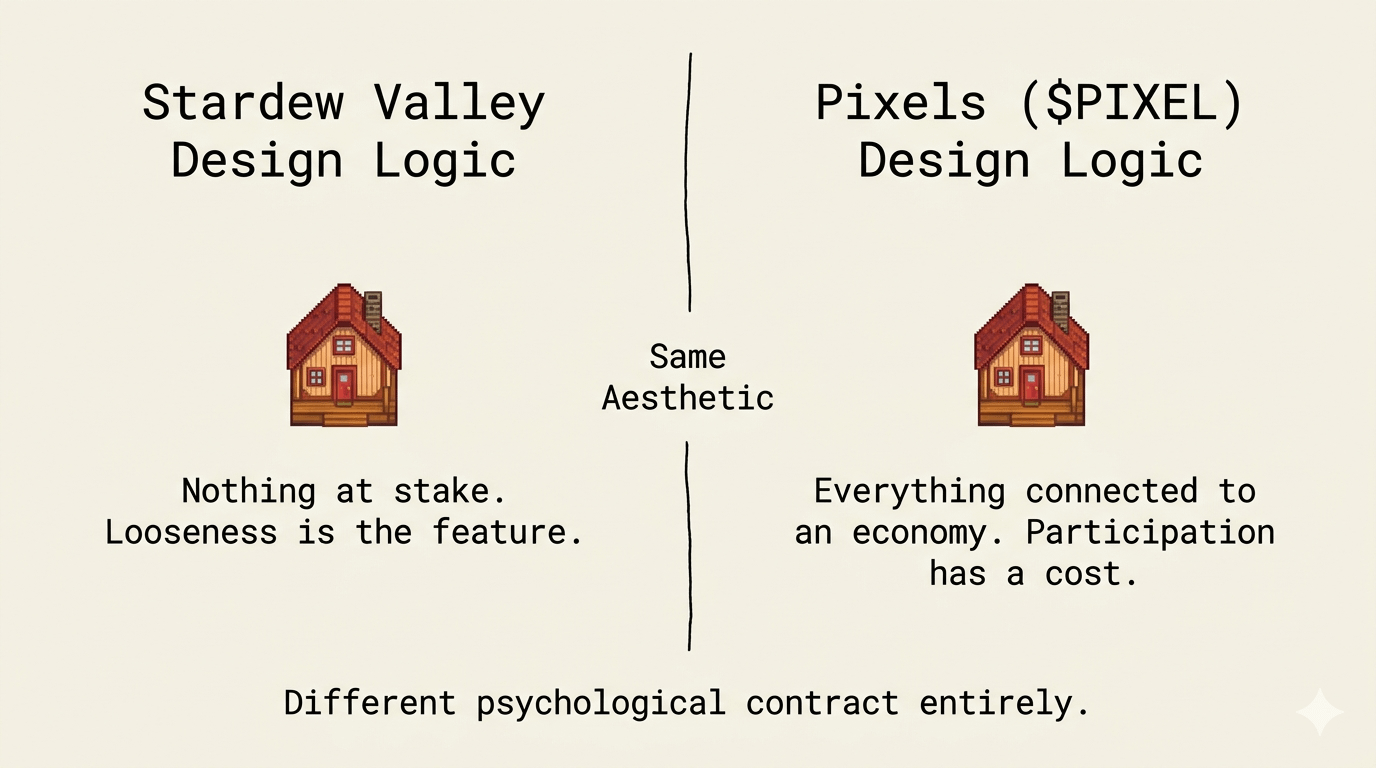
Here's what clicked for me while I was playing: Stardew Valley worked because nothing was at stake. That's not a side detail — that's the whole design. ConcernedApe spent years removing friction, removing pressure, removing the feeling that you could fall behind or lose something. You could ignore your farm for a week and come back and nothing had rotted in any meaningful way. The game held you loosely. And that looseness is exactly why millions of people who had never touched a farming game before fell completely into it.
Pixels (#pixel , @Pixels ) is designed around the opposite logic. The energy resets. The guild meters tick. The $PIXEL yield compounds differently depending on whether you hold land. There's an underlying economy that actually requires consistent participation to extract value from — and that economy is, by design, not neutral. It has winners and it has participants whose activity quietly benefits someone else's position. That's not a criticism exactly. That's just what on-chain economies do.
But here's the part that bothers me: the players who loved Stardew Valley loved it precisely because it had no economy like that. The people most likely to respond to the "Stardew Valley of Web3" framing are the exact people who might feel the most friction once they're inside the actual loop. I thought the comparison was just marketing shorthand at first. Then I realized it might be actively attracting the wrong expectations.
Which raises a messier question. What if the comparison is working as acquisition but quietly failing as retention? Because the people who stay in Pixels long-term — the ones actually coordinating guilds, holding land, timing their $PIXEL activity around market conditions — those people aren't playing something that feels like Stardew Valley. They're playing something closer to a light resource management game with a real economy attached. Which is genuinely interesting. But it's a different thing.
I'm not fully convinced this holds under pressure, by the way. Maybe the casual layer is thick enough that most players never feel the economic structure underneath. Maybe the comparison to Stardew brings in enough volume that the retention numbers smooth out. I don't have that data. And maybe I'm overweighting the design philosophy angle when the actual behavior is more forgiving than I'm giving it credit for.
But I keep coming back to this: Stardew Valley's creator deliberately kept it away from online economies, live-service mechanics, anything that would make the player feel obligated. That wasn't an accident. That was the point. And Pixels is — by its nature as a Web3 project — unable to make that same choice. The on-chain layer isn't cosmetic. It changes the texture of what playing actually feels like, even when the surface looks familiar.
Anyway. Market's still sideways. I'll probably log back in tomorrow without thinking too hard about any of this.