
I used to think GameFi was all about skill determining rewards – the better you played, the more you earned. But when I bought land in Pixels right as the token was dipping, a clearly illogical move, I started realizing that things don't operate that way.
In the context of GameFi maturing after many hype – cooldown cycles, concepts like 'commitment' are no longer vague; they’re becoming a behavioral infrastructure. Players aren't just participating – they're being retained by what they've built.
Reading through how Pixels designs their loop and reward, I find it very smooth - nothing feels forced. You look at it and think, 'that's solid.' But there's an important point that isn't stated outright: this system doesn’t actually reward skilled play, but rather rewards you for sticking around long enough.
A solid example: owning land. Technically, it's totally optional - you can still play without buying. But reality is different. Once you own it, you start building, optimizing, remembering everything: when to harvest, where the resources are, how the loop works. And from there, gameplay shifts from 'do this → get that' to 'maintain what you've built.'
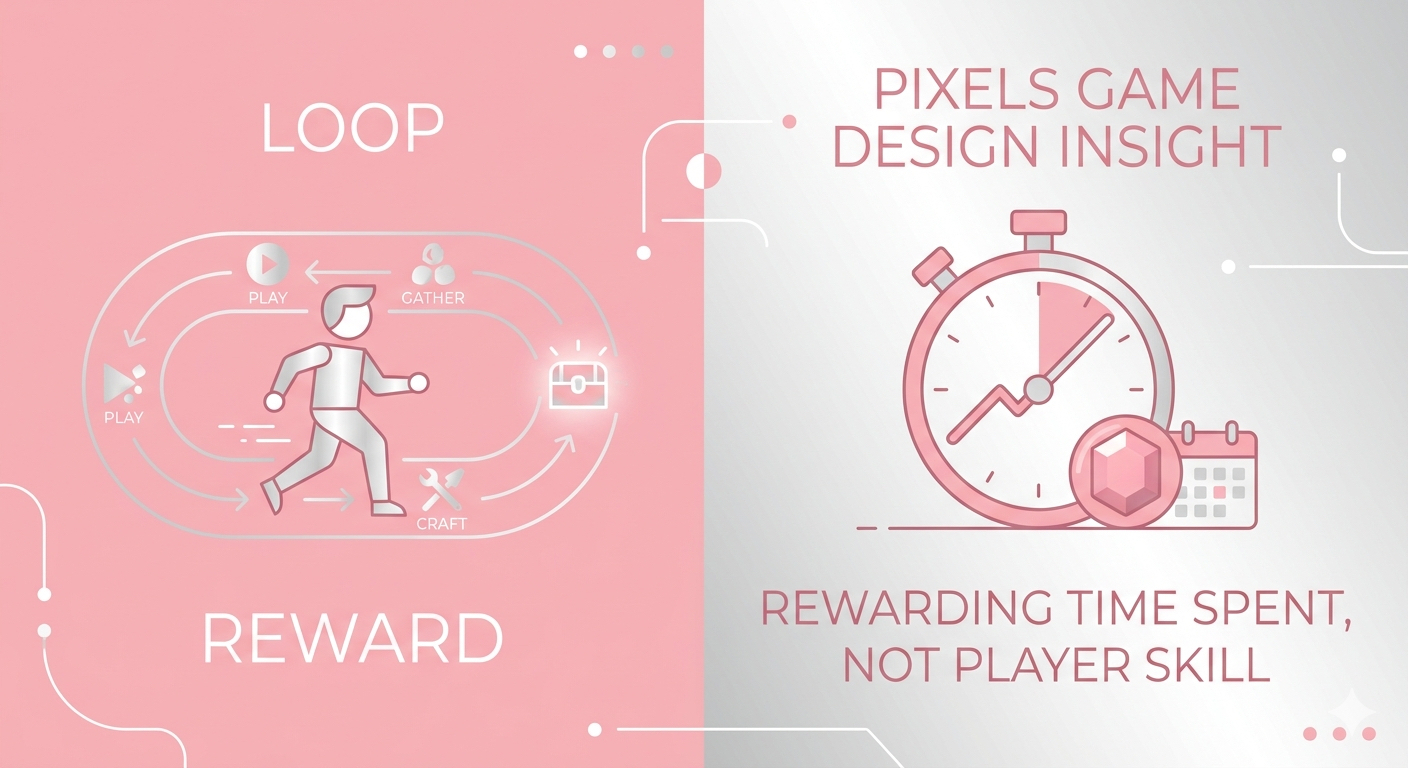
Today, I spent over 2 hours in Pixels just doing a familiar round: logging in, checking crops, harvesting, replanting, rearranging a few small things, then standing back to see if there’s anything else 'to do.' Nothing special happened, no crazy rewards - to be frank, it was pretty chill, but I was still there, going from one task to another as if stopping mid-task would mean something 'off.'
It’s like tending to a garden in real life: you’re not doing it because every time you water the plants you get a reward, but because you’ve already planted it and now you have a responsibility to keep it alive.
Pixels is tackling the retention issue in a very distinct way characteristic of modern GameFi: not forcing players to stay, but making it harder to leave - it’s like no one’s holding you back, but you just don’t want to bail.
However, this system doesn’t eliminate pressure. It just transforms it. It’s no longer the pressure to play well, but the pressure not to leave things unfinished. Before any rewards are 'recognized,' a very human factor is still needed: the sense of responsibility for what you’ve invested.
This isn’t a design flaw, but a structural risk: when value is tied to commitment, the line between 'wanting to play' and 'needing to stay' starts to blur - initially, it’s about enjoyment, but after a while, you don’t know if it’s enjoyment or just habit.
For those who have spent months building, stopping feels like losing not just resources - but the entire system they’ve become familiar with. There’s no game mechanism that can 'reset that feeling' because it’s not in the code, but in the perception.
Traditional systems fail when they push too hard. Completely free systems can't keep users either. Pixels is taking a third route: a kind of 'soft lock-in' - not mandatory, but making it burdensome to leave; the longer you stay, the harder it is to break free.
Rewards are no longer for the best players - but for those who stick around the longest.
Skill still exists, but it gets blurred by the weight of time + ownership.
That's why I still keep an eye on how Pixels operates, especially how they handle long-term loops and the feelings of players after they've 'invested in the system.' At a deeper level, what's noteworthy isn’t the reward, but how a game can gradually become a habit.
Something to ponder: when a system is designed to keep you around long enough, is the decision to stay really yours?