
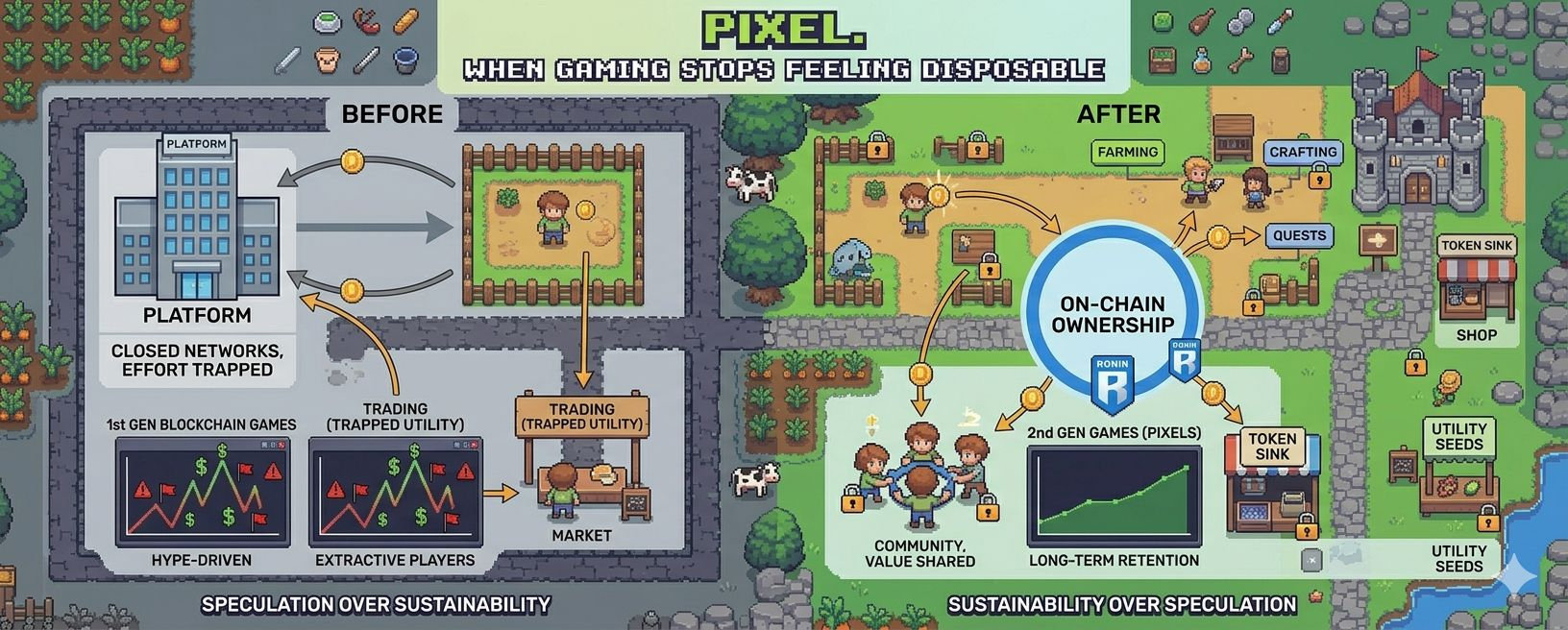
In the history of entertainment games have created a lot of emotional value but they leave little lasting economic value for the people who spend the most time playing them. Players build farms collect items make friends and join communities over years. Most of that effort stays trapped inside closed platforms. They can't move their items freely they can't own their progress in a way and playing often makes the game system richer than the player.
PIXEL comes into this picture not just as another gaming token. As part of a bigger effort to change how value works inside digital worlds.
At the center of this movement is Pixels, a social casual game that you can play in your browser, built on the Ronin Network. On the surface it feels like a game you might have played before: it has pixel art, farming, crafting, quests, exploration and social interaction.. Beneath that simple design is a bigger idea. Pixels knows that people won't play Web3 games because of the money. They'll play because they enjoy the game first and then the ownership and economic systems will support that.
This is where Pixels is different from early blockchain games. Earlier projects showed that NFTs, tokens and player-owned assets were possible. Many of them failed to create worlds that people wanted to stay in. The rewards were often too generous. Caused inflation the gameplay was shallow and players were mostly there for the profit. When the incentives went away people lost interest. Pixels is a second-generation game: ownership without people sticking around is fragile and demand for tokens without a community is temporary.
The project addresses an issue than just giving players tokens. Traditional gaming platforms often rely on their dedicated users. The ones who create communities help newcomers sell items and keep people engaged. But they capture most of the money themselves. Pixels tries to rebalance that relationship by creating a world where time, contribution and participation can have value. It doesn't promise wealth but it rejects the idea that player effort should be disposable by default.
Its design philosophy is subtle but powerful. Farming is not repetition; it helps you get resources, craft items and progress. Exploration is not just moving around; it creates opportunities for quests, discovery and social interaction. Creation is not just for looks; it becomes part of who you're how you express yourself economically. Because the game is browser-based and lightweight it's easy to start playing, which's different from many blockchain titles that require big downloads or complicated wallet setup. Players feel the game first. The technology second.
The choice of Ronin Network is also strategic. Ronin was built with gaming in mind making transactions faster and cheaper than general-purpose chains. That matters because casual players won't tolerate fees, delays or technical confusion. They compare every experience to the best consumer software available. By using gaming-focused infrastructure Pixels lets blockchain functionality exist in the background while preserving gameplay.
Technically Pixels operates through architecture. The front layer is the game experience itself: in your browser socially interactive and easy to understand. Beneath that sits the economy layer, where PIXEL helps coordinate incentives and participation. Another layer secures ownership allowing certain assets to exist independently of a centralized database. Infrastructure below that handles transactions, wallet connectivity and network throughput. Most users never need to think about these layers, which's exactly the point. Strong technology disappears behind design.
Scalability and security are critical. Every growing game economy faces tension between rewards, inflation, accessibility and long-term sustainability. Pixels must balance utility sinks, progression systems and demand carefully. Security also extends beyond contracts into behavioral risks such as bots, farming abuse and extractive gameplay. In worlds cheating can distort real economies, not just leaderboards.
Perhaps the strongest sign of Pixels’ promise is its community. Players often return because they enjoy farming, socializing, progressing and building routines. Not purely because they expect profits. That difference matters. Economies built on speculation often become fragile. Worlds built around enjoyment develop loyalty, identity and resilience.
In the end PIXEL represents more than a token attached to a game. It represents a maturing vision, for Web3 gaming. One where ownership enhances play of replacing it. Pixels does not rely on hype or complexity. It simply focuses on creating a world worth returning to. That may be the most important innovation of all.
