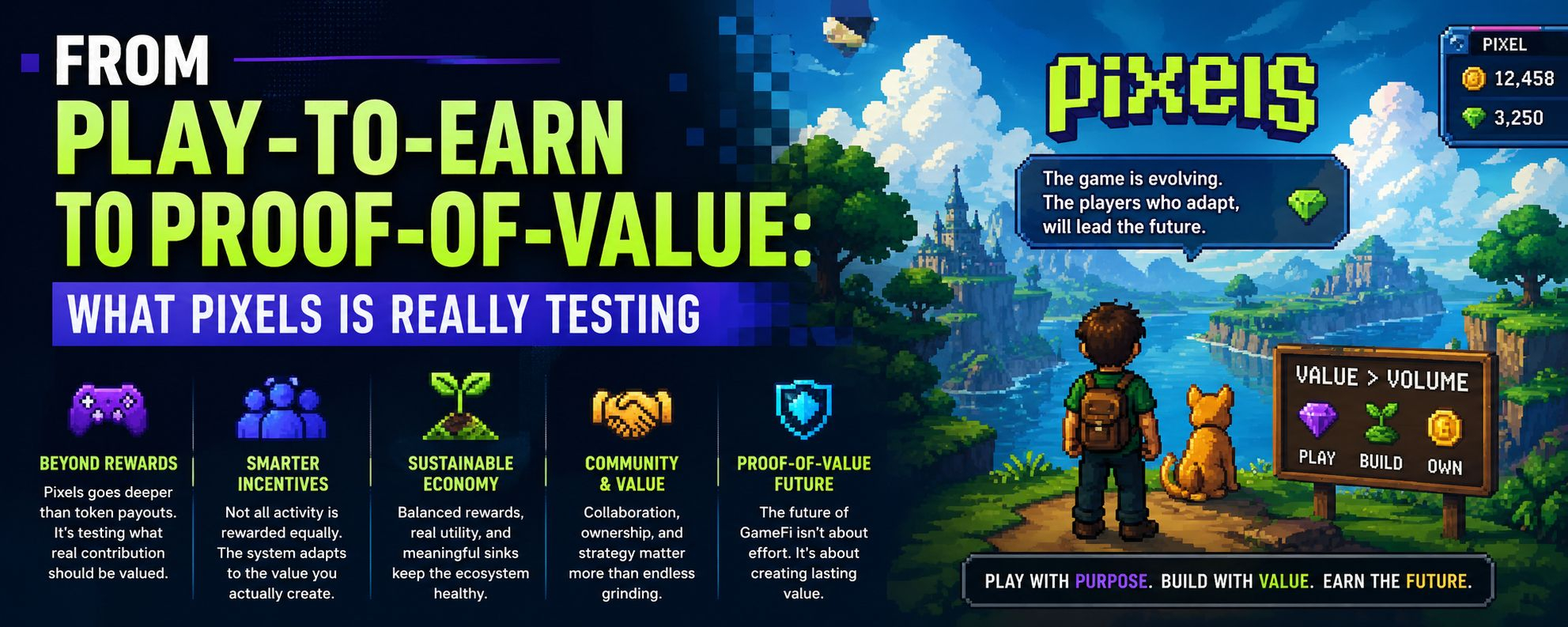

When most people look at Web3 games they ask a simple queobvious
Can I make money from this?
That question helped define the first wave of blockchain gaming. Rewards were visible, tokens were tradable, and players quickly learned that time spent inside a game could sometimes convert into income.
Pixels entered that landscape with a familiar promise play participate earn.
But after spending time watching how the ecosystem behaves, it feels like Pixels may be attempting something more complex than a standard play-to-earn model. Instead of simply rewarding activity, the game appears to be testing whether it can reward valuable activity.
That difference may sound small, but it changes everything.
Why Early Rewards Can Be Misleading
In almost every tokenized ecosystem, early participants often experience outsized returns. This happens for several reasons:
Low competition
Strong incentive emissions
Curiosity-driven growth
Untapped strategies
High user enthusiasm
For players, the conclusion usually feels obvious.
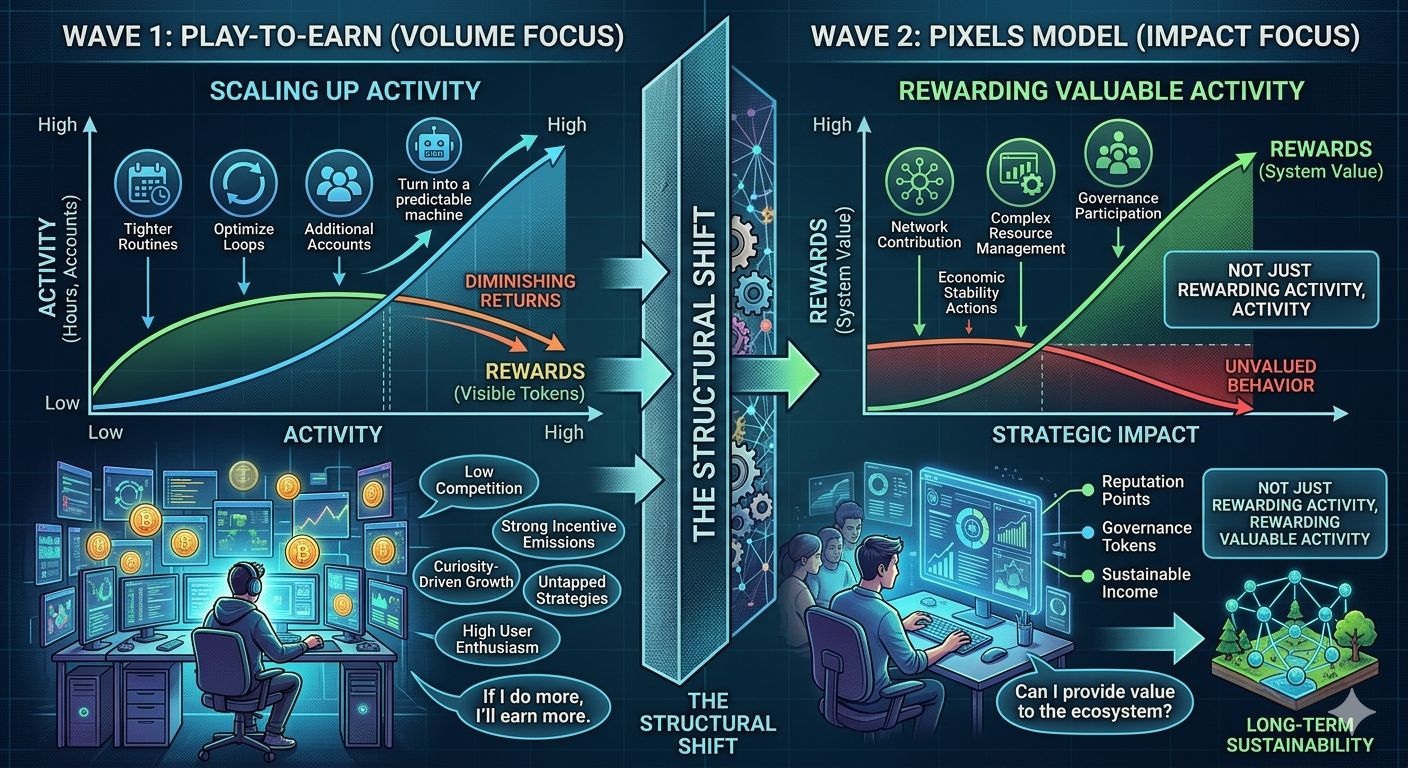
If I do more
I’ll earn more.
So they scale up. They create tighter routines, increase hours played, open additional accounts, optimize every loop, and try to turn the system into a predictable machine.
At first, it can work.
Then results begin to flatten.
The same actions that once felt profitable no longer deliver the same outcomes. Players often assume it is bad luck, market weakness, or token volatility. Sometimes that is true.
But sometimes the deeper reason is structural: the system no longer values that behavior the same way it did before.
The Common Failure of GameFi Economies
Many Web3 games run into the same long-term problem.
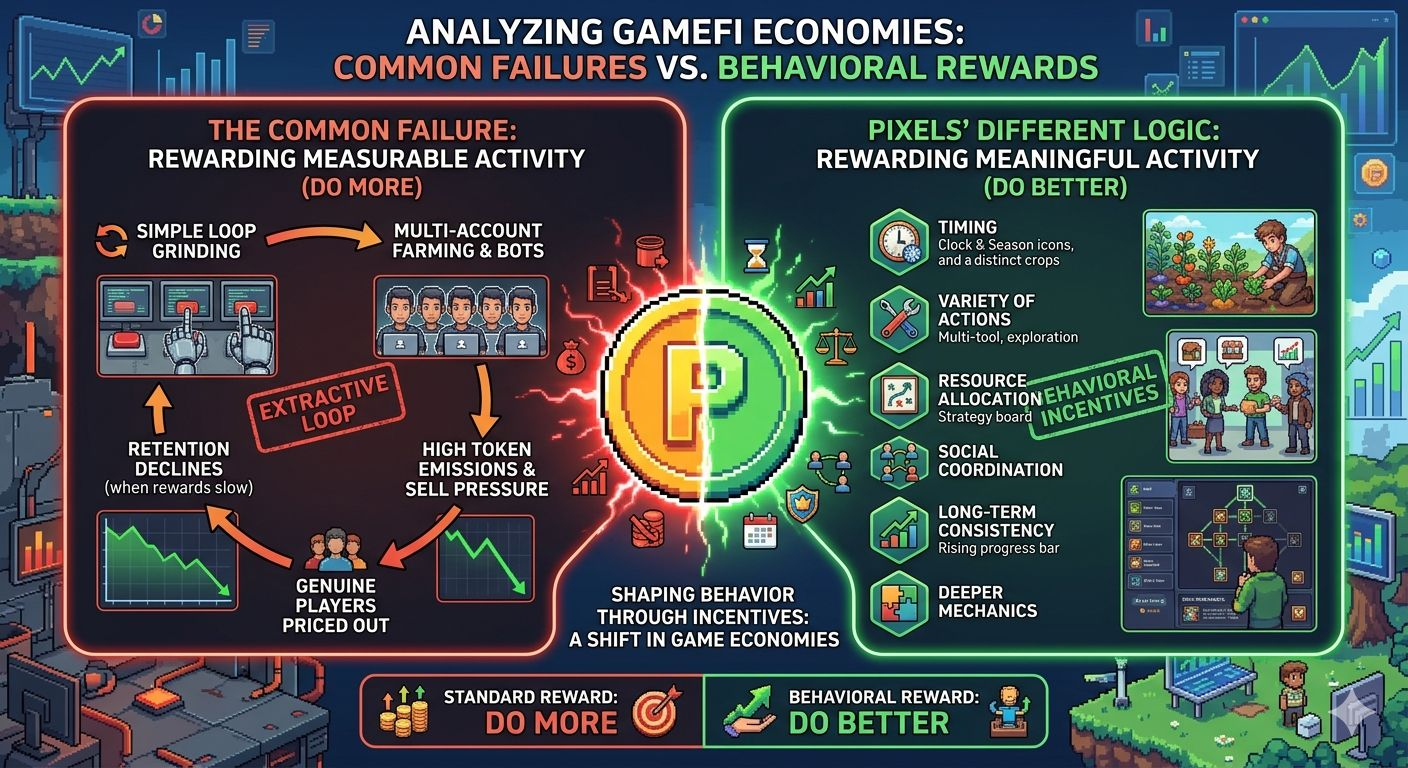
They reward measurable activity, but not meaningful activity.
That means the most profitable user is not always the best player or the most committed community member. Often, it is simply the person most willing to repeat efficient loops at scale.
This creates predictable consequences
Gameplay becomes secondary to extraction
Multi-account farming rise.
Bots or semi-automation appear
Token emissions increase sell pressure
Genuine players feel priced out or ignored
Retention declines once rewards slow
We have seen versions of this cycle repeatedly across crypto gaming.
The issue is not rewards themselves. The issue is rewarding the wrong things for too long.
Pixels May Be Using a Different Logic
@Pixels feels different because outcomes do not always scale linearly with effort.
Some users grind heavily but report diminishing efficiency. Others seem less intense, yet maintain steadier progress. Some strategies become crowded quickly, while others remain quietly useful longer than expected.
That suggests a system where participation alone is not the only variable.
Instead, the game may be placing greater value on
Timing
Variety of actions
Resource allocation
Market participation
Social coordination
Long-term consistency
Engagement with deeper mechanics
If that interpretation is accurate, then Pixels is not simply distributing tokens.
It is shaping behavior through incentives.
This is an important distinction.
A standard reward system says
Do more.
A behavioral reward system says
Do better.
Why This Matters for $PIXEL
Every game token eventually faces the same economic challenge emissions versus demand.
If too many rewards enter circulation without enough reasons to hold or spend the token, price pressure builds. When that happens, even active communities can weaken because users begin extracting value faster than the ecosystem can replace it.
That is why sustainable token economies need more than payouts. They need sinks, utility, and selective incentives.
#pixel has several mechanisms that can support this balance:
Crafting costs
Land progression
Upgrades
Resource cycles
Marketplace interaction
Competitive positioning
These systems help create internal demand. But demand alone is not enough if rewards remain easily farmable.
That is where behavioral filtering becomes powerful.
If low-value repetitive actions become less attractive over time, then emissions pressure can ease without punishing every player equally.
In theory, this creates a healthier loop
Useful participation → better incentives → stronger economy → better retention
The Invisible Sorting Layer
One of the most interesting dynamics in adaptive systems is that users often feel the effect before they understand the rule.
There may be no clear message explaining why two players with similar hours achieve different results. Yet over time, divergence appears.
That creates a new kind of competition.
Instead of racing for the fastest route, players begin asking smarter questions:
Which activities remain undercrowded?
What creates lasting in-game value?
Are social or land systems undervalued?
Does consistency matter more than intensity?
Which behaviors scale poorly when copied?
This is closer to market strategy than traditional grinding.
And that may be exactly the point.
The Risk of Over-Engineering Rewards
There is also a downside to intelligent systems.
Once players believe a game is evaluating behavior, they begin trying to reverse engineer it.
That can lead to new forms of exploitation:
Fake participation patterns
Diversified farming across wallets
Simulated “normal” activity
Optimizing appearance instead of contribution
This happens in every system that rewards signals rather than transparent rules.
There is also another risk: genuine players may feel confused if progress becomes too hard to interpret.
If users cannot tell whether effort matters, motivation drops.
So the challenge for Pixels is balance.
Too simple, and farmers dominate.
Too complex, and honest players disengage.
The strongest systems usually combine clear progression with subtle optimization layers.
Why Retention Matters More Than Rewards
At some stage, token payouts stop being the core metric.
What matters is whether players want to return tomorrow.
That decision is driven by factors no spreadsheet fully captures:
Ownership identity
Social belonging
Land attachment
Strategic goals
Fun progression
Status within the ecosystem
Rewards may bring users in, but meaning keeps them there.
If Pixels succeeds, it will likely be because users feel part of a living economy not because they found the best farming route.
That is a far more durable foundation.
What Smart Players May Already Understand
Some of the most effective participants in these ecosystems often look less active on the surface.
They are not always grinding the hardest. They are not chasing every temporary meta. They are not maximizing each hour individually.
Instead, they focus on:
Positioning early
Understanding demand shifts
Owning useful assets
Building networks
Choosing efficient moments to act
Staying adaptable as systems evolve
This often produces steadier outcomes than brute-force repetition.
In other words, they are not optimizing actions.
They are optimizing alignment with the system.
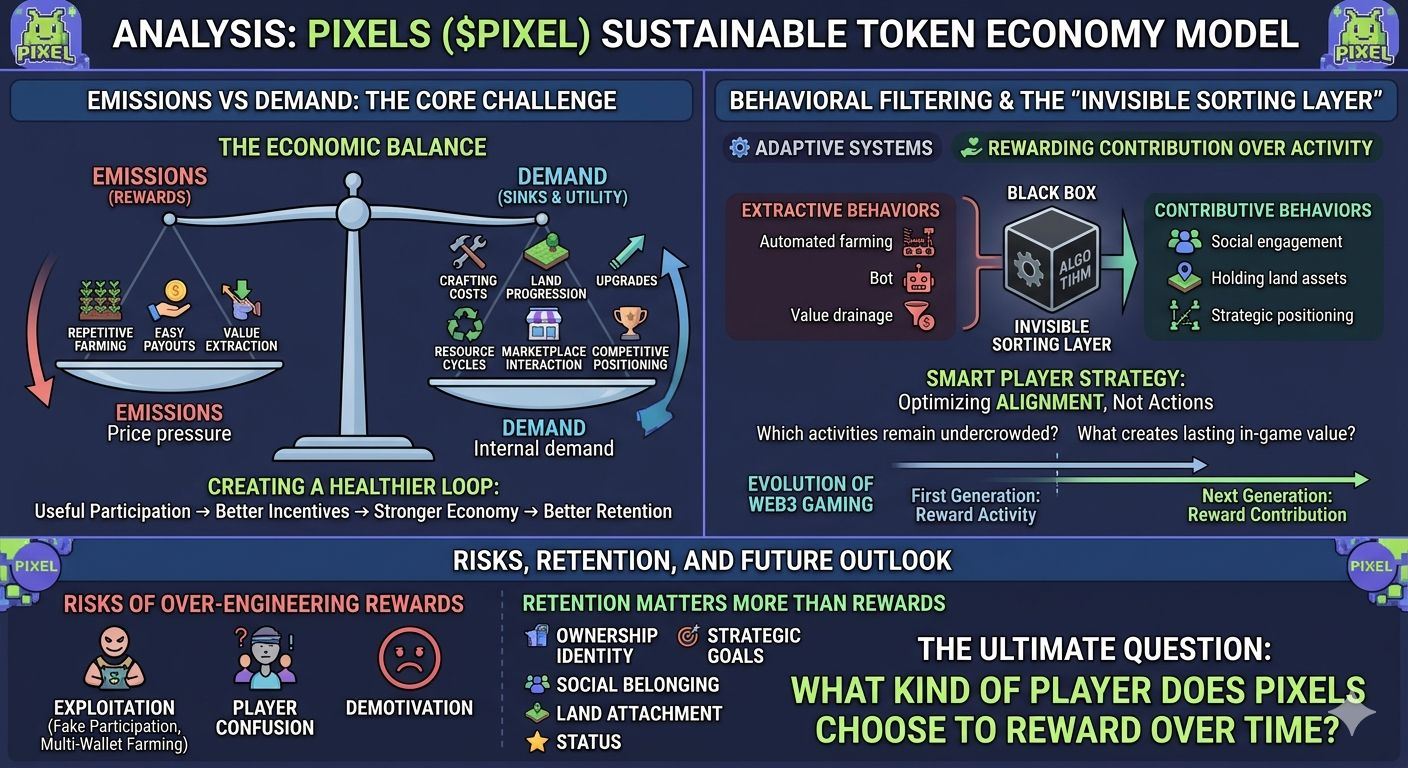
Pixels may be testing a broader future for Web3 gaming.
The first generation rewarded activity.
The next generation may reward contribution.
That is a meaningful evolution.
Because if every user is paid equally for extractive behavior, collapse becomes a matter of time. But if systems can identify and reinforce participation that strengthens the economy, they have a better chance to survive.
Whether Pixels fully achieves that remains uncertain. All live economies face pressure from speculation, user behavior, and changing incentives.
But the direction itself is worth watching.
Many people still ask whether Pixels can make money.
A better question may be:
What kind of player does Pixels choose to reward over time?
The answer to that question may determine not only the future of the game but the future of GameFi itself.