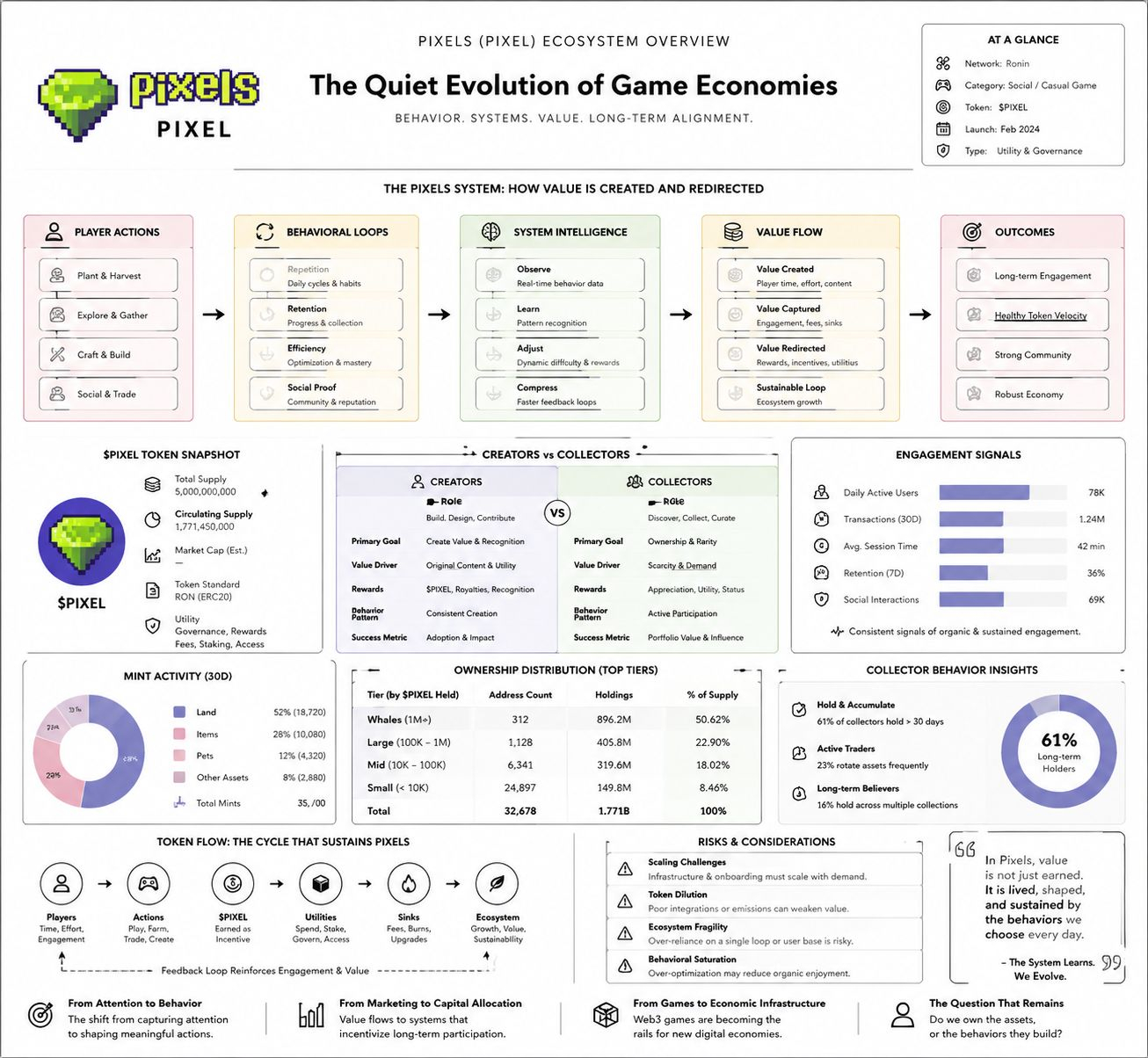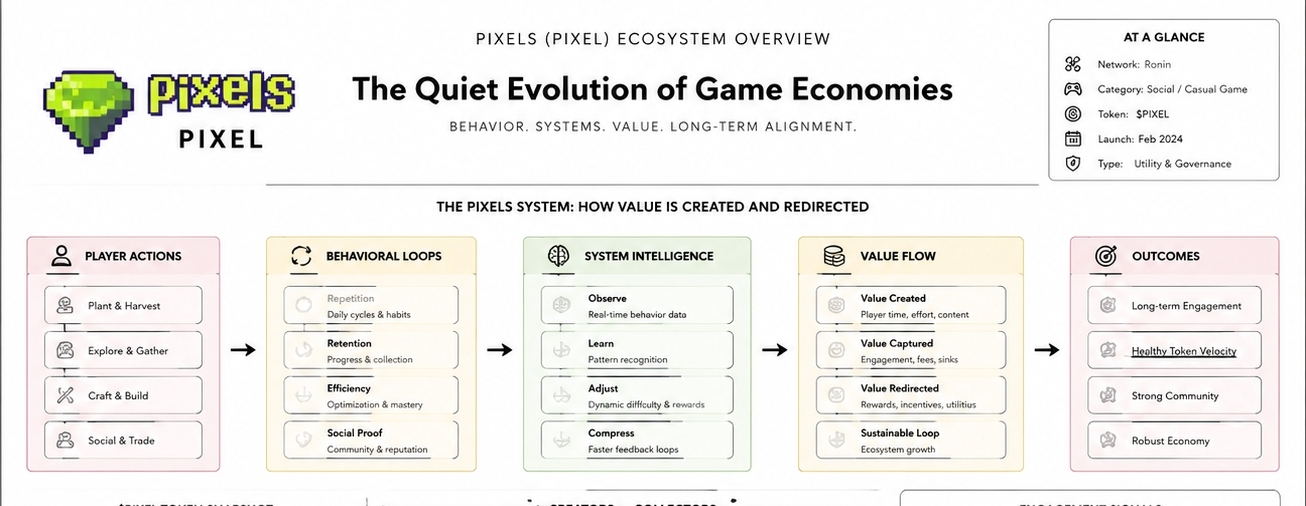

There’s a subtle shift that happens when you’ve spent enough time observing a system, especially one that intersects with the dynamic world of Web3. It’s not the flashy moments that catch your attention—those obvious changes are easy to see. No, what begins to intrigue me is the quieter transformation. It’s that point when something that once felt normal, even comforting, begins to feel just... off. It’s hard to put a finger on at first, but after a while, you start noticing that what you thought was simple or familiar is actually much more complex. This is where I found myself with Pixels (PIXEL), a game built on the Ronin Network.
When I first engaged with Pixels, the experience seemed straightforward enough. It’s a casual farming game set in a pixelated world, with the usual loop: plant, wait, harvest, repeat. There was a token involved, and people framed it as a reward system—effort in, value out. At first, this felt familiar, like so many other Web3 games that claim to merge gaming and earning. But as I spent more time in the game, something started to feel different. Not in a broken way, but in a way that left me wondering: What’s really going on beneath the surface here?
I might be wrong, but I started to sense that Pixels wasn’t just another “play and earn” system. Sure, it had the mechanics—a token, actions to perform, rewards—but something deeper was unfolding. At its core, it felt more like a system designed to reshape player behavior rather than simply provide rewards. And in that quiet shift, I began to see the evolution of the game not as a product, but as a living, breathing entity that adapts and learns over time.
From Play and Earn to Quiet System Evolution
Let’s pause for a moment and reflect. On the surface, Pixels appears to follow a well-trodden path. Players engage in simple tasks—plant crops, wait for them to grow, and then harvest them. Each cycle seems like a straightforward loop of cause and effect. But as I spent more time with the game, it started to feel less like a loop and more like a rhythm. And that’s when I realized: This is not just about completing tasks; it’s about adjusting to a system that shapes my behavior in ways I hadn’t noticed before.
This shift wasn’t loud. There were no flashing alerts or obvious cues. Instead, it was the way the game felt after hours of engagement—how I started checking in more often, how I adjusted my playstyle without even realizing it. It was like I was slowly becoming attuned to the rhythm of the system, responding to its subtle nudges. I wasn’t just playing the game anymore; I was participating in an ecosystem, where every action, no matter how small, contributed to the unfolding experience.
This quiet reshaping of behavior is at the heart of how Pixels operates. It’s not about the initial reward—it’s about the long-term engagement that comes from repetition, retention, and efficiency. The game doesn’t loudly signal that it's adjusting itself to your behavior. Instead, it simply offers more space for that behavior to evolve, and over time, it feels like the system has learned how to mirror your actions more efficiently.
Feedback Loops and Real-Time System Intelligence
What fascinated me next was how the system, in its quiet way, started to learn from my actions. In a typical game, I would expect to see the feedback loops clearly signaled: a reward here, a penalty there, actions tied directly to outcomes. But in Pixels, the feedback loop felt much more compressed. It wasn’t always clear when the system adjusted to my actions, but over time, I noticed that my interactions with the game felt more... responsive.
This kind of real-time adjustment is, at least in my view, the hallmark of a system that’s learning and evolving. In Pixels, the actions I take, the resources I gather, the land I cultivate—they all seem to feed back into the system without obvious interruption. It’s as if the game is constantly observing and fine-tuning its interactions with me. And in turn, I adapt as well. Small nudges in the form of rewards, tasks, or new mechanics begin to feel like a natural part of the environment, not forced actions or goals.
In other words, the game is not static. It’s dynamic, constantly learning from the way players interact with it, and adjusting the game environment accordingly. This is more than just a set of mechanics—it’s an ecosystem that observes, processes, and adapts based on real-time inputs.
Value Flow and Behavioral Nudges
The real insight here, though, is in how value is created, captured, and redirected. On the surface, Pixels feels like a play-to-earn game. Players perform tasks and receive tokens in return. But as I dug deeper, I realized that the true value in Pixels wasn’t coming from the actions themselves, but from how those actions were structured within the larger system.
The game’s token layer, $PIXEL, isn’t just a reward. It’s a behavioral instrument. The game creates and captures value by steering player actions in certain directions, often without players even realizing it. Through repetition and retention, the system doesn’t just encourage players to earn tokens—it encourages them to engage with the system in a way that’s efficient and sustainable. This is where the true value lies: not in the tokens themselves, but in the way the system nudges behavior toward continuous engagement and participation.
At the same time, the game’s ecosystem relies on a quiet, overlapping set of demand loops. Players’ engagement with $PIXEL doesn’t just serve their own gameplay—it feeds into the larger economic model of the game, driving value both for the players and for the system itself. This creates an intricate web of incentives that extends beyond simple token rewards. The tokens, in essence, become a currency for behavior, creating a feedback loop that sustains the ecosystem over time.
Risks and Scaling Issues
However, like any system, Pixels isn’t without its risks. As the game grows, it faces challenges typical of Web3 economies—scaling issues, dilution from weak integrations, and fragility across different player bases. There’s a fine balance to strike between creating a system that’s engaging and one that remains resilient across a broad spectrum of users. If the system fails to scale properly or if integrations weaken over time, the value created by the game could erode, leaving the system vulnerable to collapse.
But even within these risks, there’s something to be learned. The game’s underlying mechanics—its ability to evolve quietly and continuously—demonstrates the potential of Web3 systems to transcend traditional game mechanics and become more like living economies. But whether this potential will be fully realized is yet to be seen.
From Attention to Behavior: A Larger Industry Shift
This quiet evolution in Pixels reflects a larger shift in the industry. The emphasis is moving away from attracting attention and toward shaping behavior. Instead of focusing on short-term marketing spend or flashy features, Web3 games like Pixels are creating economic infrastructures that build long-term engagement and sustainable value. This shift mirrors a broader trend in how we think about marketing, capital allocation, and even ownership itself.
In many ways, this is the next step in the evolution of digital economies—away from attention-driven marketing campaigns and toward systems that incentivize long-term participation and behavior. It’s a shift from short-term hype to long-term utility, from products to ecosystems.
Control vs Freedom, Ownership vs Permission
And perhaps that’s where the philosophical question lies: What does it mean to truly own something in a Web3 world? Pixels offers us a glimpse into a future where value isn’t just something to be bought or sold—it’s something to be lived. The freedom to participate, to create, and to earn in ways that are self-sustaining is the true promise of decentralized systems. But this freedom is not without its tensions. The system may offer ownership, but it also requires us to cede some control in exchange for participation. The question, then, is not whether we own our tokens or our assets—it’s whether we own the behaviors that those assets are built on.
As I reflect on all this, I realize that the quiet, gradual reshaping of behavior in Pixels is less about the game itself and more about the broader transformation happening within the Web3 ecosystem. The future, I think, will be shaped by systems that work in the background, nudging us into new patterns of behavior—patterns that may ultimately redefine what it means to be a player in this new digital world.
And so, as I continue to observe Pixels and other Web3 projects, I’m left with more questions than answers: Can these systems scale without losing their subtlety? How much freedom can we have if we are constantly nudged toward behavior that serves the system? And in the end, what does true ownership really look like when the systems we engage with learn to adapt to our every move?
In this quiet, evolving space, I can’t help but wonder if the answers lie somewhere between efficiency and identity, control and freedom where the system itself becomes a mirror of who we are, not just what we play.