
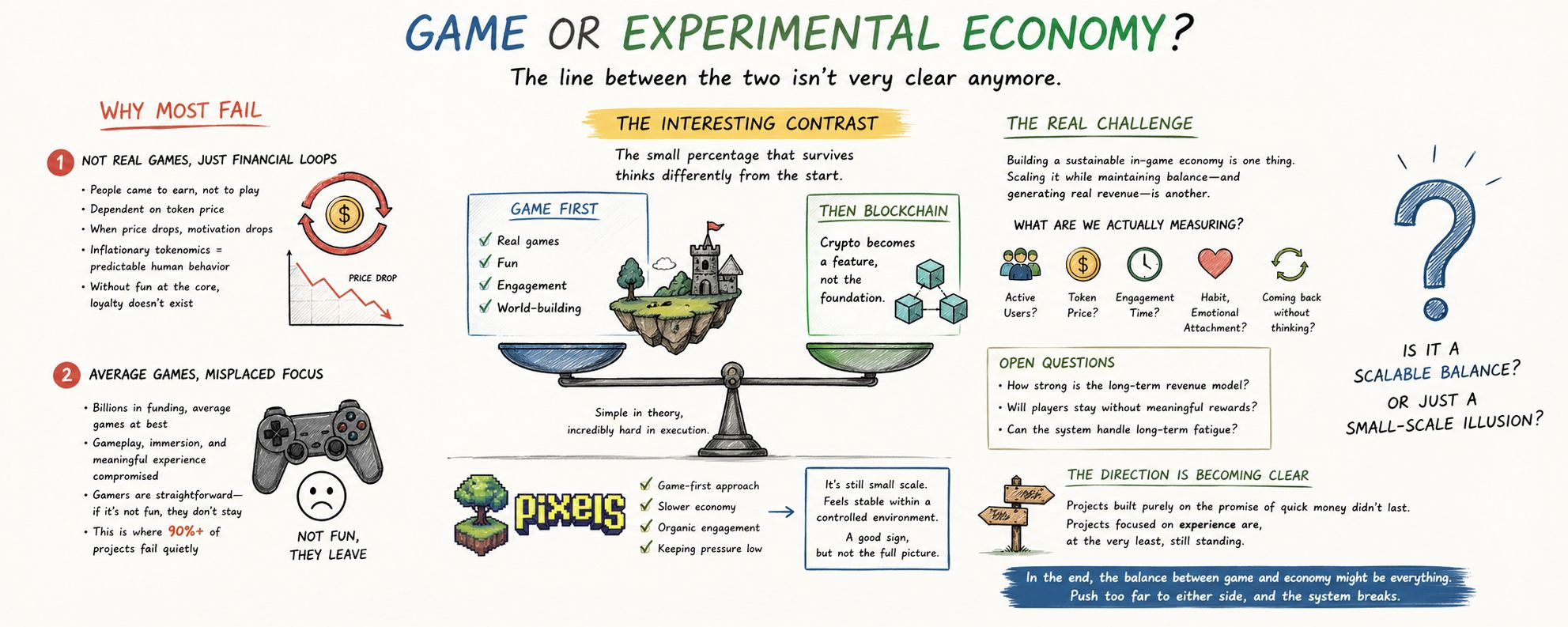
Sometimes it’s hard to tell… are we actually talking about gaming, or about an experimental economy? The line between the two isn’t very clear anymore.
When I look at projects like Pixels, that question becomes even stronger. In the same industry where so many projects fail and burn out, a few somehow keep working. Not perfectly—but enough to make you pause and think.
If you go through major research reports, a pattern shows up again and again. The reasons aren’t complicated—but their impact runs deep.
First, most “games” were never really games. They slowly turned into financial loops. People didn’t come to play—they came to earn. In the beginning, it worked because the incentives were strong. But the flaw in this model is obvious in hindsight: it’s completely dependent on price. When the token price drops, motivation drops with it.
There’s a simple but uncomfortable truth here—when fun isn’t the core, loyalty doesn’t exist. Players leave as soon as the numbers stop making sense. The system becomes hollow from the inside. We call it “inflationary tokenomics,” but at its core, it’s just human behavior reacting predictably.
The second issue is even more uncomfortable. Despite billions in funding, many of these games were… average at best. The problem wasn’t a lack of resources—it was misplaced focus. Gameplay, immersion, and meaningful experience were often compromised.
And gamers are very straightforward—if it’s not fun, they don’t stay. This is where around 90%+ of projects quietly fail.
But then there’s an interesting contrast.
The small percentage that survives tends to think differently from the start. They build games first—real games. They prioritize fun, engagement, and world-building. Only after that do they integrate blockchain elements.
In other words, crypto becomes a feature—not the foundation.
It sounds simple, but it’s incredibly hard to execute. Especially in a hype-driven market where slow building doesn’t get much attention. Still, some projects have taken this path—and Pixels often comes up as one of those examples.
That said, there’s an important detail we shouldn’t ignore: Pixels is still operating at a relatively small scale. The system feels stable—but within a controlled environment.
And honestly, that’s a good sign… but not the full picture.
Because the real challenge might just be beginning.
Building a sustainable in-game economy is one thing. Scaling it while maintaining balance—and generating real revenue—is a completely different challenge.
So the real question becomes:
What are we actually measuring?
Active users?
Token price?
Engagement time?
Or something harder to quantify—like habit, emotional attachment, or the idea of “coming back without thinking”?
What Pixels is doing, interestingly, is keeping the pressure low. It doesn’t aggressively push the “earn” narrative. Instead, it creates an environment where players stay naturally.
It’s subtle—but that subtlety might be its strength.
Still, the doubt remains.
As the system scales and expectations grow, can this balance hold?
Or will incentives slowly become heavier again?
History leans slightly pessimistic here. But it’s too early to dismiss everything.
This space is still evolving.
The first wave made its mistakes—over-financialization, weak gameplay, short-term thinking. The second wave seems to be learning from those mistakes.
Pixels may be part of that learning phase.
So I don’t see it as a clear success or failure.
I see it as an ongoing experiment.
Some things are clearly working—
a game-first approach, a slower economy, more organic engagement.
And some questions are still open—
How strong is the long-term revenue model?
Will players stay without meaningful rewards?
Can the system handle long-term fatigue?
We don’t have clear answers yet.
But one thing is becoming more obvious over time—
Projects built purely on the promise of quick money didn’t last.
Projects focused on experience are, at the very least, still standing.
That may not be a breakthrough…
But it does point to a direction.
In the end, the balance between game and economy might be everything. Push too far to either side, and the system breaks.
Right now, it feels like Pixels is quietly trying to find that balance.
But the question still remains—
Is it a scalable balance?
Or just a small-scale illusion?
Maybe time will tell. For now, it’s still too early to conclude 🚀


