
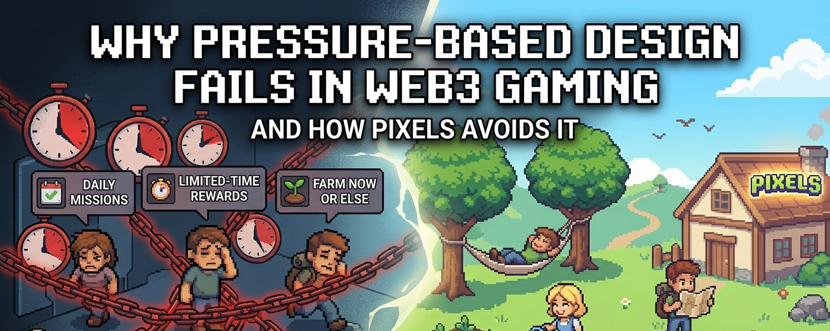
If you look closely at most Web3 games, you’ll notice a pattern in how they’re designed.
They rely heavily on pressure.
Not direct pressure, but structured pressure. Daily tasks that reset, reward systems that depend on constant activity, and mechanics that make players feel like they need to stay engaged or risk falling behind.
At first, this approach works.
Players log in frequently, activity stays high, and the system looks successful on the surface. But over time, the same issue starts to appear.Fatigue.
The more a game tries to control player behavior, the more it turns the experience into something that feels like an obligation. Instead of playing because they want to, players start logging in because they feel like they have to.
That’s where the disconnect begins.
Pixels approaches this differently by reducing that pressure instead of increasing it.
The game doesn’t rely on forcing players into constant activity. It allows space between interactions. You can log in, engage with the world, and leave without feeling like you’re missing something critical.
This creates a more relaxed loop.
Farming, exploring, and interacting become part of a natural flow instead of a checklist. You’re not optimizing every move or chasing every possible reward.
You’re just playing.
That shift changes how players relate to the game.
When there’s less pressure, there’s less burnout. When there’s less burnout, players are more likely to return consistently over time.
It replaces forced engagement with voluntary engagement.
Another key factor is the environment itself.
Pixels is built as a shared world, not a series of isolated sessions. Players move within the same space, interact with each other, and create a sense of continuity that extends beyond individual gameplay.
This makes the experience feel ongoing.
Even when you’re not actively playing, the world doesn’t feel paused. That adds depth without adding complexity.
On the technical side, running on Ronin helps maintain that smooth experience. Lower friction and faster interactions reduce the chances of frustration, which is critical in keeping players engaged over time.
Because in gaming, even small friction points can accumulate into bigger problems.
But the most important difference lies in the design philosophy.
Pixels doesn’t try to maximize player activity at all costs.
It focuses on making the experience sustainable.
It understands that long-term engagement doesn’t come from pressure.
It comes from comfort.
From a broader perspective, this highlights a shift that Web3 gaming needs to embrace.
Less control.
More flexibility.
Because players don’t stay where they feel obligated.
They stay where they feel comfortable returning.
And that’s exactly the space Pixels is building.
