
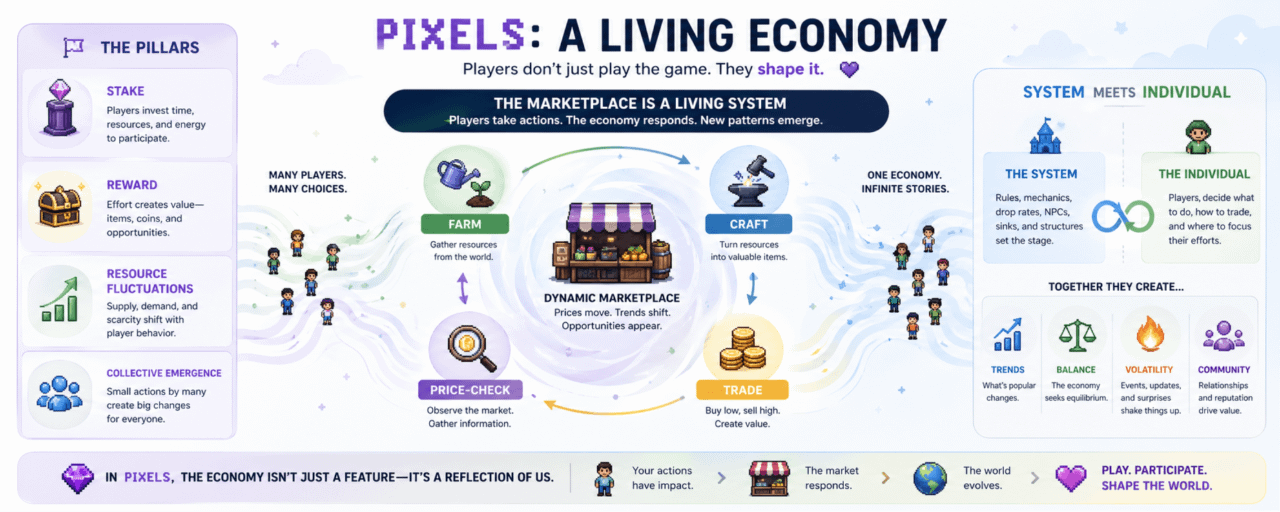
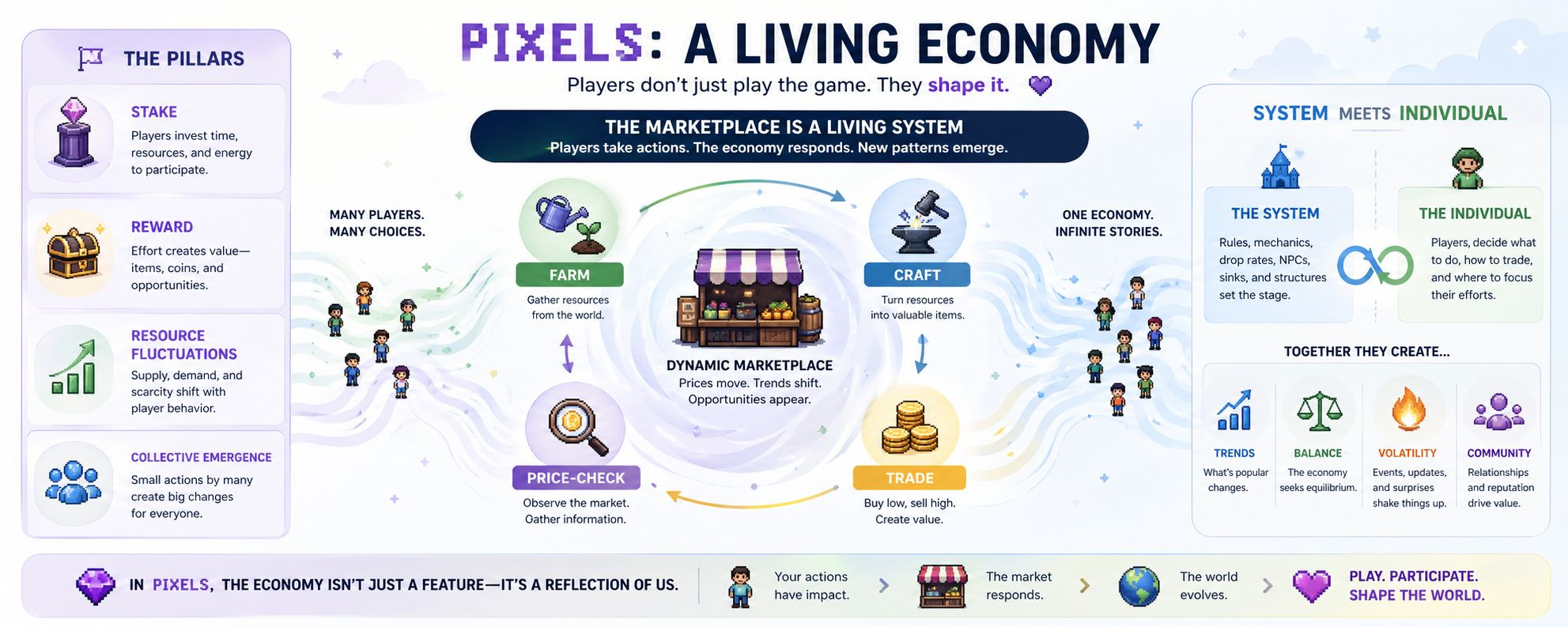
I was supposed to take a break from the game this weekend, but this morning I still opened Pixels just to quickly check the prices of a few resources because I farmed quite a bit of wood and stone the other day. But the more I looked at the marketplace, the more I felt something was off. It wasn't like 'the game is fun' or 'the game is grinding well,' but rather like watching a self-running system, and I was just a small feedback point within it.
I used to think Pixels was just a simple Play to Earn game. Farm, craft, sell, and then optimize profits. This view is pretty common in crypto, where the game is just a layer of the earning loop. Those who optimize well win, and those who lag behind lose. Everything seems linear, almost like a performance equation.
But the more I play and observe closely, the more I start to see that assumption lacks an important layer. It's not just 'a game with an economy,' but more like an economic system birthed in the form of a game. And the difference lies in the fact that players no longer optimize towards a single goal, but are pulled by many small signals at once, sometimes making it unclear what is actually driving their decisions.
I've started compiling my gameplay sessions, marketplace behaviors, and feedback from other players to see if this is a unique pattern or a structure repeating across various observations.
If you look at it simply, everyone thinks the logic will be similar to staking in blockchain: rewards shape validator behavior. But with Pixels, the reward is just a tiny part. The more important thing is the friction distributed across the entire system. It's not a big pull, but many small forces that make certain behaviors feel 'more natural' than others.
In some previous GameFi systems I've played, everything often followed a clear input-output: APR, reward curves, profit optimization. But Pixels doesn't operate along a straight line like that. Movement time, crafting delays, material chains, price volatility - no single factor is big enough to decide alone, but when stacked together, they create a form of behavior-navigating force that's hard to see if you separate each part.
In a few recent observation sessions, I've noticed something clear: the decision to farm or craft doesn't hold stable for long. It's not because players lack a plan, but because the system continuously creates small fluctuations that rewrite the plan right in the execution process.
What I've noticed most clearly isn't in the actions but in the state between actions. Players are constantly moving, waiting to craft, checking prices, or standing still for a few seconds before deciding their next step. It's not the game forcing them to do this, but the system makes the 'considering' state the default.
But the longer I observe, the more I see an inverse possibility. Maybe the system doesn't directly control behavior in the way I thought. Perhaps it's the thousands of players optimizing according to similar logics that actually create the structure I'm observing.
So what I call 'economic simulation' isn't a complete design but rather the result of behaviors repeating enough to stabilize into a system.
From that perspective, Pixels no longer resembles a game. It feels like a mini economic environment where players not only participate but continuously leave behavioral traces in the structure that is forming.
If you look at it more simply, it resembles an ecosystem without a center. Each player is a small branch, not seeing the whole picture, but when enough branches interact, the system starts to create its own direction. The flow of value doesn't follow design but rather goes where there's the least friction.
This makes me think of blockchain on another level. Validators aren't forced to behave according to a specific model, but the cost and reward create a stable behavior pattern that forms over time. Pixels is just a miniature version of that same mechanism, but it plays out at the player behavior level.
The most important point I've realized is that the boundary between system and behavior is no longer clear. It's not because they influence each other, but because they actually describe the same process, just from different observational angles.
What we call a system is just behavior that has repeated long enough to become a structure. And what we call behavior is always shaped by that very structure right as it unfolds.
They're not separate. They're the same thing looking at itself from two different time points.
Pixels, in that sense, is not a game. It's an economic simulation that is self-forming from the behaviors of the participants.
In crypto, sometimes what's important is not the assets you hold. It's about which operational logic you're becoming a part of, even before you realize it.
