
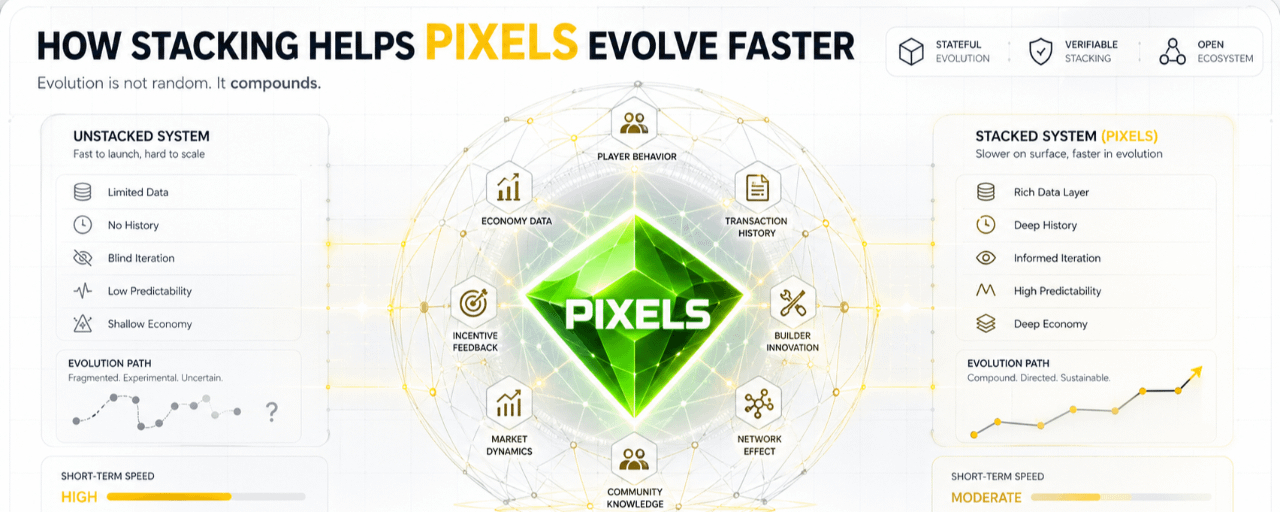
I think there’s a simple, almost mechanical way to understand this: the speed of a system’s evolution depends not only on how fast a team can build, but also on how much has already been stacked before. Evolution never starts from zero—it always happens on top of an existing foundation. The deeper and stronger that foundation is, the faster future progress can happen, or at least, the more possible paths the system can take.
From this perspective, Pixels is no longer just a game being developed, but a system evolving from an accumulated state built over time. Once a system becomes sufficiently stacked, progress is no longer just about adding new features—it becomes about recombining, refining, and expanding what already exists.
I see this as a kind of “stateful evolution.” Every update begins from a system that already contains valuable information: player behavior, capital movement, incentive responses, and economic balance. Because this state already exists, experimentation becomes more efficient. Each new iteration benefits from clearer feedback because it is built on known behavior instead of assumptions.
This is where the difference between Pixels and newer competitors becomes clear. A system that hasn’t stacked much can move quickly on the surface—it can launch faster, pivot harder, and experiment more aggressively. But it often lacks depth. Without enough historical data and behavioral memory, every change becomes closer to guesswork.
Pixels, on the other hand, may seem slower in certain areas because it has to maintain economic stability and protect balance. But that slower pace comes with an advantage: it doesn’t need to guess as much. Its own history acts like a living dataset.
This logic applies in both web2 and web3. Large web2 companies often evolve faster not because they build better from day one, but because they have accumulated years of user behavior, operational knowledge, and network effects. The difference in on-chain systems is that much of this stacking is public and verifiable.
That changes everything. It’s not only the internal team learning from the system—the entire ecosystem can read it. Players, builders, and even speculators can observe, react, and build on top of the same shared state. Evolution becomes less of a closed internal loop and more of an open-ended process.
But there is an important nuance here: stacking doesn’t only make evolution faster, it also shapes the direction of that evolution. Systems naturally move along paths that previous stacking has already reinforced. If players are used to certain incentives, if behaviors have formed around the economy, then future changes must fit within that structure to some degree.
This creates both an advantage and a limitation. The advantage is obvious—you don’t need to rebuild from scratch. The limitation is that you can’t change too aggressively without breaking trust or destabilizing the system.
In a less stacked system, you can rewrite everything overnight. In a heavily stacked one, every change must be incremental and aligned with the current state. It may appear slower from the outside, but over time it creates a stronger and more stable trajectory.
This is where many people misunderstand competition. They see new projects launching features faster and assume they are evolving faster. But if those experiments are not connected to a stacked foundation, they remain isolated experiments rather than compounding advantages.
In Pixels, even small changes become part of the system’s memory. They influence every future decision. This is a form of compounding—not compounding of capital, but compounding of system knowledge.
And this knowledge doesn’t belong only to the team. Players learn how to optimize, collaborate, and adapt. Builders learn where new layers create the most value. Over time, the entire ecosystem becomes smarter together.
The real question is whether stacking creates speed or simply creates inertia. A system that becomes too stacked can also become heavy, much like legacy systems in web2 that are difficult to change.
This is where truth and verification become critical. In an on-chain system, evolution is not just a product decision—it is also a trust decision. If changes break what users have already built around, the reaction can be strong.
So the real challenge is not just evolving quickly, but evolving without breaking continuity. It means preserving what has already been stacked while still creating room for new directions.
This may be the real long-term advantage for Pixels. They do not necessarily need to be the fastest at experimentation. If they can accumulate the deepest and most meaningful stacking, they may evolve in ways competitors struggle to replicate.
But the core question remains: does stacking always create an advantage, or does it eventually become a burden? If Pixels keeps stacking more layers, are they building the strongest possible foundation for future evolution—or slowly limiting themselves to the paths their past has already defined?