
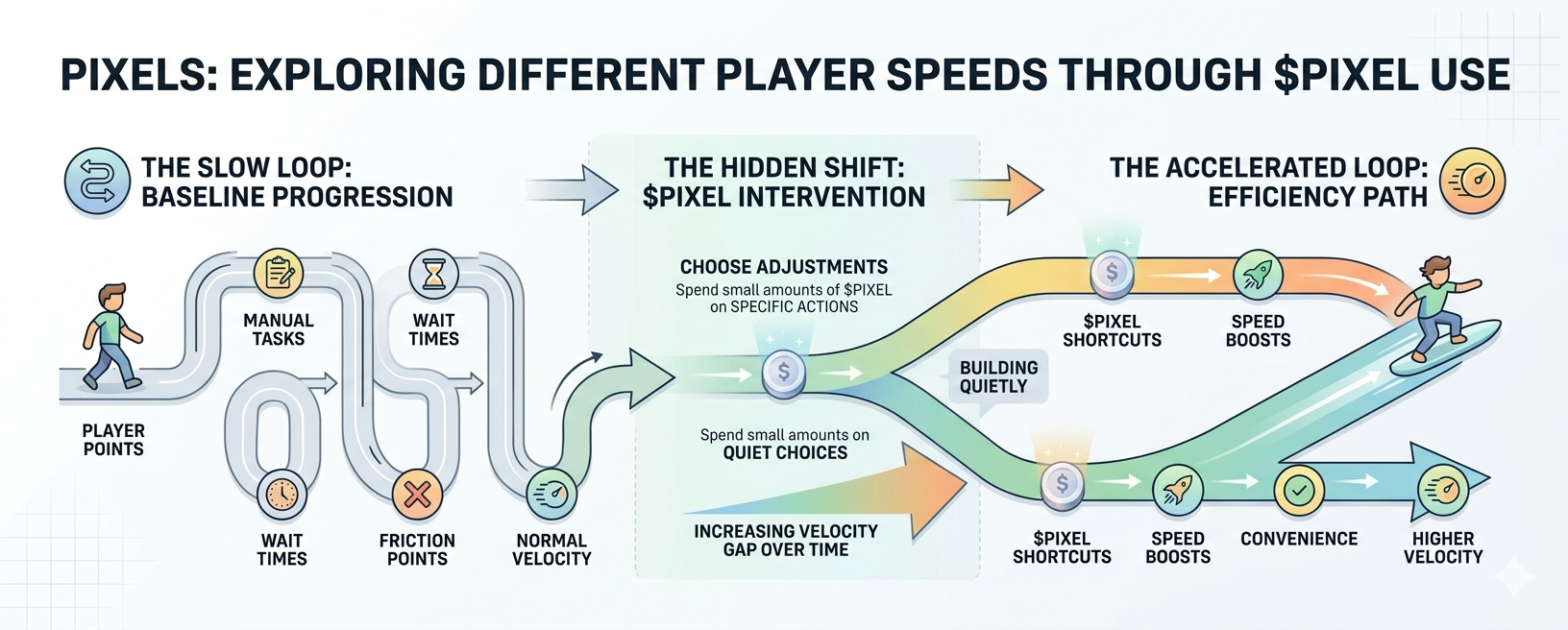

At first glance, Pixels feels easy going. Almost too easy. That is usually how these systems work. They look soft on the surface, but the pressure is still there. It is just hidden in the way progress is paced.
That is what makes farming games interesting. They rarely force you into anything. You log in, do a few tasks, wait, come back later. It feels calm. But if you pay attention, you start to notice that not everyone is moving at the same speed.
Pixels gives off that same feeling. It looks slow, simple, and relaxed. For a while, I thought that was the whole idea. A cleaner, quieter version of play-to-earn. But the more you watch how players actually move through it, the more you realize the experience is not as equal as it first appears.
Some players stay in the slow lane. Others do not.
And the difference is not always about skill or grind. A lot of it seems tied to how they use $PIXEL. Not in a loud or obvious way. That is part of why it is easy to miss. The token is not sitting in your face at every step. It shows up at specific points, and those points matter more than they first seem.
That is where the real shift happens.
Most people would describe it as a premium currency. Something for upgrades, convenience, or small boosts. That is true, but it does not fully explain the role it plays. $PIXEL does not just make things faster. It seems to decide which parts of the game can be sped up at all.
That is a bigger deal.
Think about a new player going through the early game. They do everything by hand. Slow, normal, nothing unusual. That is how the game is built to feel. But then compare that to someone making selective use of $PIXEL. Not huge spending. Just small choices. A shortcut here. A faster action there. The gap does not open all at once. It builds quietly. Then it stays.
And once it stays, it grows.
That is what makes it feel less like simple game design and more like a system built around different speeds. The same actions do not always lead to the same results. Not because one player is better, but because the structure lets one player move through friction more easily than another.
It is a bit like priority access in online services. Everyone can use it, but not everyone gets the same experience. At first, the difference is easy to ignore. The baseline still works. But once you compare paths side by side, the gap becomes obvious.
Pixels seems to work in a similar way. It does not block anyone. It does not say no. It just quietly asks how much time you are willing to spend going the slow way.
That changes behavior.
The question is no longer just whether to play. It becomes whether to stay in the slower loop or adjust it. And once players start making those adjustments, even small ones, they tend to keep doing it. Not in a dramatic way. Just enough to make things feel smoother, less wasteful, less annoying. That is probably where a lot of the demand comes from. Not from huge purchases, but from repeated small decisions.
Still, there is something a little uncomfortable about that.
Not because it is automatically bad. Just because it changes the shape of the experience. A system that quietly favors smoother progression is also shaping who feels fine staying in it long term. Some players will not care. Others will feel the difference without being able to explain it. And over time, that matters.
It can affect retention in ways that do not show up right away.
There is also a risk here. If too many parts of the game start depending on $PIXEL for efficiency, then the whole model changes. It stops feeling like optional acceleration and starts feeling like the expected route. That is where things get tricky.
At the same time, it is easy to see why this approach exists. If everything is perfectly equal, progress can feel slow and flat. If everything is pay-driven, the game breaks. So the middle ground is where most systems end up. The base experience stays open, but certain players move through it with less friction.
The real question is whether that balance holds.
What stands out most is how quiet the whole thing is. There is no giant banner telling you that this is the advantage layer. You just notice patterns. Some players stay ahead. Some loops feel slower unless you intervene. It is subtle, but it is there.
And once you see it, it is hard to ignore.
So the bigger question is not whether affects progress. It clearly does. The real question is what happens when a game starts deciding, even in small ways, whose time moves faster.