
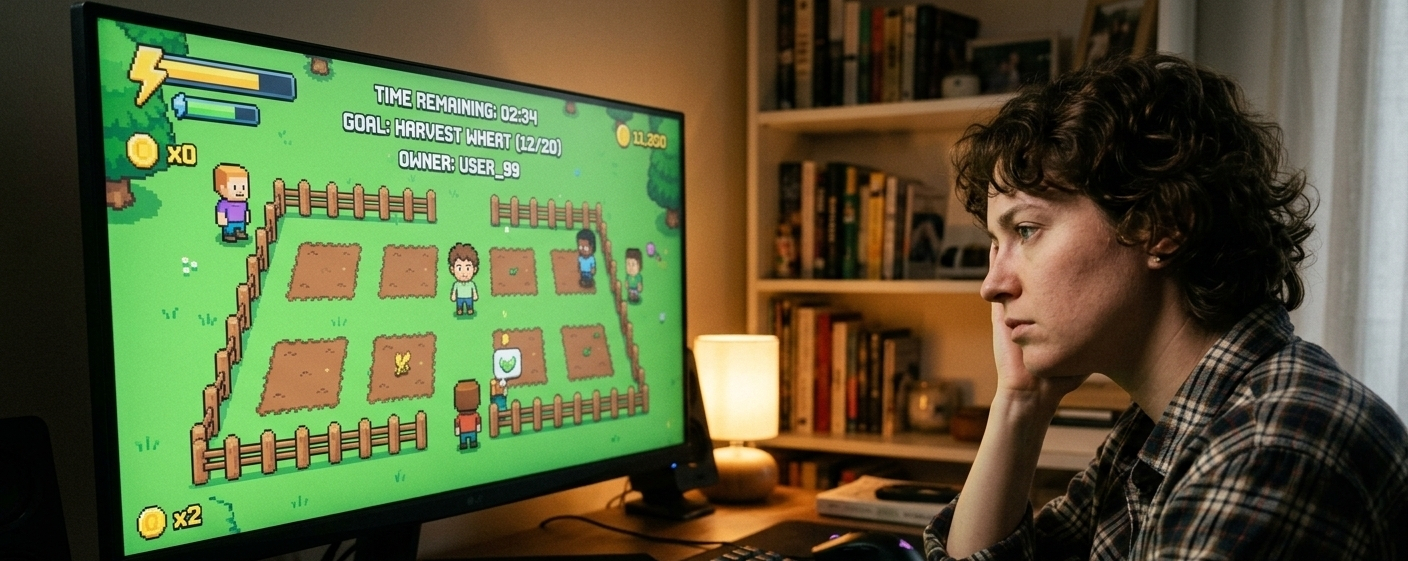
Why do so many blockchain games slowly stop feeling like games?
I didn’t think much about that at first. When I opened Pixels for the first time, it felt easy. I could move around, plant crops, gather things, and just exist in the world without overthinking it. There was no pressure to understand tokens or systems right away. It felt closer to a normal game than most things I had seen in crypto.
But the longer I stayed, the more I started noticing a shift. Not a dramatic one, just something subtle. I stopped asking “what do I feel like doing?” and started thinking “what should I do before I log off?”
That shift is not really about Pixels alone. It points to a bigger problem that crypto games have been trying to solve for a long time. The idea sounds simple: give players ownership, let them earn, and make their time meaningful. But in practice, those goals don’t always sit well together.
I remember earlier blockchain games that focused heavily on earning. Everything revolved around rewards. You played because there was something to gain, not necessarily because the game itself pulled you in. And for a while, that worked. People showed up.
But those systems always felt fragile. They depended on new people joining, on rewards staying attractive, on everything continuing to grow. Once that slowed down, the experience started to feel repetitive and empty. It became hard to ignore that the gameplay itself wasn’t enough.
Pixels feels like it is trying to step away from that, at least a little. When I play, I’m not immediately thinking about extracting value. I’m farming, crafting, walking around, seeing other players. It feels softer, more grounded.
What stood out to me is how easy it is to enter. I didn’t need to buy anything to understand the game. I could just start. That alone already separates it from a lot of earlier projects where you had to commit before you even knew what you were getting into.
But even with that softer entry, the system underneath is still there. I start to notice different layers. There’s the simple loop of playing, and then there’s the deeper structure tied to ownership and value. It doesn’t hit all at once. It slowly reveals itself.
Land is where I really start to feel it. Some players own parts of the world, and over time I realize that activity happening there connects back to them. That’s interesting, but it also changes how I see my own role. I’m not just playing in a neutral space anymore.
I don’t think that’s inherently bad. It creates connections between players. But it also creates differences. Some people are clearly operating with more leverage than others. And even if that gap isn’t obvious at the start, it becomes more noticeable the longer I stay.
Then there’s the way time works in the game. I can’t just sit and play endlessly. There are limits, energy systems, cooldowns. At first, I didn’t mind. It gave structure. It made things feel paced.
But after a while, it started to shape my behavior. I found myself checking in at certain times, doing specific tasks, then leaving. Not because I was deeply engaged, but because I didn’t want to fall behind. That feeling is hard to ignore once it sets in.
That’s when I start questioning what I’m actually doing. Am I playing because I enjoy it, or because the system is quietly nudging me to stay consistent?
The social side tries to pull things back toward something more natural. I see other players, shared spaces, small interactions. It gives the world a sense of life. It’s not just menus and mechanics.
But even there, I can feel how incentives shape things. When actions have value attached, I start thinking differently. I become more careful, more deliberate. I optimize without even realizing it. Exploration becomes secondary.
Ownership is another thing that feels different the more I think about it. Yes, assets are on-chain. In theory, they belong to me. But their meaning is still tied to the game existing and staying relevant. If that changes, ownership doesn’t disappear, but it does lose weight.
I don’t think Pixels ignores these issues. In some ways, it handles them better than most. It doesn’t overwhelm me early on. It gives me space to just play before asking for deeper engagement. That matters.
But it doesn’t fully escape the core tension either. It still tries to be a game and an economic system at the same time. And those two things keep pulling in slightly different directions.
When I think about who benefits, it feels layered. As a new player, I get accessibility. I can move in and out without much friction. But players with assets, especially land, seem to exist in a different version of the same world. Their experience is more structured, more connected to the system itself.
Over time, I can feel those paths separating. I can stay casual, treat it like something I visit occasionally. Or I can lean in, start tracking things, managing my time, paying attention to systems. Both options are there, but they don’t feel the same.
That’s why Pixels doesn’t feel like a clear answer to me. It feels more like a step in an ongoing process. It smooths out some of the rough edges of earlier crypto games, but it also shows how difficult it is to fully solve the underlying problem.
And maybe that’s the part I keep thinking about.
If I keep showing up not because I’m curious, but because I feel like I should, then at what point does playing quietly turn into maintaining something I didn’t realize I signed up for?
