
There’s a point in most games where you stop making decisions and start following routines.
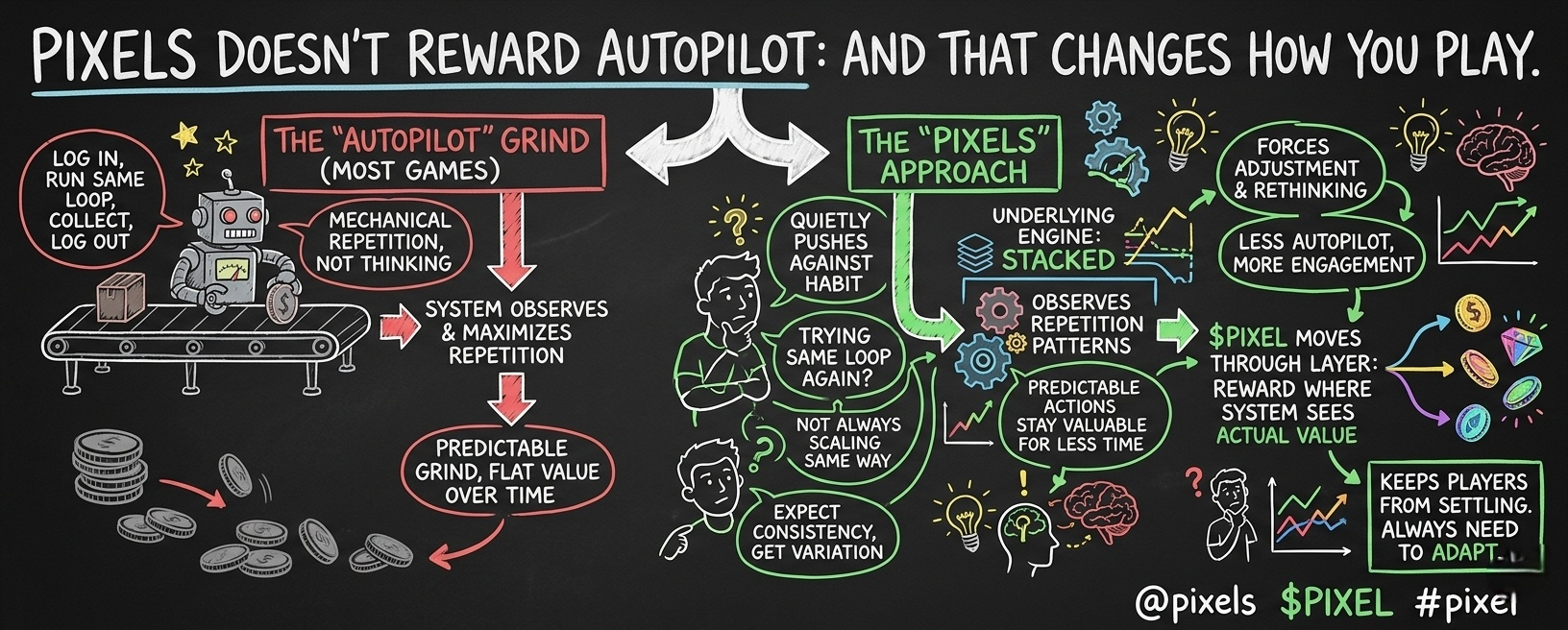
You log in, run the same loop, collect the same rewards, and log out. It works, but it gets mechanical. After a while, you’re not really thinking,you’re just repeating.
What I noticed in Pixels is that it quietly pushes against that habit.
The game doesn’t fully reward repetition the way you’d expect. If you try to run the exact same loop again and again, the outcome doesn’t always scale the same way. At first, that feels a bit off. You expect consistency, but instead you get variation.
Then it clicks.
The system isn’t designed to maximize repetition,it’s designed to observe it.
Stacked, which sits underneath all of this, seems to treat repeated behavior differently over time. Actions that look efficient on the surface don’t always stay valuable if they become too predictable. That forces you to adjust, even slightly, instead of locking into autopilot.
It creates a different kind of engagement.
You start paying attention again. Small decisions matter more because you can’t fully rely on a fixed path. Even minor changes in how you approach things can shift outcomes, and that keeps the experience from flattening out.
What’s interesting is that this doesn’t feel restrictive.
You’re not being blocked from doing something,you’re just not being overly rewarded for doing the same thing endlessly. That’s a subtle distinction, but it changes how the system feels. Less like a grind, more like something that reacts.
PIXEL moves through this layer in a way that reflects those shifts. It’s not tied to mindless repetition, it shows up where the system sees actual value over time.
That design choice does something important.
It keeps players from settling too early. You don’t reach a point where everything becomes automatic. There’s always a small need to adapt, to rethink what you’re doing.
And in a space where most systems become predictable very quickly, that alone makes a noticeable difference.