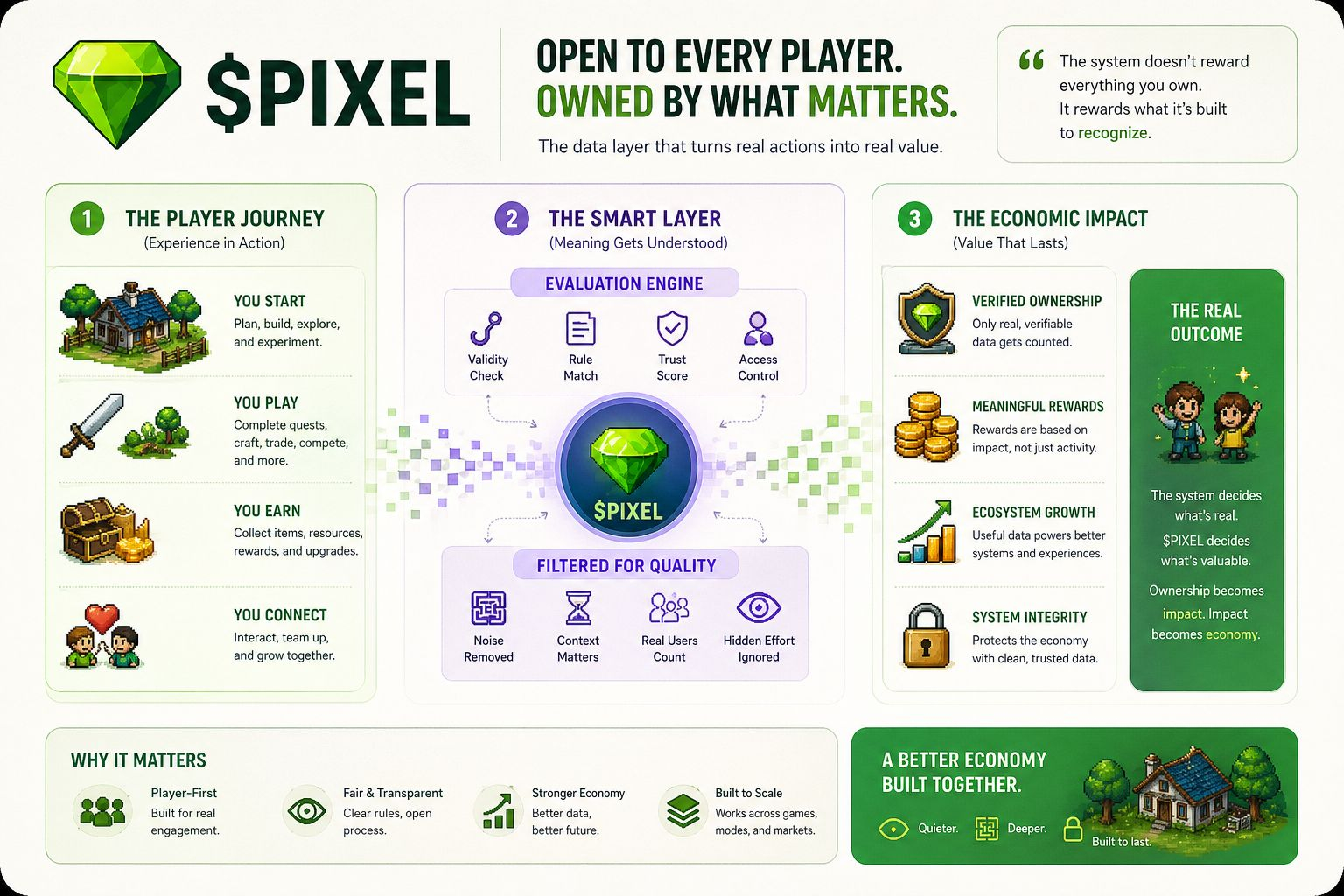
For a long time, I treated “ownership” in Pixels as something simple.
If you earned it, held it, or had it in your wallet — it was yours. That felt obvious. Stable. Almost unquestionable.
But the more I sit with the system, the less certain that feels.
Because a smaller question keeps coming back:
Which version of ownership actually matters to the system?
---
Ownership Isn’t What You Hold — It’s What the System Can Read
On the surface, Pixels looks fully player-owned.
You have assets. Land. Progression. Items. Everything feels like it belongs to you.
But the system doesn’t operate on your full experience.
It doesn’t see the effort, the process, or the messy path that led you there.
It sees something else:
A filtered version.
A clean, structured state — something that fits into its logic.
And once you notice that, the idea of ownership starts to shift.
---
Compression Changes Meaning
We often assume that once something is recorded — on-chain or in-game — it carries its full story with it.
But systems don’t work that way.
They compress.
They simplify.
They turn complex sequences into stable outputs… and discard everything else.
The result?
The object remains.
But the process that created it disappears.
---
Where Pixel Actually Fits
At first, Pixel looks like a reward layer.
But it might be doing something more subtle.
Not rewarding ownership —
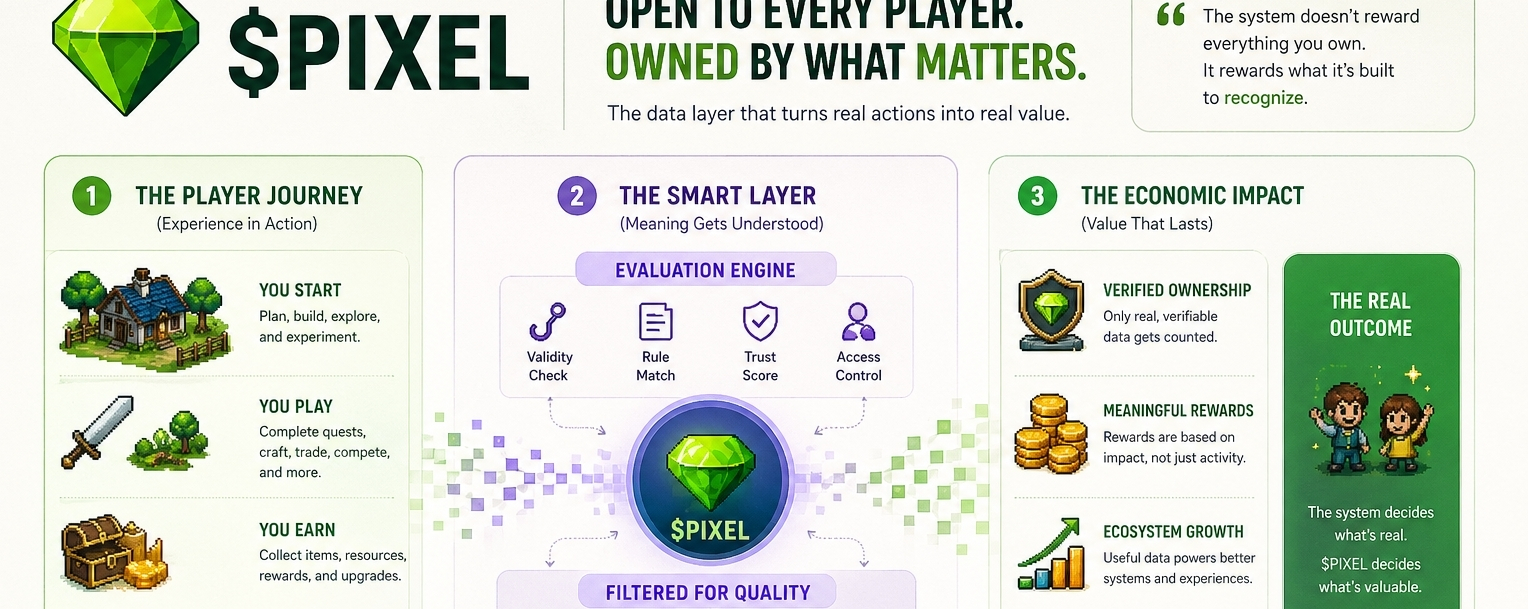
But filtering which ownership survives long enough to matter.
Because not every state makes it through.
Only the ones that are:
clear
repeatable
easy to evaluate
Everything else gets dropped before it ever reaches the reward layer.
---
Two Versions of Ownership Exist at Once
This creates a split:
1. Experienced ownership — what the player lives through
2. Recognized ownership — what the system can process
And those two are not the same.
A player might spend time experimenting, optimizing, even failing — all of which feels meaningful.
But if the final result doesn’t match what the system can interpret…
It’s as if that effort never existed.
---
The Role of Legibility
This is where things get interesting.
Players don’t just optimize outcomes.
They start optimizing for legibility.
For actions that the system can easily recognize and reward.
Not necessarily better gameplay.
Just cleaner signals.
And over time, behavior bends around that.
---
The Hidden Control Layer
This shifts where control actually sits.
Not in the wallet.
Not in the assets themselves.
But in the filters:
the schema
the evaluation logic
the checkpoints where reality gets translated into usable input
That’s where ownership gets defined.
Because once something passes that layer, it becomes part of the system’s memory.
Everything else fades out.
---
Why This Matters
This doesn’t necessarily mean the system is flawed.
All systems need boundaries. They can’t process everything.
But those boundaries aren’t neutral.
They decide:
what gets rewarded
what gets remembered
what becomes “real” inside the economy
And that shapes behavior more than most players realize.
---
A Different Way to Think About Pixels
Maybe Pixels isn’t just a player-owned system.
Maybe it’s a selectively legible system.
Where ownership exists broadly…
But only a narrow slice of it becomes economically visible.
---
Final Thought
If that’s true, then most of what players “own” might sit just outside the layer that actually matters.
Present — but not recognized.
Real — but not usable.
And the real role of $PIXEL might not be to reward ownership itself…
But to decide which ownership is allowed to count.