
I did not take Pixels seriously at first.
That is the honest truth. When I first saw it, it felt like another Web3 game trying to find space in a market already full of tokens, farming loops, digital land, and big promises. Pixels had the familiar pieces too. A casual social game, an open world, farming, exploration, creation, Ronin Network, and the PIXEL token sitting around the center of it all.
Usually, that is enough for me to move on.
Not because the idea is bad, but because crypto has made everything feel repetitive. Every project says it is building a world. Every game says it is creating ownership. Every token says it will give users more value. After hearing that for years, you stop reacting to the words. You start looking for what is underneath them.
Pixels did not feel special immediately. It felt simple. Maybe too simple. But the more I looked at it, the more that simplicity started to feel like the point.
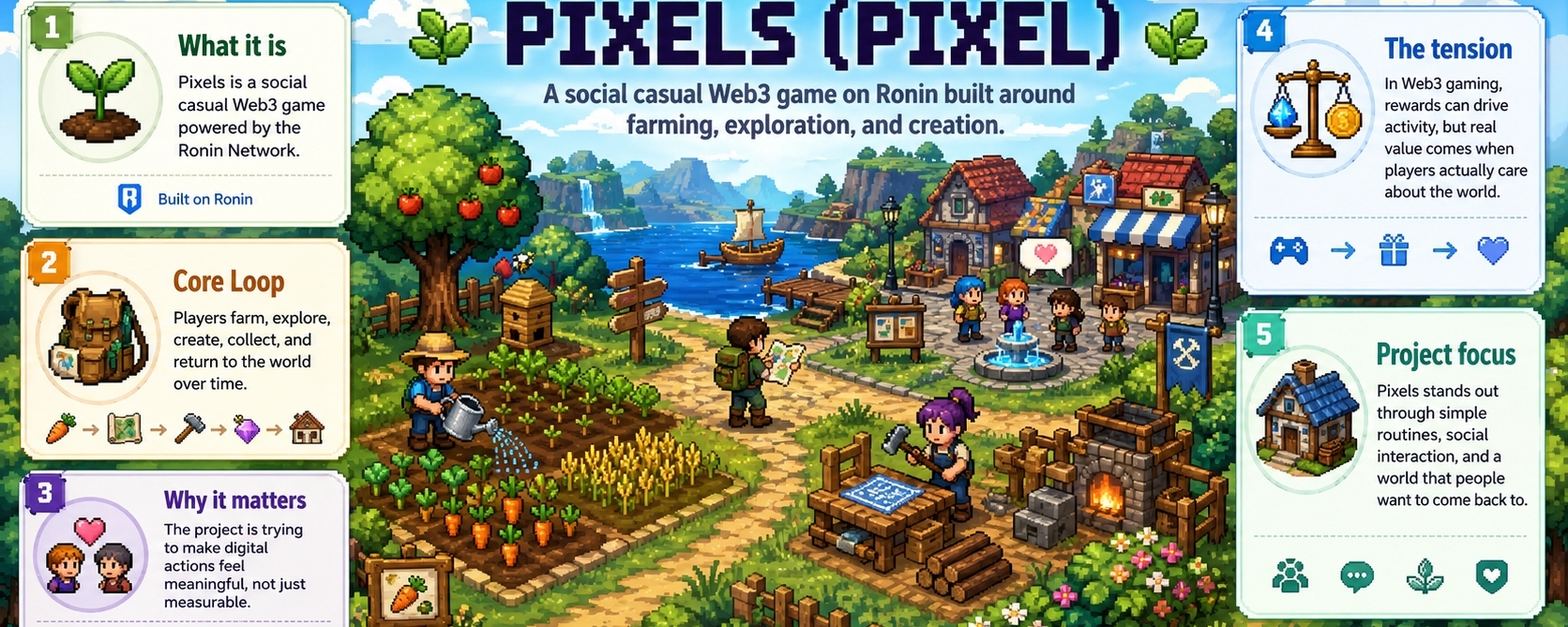
Pixels is not trying to impress with a complicated surface. It is built around small actions. Farming, gathering, building, exploring, meeting people, returning to the same world again. These are not loud ideas, but they are the kind of actions that actually make a game feel alive over time. A player does not build attachment through one big announcement. They build it by coming back, doing small things, seeing progress, and feeling like their time did not disappear.
That is where Pixels becomes more interesting.
The real question around Pixels is not only what the game does. The bigger question is why people return to it. In crypto, activity is easy to create for a while. Rewards can bring people in. Tokens can create movement. Airdrops can make users click. But none of that automatically means people care. A wallet interaction is not the same as loyalty. A transaction is not the same as trust. A reward is not the same as meaning.
Pixels sits directly inside that tension.
It has the Web3 layer, but it also has a very human loop. Plant something. Build something. collect something. Talk to someone. Come back later. Do it again. That kind of loop looks small from the outside, but small actions can become powerful when they repeat long enough. They become habit. Habit can become attachment. Attachment is what most crypto games never really manage to create.
That is why the project deserves a closer look.
Not because it has solved everything. It has not. The danger is still there. A game with a token can easily become too focused on earning. Players can slowly turn into farmers of rewards. The world can become secondary to the economy. That is the risk every Web3 game carries, and Pixels is not free from it.
But Pixels feels more grounded than many projects because it starts from something people already understand. A place. A routine. A small world where actions leave a mark. It does not need to sound massive to matter. Sometimes the strongest test for a digital world is simple: do people want to come back when the first excitement fades?
That is the part I keep thinking about.
Crypto often talks about ownership as if ownership alone is enough. But it is not. Owning a digital item does not make someone care about it. Holding a token does not make someone feel connected to a game. True value comes when the item, the action, and the experience all connect together. Pixels seems to be working toward that connection.
The project feels focused on turning digital participation into something more lasting. Not just clicking for rewards. Not just playing for speculation. More like building a record of presence inside a world. That is a difficult thing to get right, but it is also one of the most important problems in Web3 gaming.
Because if a game cannot make people care, the economy will not save it.
Pixels has a chance because its foundation is easy to understand. It does not ask users to learn something heavy before they can participate. It gives them familiar actions and then adds ownership, community, and token value around those actions. That makes the Web3 side feel less forced. The blockchain layer is there, but the game still needs to feel like a game first.
That matters.
A lot of Web3 projects forget the human part. They build the economy before they build the reason to stay. Pixels feels more interesting because the project is trying to create a world where the reason to stay is not only financial. It is social. It is routine. It is progress. It is the quiet feeling of having something to return to.
I still do not see Pixels as something that should be overhyped. That would miss the point. The project is more interesting when it is understood calmly. It is not perfect, and it still has to prove that its world can stay meaningful beyond market cycles. But it does feel like one of the cleaner attempts to make Web3 gaming feel less like a transaction and more like a place.
That is the shift for me.
At first, Pixels looked like another crypto game.
Now it feels like a project circling a much bigger question: can digital ownership make online worlds feel more meaningful without turning every action into work?
I do not think that question has an easy answer. But Pixels is one of the projects actually living inside it. And sometimes that is enough reason to keep watching.