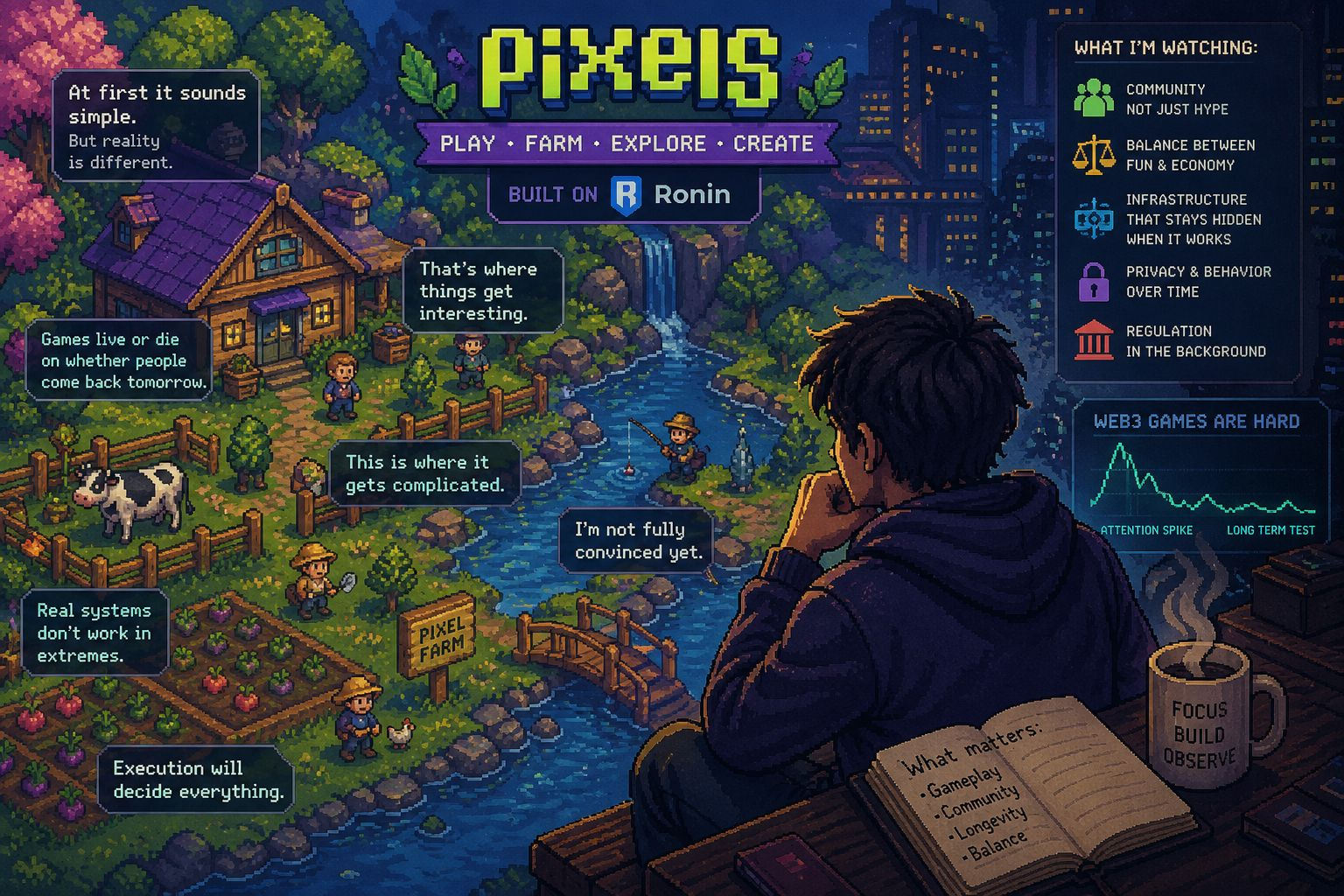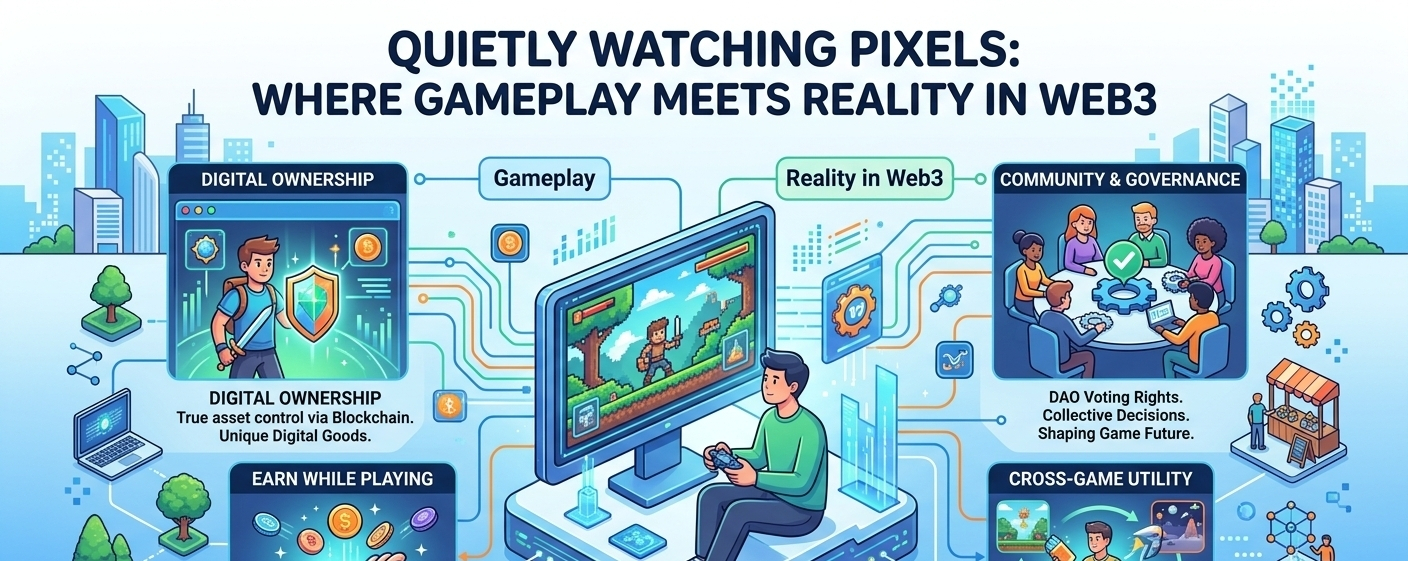
I'm watching Pixels from the edge of the room, and what keeps catching my attention is not the pitch, but the mood around it. People talk about it like it is a game, which it is, but they also talk about it like it is a test case, a signal, a place where Web3 either feels human or falls back into its usual awkwardness. That alone makes me careful. In this space, the distance between something that feels alive and something that is just being circulated is usually very small. Pixels sits right in that space, and I keep looking at it with the kind of attention you give something that might be more important than it first appears.
At first it sounds simple. A social casual game on Ronin, with farming, exploration, and creation at the center. That description is clean enough that it almost hides the hard part. Games like this do not live or die on the promise of owning assets or moving on-chain activity around. They live or die on whether people actually want to come back tomorrow. That is where things get interesting. The blockchain layer may be the reason the project gets noticed, but the actual experience still has to survive the oldest test in software: whether it feels worth opening twice. I’m not fully convinced yet that most Web3 projects understand how unforgiving that test is.
Pixels has always felt like part of a broader correction happening in the industry. For a while, a lot of crypto projects behaved as if the chain itself was enough to create interest. That phase left a lot of wreckage behind. Users got tired, capital got cautious, and the language got softer because the reality got harsher. In that context, a game like Pixels is more interesting than a lot of louder projects because it is not pretending that blockchain alone is the product. It seems to understand that the product has to work as a game first, and only then as a Web3 system. Real systems don’t work in extremes. They do not become useful just because they are decentralized, and they do not become durable just because they are fun for a week.
I keep coming back to this idea that the strongest Web3 projects are often the ones that look the least ideological from the outside. That sounds counterintuitive in a space built on strong opinions. But the projects that last tend to make compromises that purists dislike. They hide complexity, reduce friction, and try to fit into habits that users already have. Pixels feels like it belongs in that category. It is not trying to win by being the most radical thing in the room. It is trying to create a loop, a place, a rhythm. That’s where the real question starts for me: whether that rhythm can survive contact with token incentives, speculative attention, and the usual cycle of player behavior that turns every promising social game into a farm for returns.
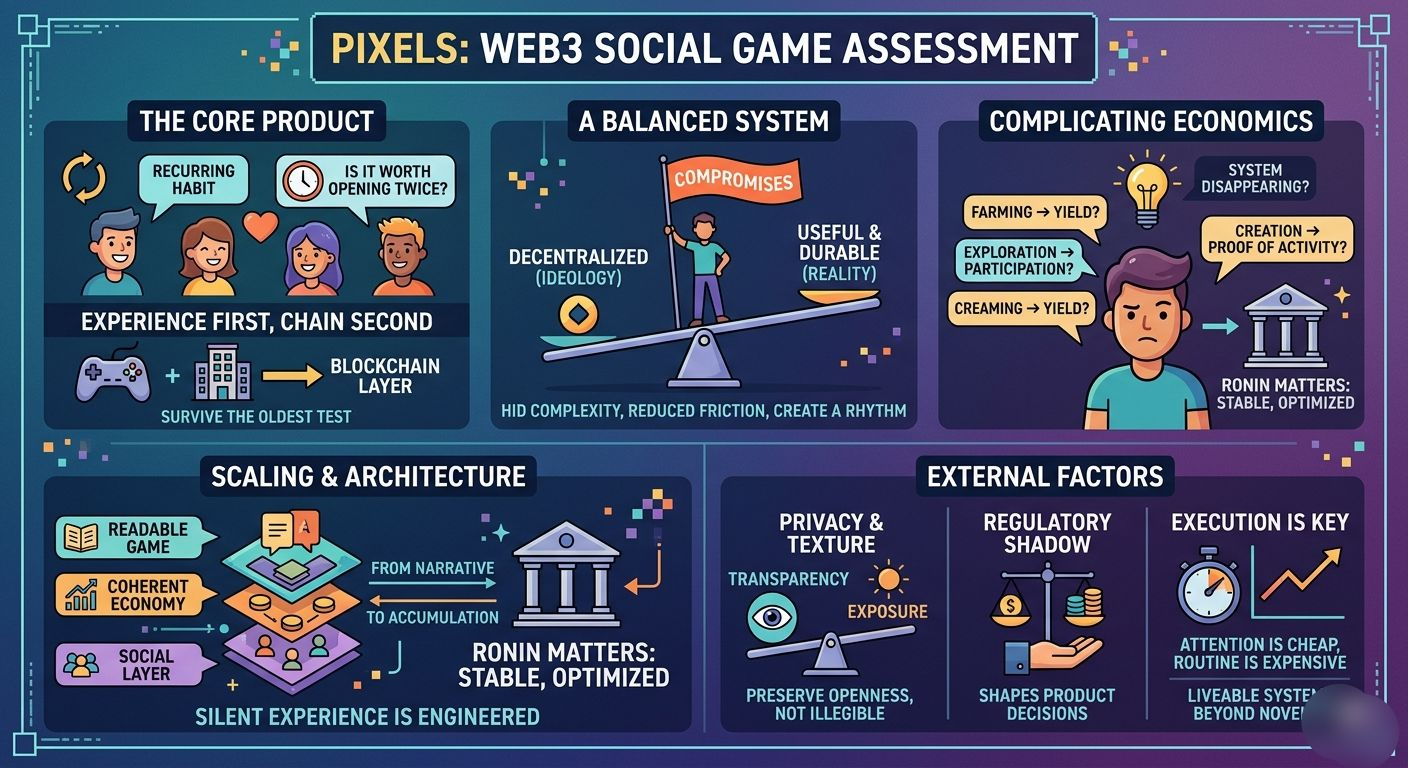
This is where it gets complicated. Social games are supposed to feel light, but they become heavy very quickly when economics get involved. The moment a game exists inside a crypto environment, every action can acquire a second meaning. Farming becomes yield-adjacent. Exploration becomes participation. Creation becomes proof of activity. That can be powerful, but it can also be exhausting. A game should not feel like it is constantly explaining itself to the player. And yet Web3 games often do exactly that. They make the user aware of the system at every step, which is usually a sign that the system is not disappearing into the experience the way it should. Pixels seems aware of that tension, but awareness is not the same as resolution.
What I notice in projects like this is that they often succeed in the early phase because the market wants a narrative. Then the narrative fades, and the architecture gets tested. That is when scaling stops being an abstract word and turns into a design problem. Can the game remain readable as more people arrive? Can the economy stay coherent if participation changes shape? Can the social layer avoid becoming noisy or extractive? Can the chain support the experience without making it feel weighty? These are not glamorous questions, but they are the ones that matter after the conversations die down. A lot of blockchain projects are built for the announcement, not the accumulation.
Ronin matters here too, at least in the practical sense. In this kind of game, the underlying network is not a side note. It affects how the product breathes. If the network feels stable, narrow, and optimized for gaming behavior, that can help the game keep its identity. If not, the friction shows up in the exact moments that should feel invisible. I do not think users spend much time thinking about the chain when things are working. They only notice it when something slows down, becomes confusing, or feels like a compromise too many layers deep. That silent experience is hard to engineer, and it is usually where the difference between a decent project and a lasting one becomes obvious.
Privacy is another thing I keep circling back to, even in games that do not present themselves as privacy products. The more social and on-chain a system becomes, the more it reveals about behavior. That is not always a problem in the narrow technical sense, but it changes the emotional texture of participation. People say they want transparency until they realize transparency is also a form of exposure. In a game, that can matter more than people expect. A social casual game has to preserve enough openness to be social without making every move feel legible, persistent, and monetized. That balance is difficult. Most systems either overshare or hide too much. Very few feel natural.
And then there is the regulatory side, which no one likes talking about until they have to. The moment a project combines gameplay, token flows, digital ownership, and active participation, it stops being just entertainment in the eyes of many observers. Maybe not immediately, maybe not in the same way across every jurisdiction, but the pressure is there. That shapes product decisions even when teams try not to talk about it. It affects token design, reward structure, secondary-market behavior, and how much the project wants to foreground ownership versus usage. A project like Pixels does not get to ignore that. It has to make choices under the shadow of a landscape that can shift faster than product cycles usually allow.
I think that is why I am cautious about reading too much into surface-level engagement. In Web3, attention is cheap in the early days and expensive in the long run. A lot of projects can create a spike. Much fewer can create a routine. Pixels feels like it is trying to build a routine, and that is more respectable than chasing a spike, but it also means the bar is higher. Once people settle into a habit, they become brutally honest about whether the time they spend feels rewarding, social, and worth the friction. If the loop is thin, they leave. If the loop is compelling but unstable, they leave a little later. Execution will decide everything.
That is probably why I am not fully convinced yet, but not dismissive either. Pixels does not strike me as the kind of project that can be understood from a distance using the usual crypto vocabulary. The more interesting part is not whether it fits a narrative about gaming or DeFi or ownership. It is whether it can survive as a lived system, one that people enter for a casual reason and stay in because the world feels coherent enough to return to. That sounds small, but it is actually hard. Most blockchain projects never get past the novelty of participation. They confuse being accessible with being durable.
I keep seeing projects in this sector try to solve everything at once: user growth, asset ownership, token value, network effects, creator incentives, and governance. Pixels, at least from where I am standing, looks more modest than that. Modesty can be a strength. It leaves room for reality. It also leaves room for disappointment. That is the trade-off I respect most. A project that claims less has less to hide when the market changes its mind. A project that lets the experience speak first has a better chance of surviving the long, unglamorous part of adoption, where nobody is impressed and everyone is counting on the system to feel normal.
That normality is the hardest thing to build in crypto. Everyone talks about disruption, but users mostly want something that works without making them feel like they are participating in an experiment. Pixels seems to understand that at least in spirit. Whether it understands it deeply enough will only become clear with time, and time is usually less forgiving than the launch thread makes it sound. For now, I am just watching it the way I watch most serious projects in this space: not for the loudest moment, but for the quiet proof that the design holds when the attention does not.