
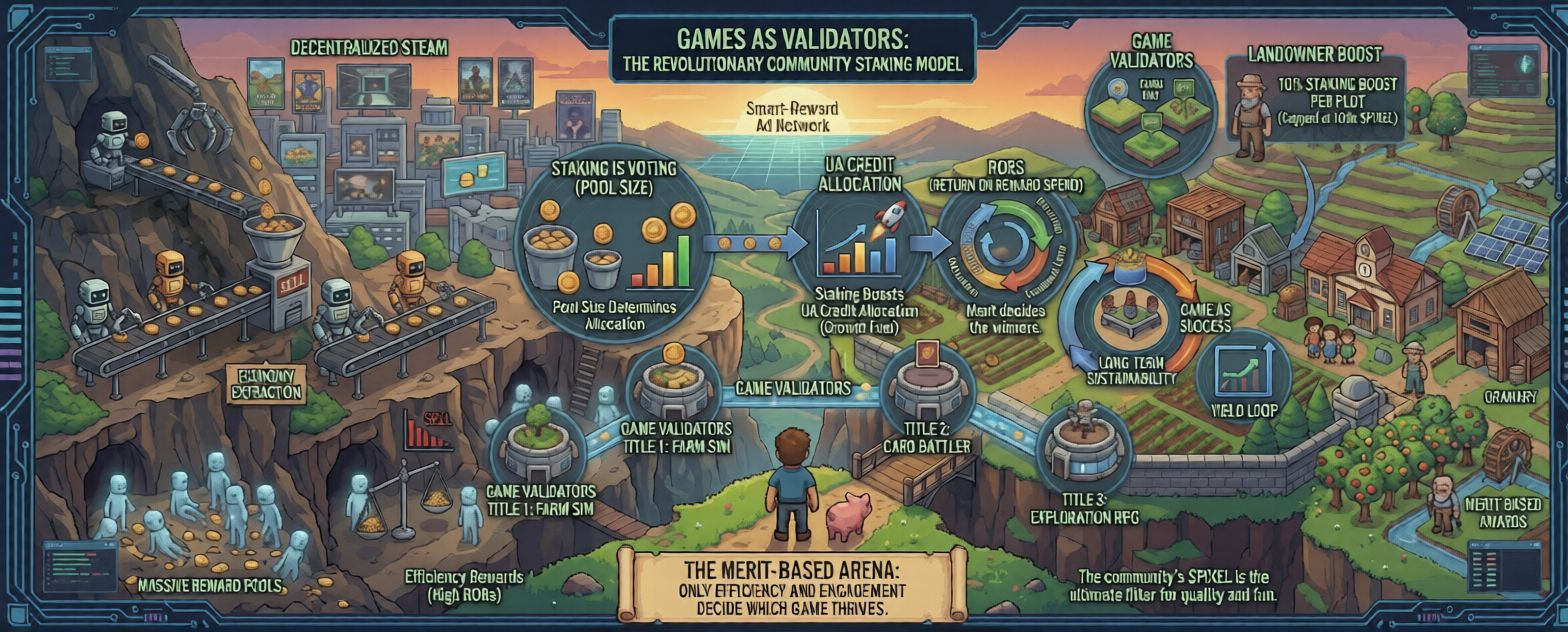
The traditional model of game publishing is being disrupted. In the new Pixels ecosystem, the power to decide which games thrive no longer rests with a central board of executives. Instead, it has shifted to the community through a revolutionary model: Games as Validators.
By turning every game into a "validator" and every pixel holder into a stakeholder, the ecosystem is creating a merit-based arena where only the most efficient and engaging titles survive.
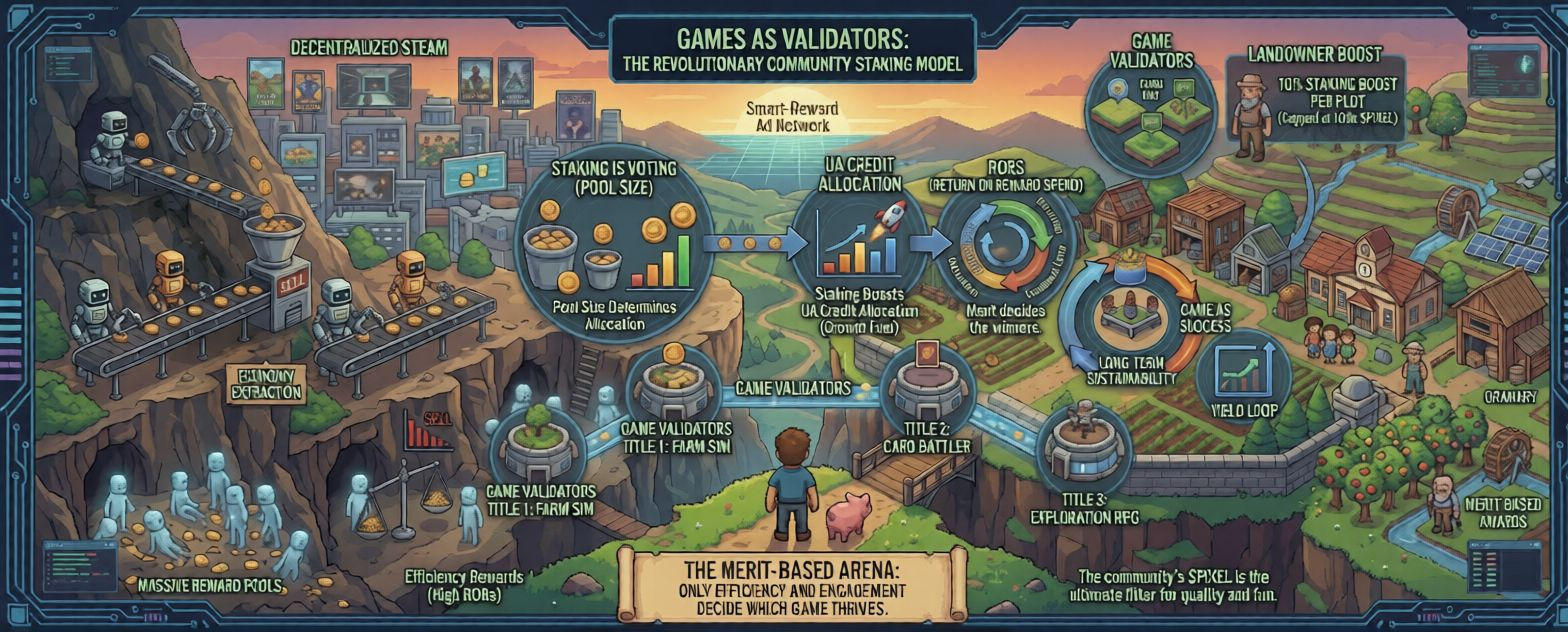
The New Role of a Game Validator
In a standard blockchain, validators secure the network by staking tokens. In the Pixels ecosystem, games act as validators for the Smart-Reward Ad Network.
Games are no longer just entertainment; they are competing entities that must prove their worth to attract pixel stakers. To do this, they must demonstrate high player retention, net-positive spending, and—most importantly—a high Return on Reward Spend (RORS).
How Community Staking Works
The process is decentralized and driven by the market. Here is how the community shapes the future of the platform:
1.Game Pools: Every game within the ecosystem has its own staking pool. Pixel holders can choose to stake their tokens into the pools of games they believe have the most potential.
2.Staking as Voting: Your stake is your vote. The larger the pool of a specific game, the more resources it is allocated from the central ecosystem.
3.UA Credit Allocation: The size of a game's staking pool directly determines its on-chain budget for User Acquisition (UA). A game with massive community backing gets more "credits" to attract new players, effectively fueling its own growth.
4.The Landowner Boost: Holders of Farm Land NFTs play a critical role here. Owning land provides a 10% staking power boost per plot (capped at 100k $PIXEL), giving long-term landowners a massive say in which games get published.
A Merit-Based Reward System
This "Validators" model solves one of the biggest problems in Web3 gaming: the distribution of rewards. Instead of a central entity guessing which game deserves funding, the data decides:
Efficiency Rewards: Games that generate high revenue relative to the rewards they distribute (high RORS) become more attractive to stakers.
The Yield Loop: When a game succeeds, stakers earn a portion of the value generated. This creates a feedback loop where the community is financially incentivized to support the highest-quality games.
Preventing "Vaporware": Since UA credits are tied to active staking and performance data, games that don't deliver fun or sustainable economics will see their pools shrink, naturally reallocating resources to better titles.
The Future: A Decentralized Steam
By moving through the phased rollout—from fixed monthly distributions to open, dynamic pools—Pixels is building a decentralized version of a platform like Steam. In this version, the players aren't just consumers; they are the curators and the financiers.
Games as Validators ensures that the next big Web3 title isn't chosen in a boardroom—it's chosen on-chain by the people who actually play it. In this new meta, the community’s pixel is the ultimate filter for quality, susta inability, and fun.
