
I keep looking at projects like PIXEL with a kind of quiet patience that only comes after spending too much time around crypto. Not excitement, not dismissal either—just that familiar pause where you’ve seen enough cycles to know how quickly things can sound important and then disappear. Every few months, there’s a new narrative that takes over timelines. It feels urgent, transformative, almost inevitable… until it isn’t. Then it fades, replaced by the next idea that promises to fix everything the last one didn’t.
PIXEL landed on my radar in that same way. At first glance, it didn’t feel very different. Another token, another system, another attempt to wrap something meaningful inside a tradable asset. Crypto has a way of making everything look like an opportunity before it proves it’s actually useful. So the instinct is to step back a bit and not get pulled in too quickly.
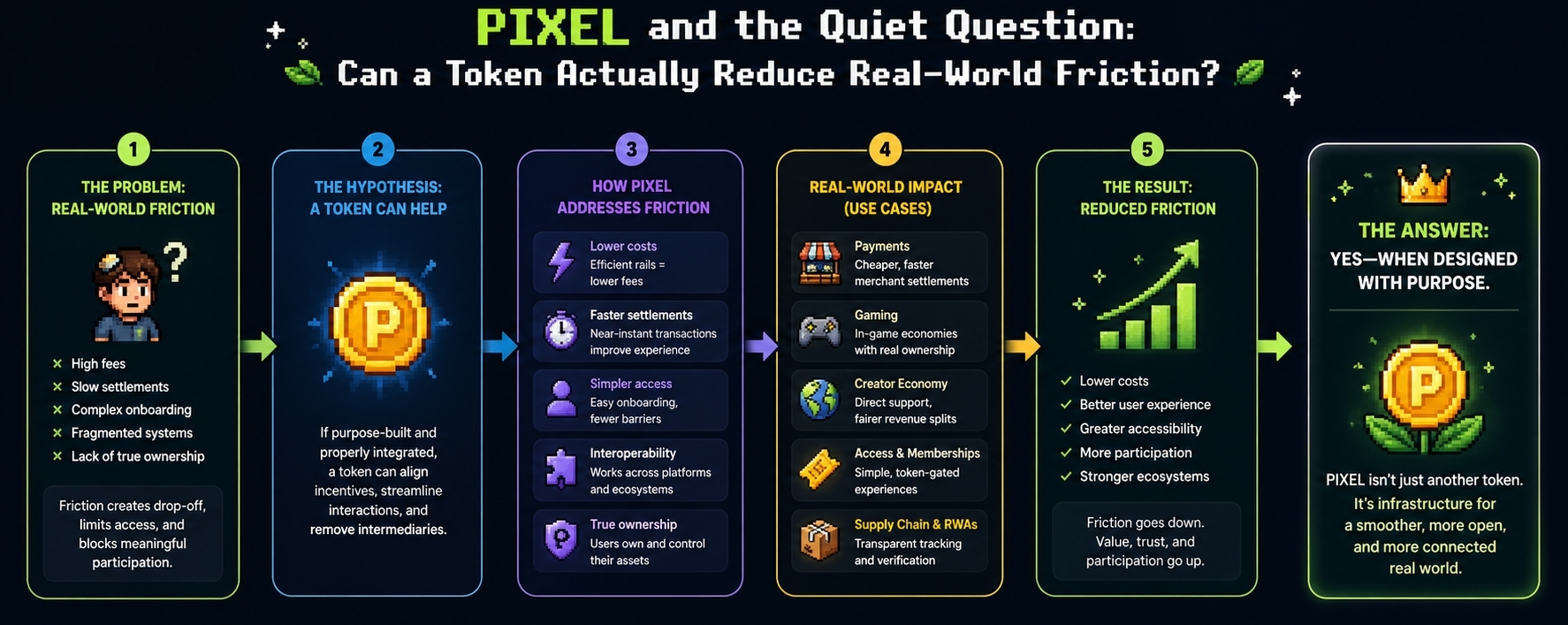
But after sitting with it for a while, there’s something about the idea that sticks. The way I understand it, PIXEL isn’t just trying to exist as a token for speculation—it’s trying to act like a kind of shortcut. Not in a flashy sense, but in a practical one. Almost like holding it could give someone a way to move through systems with less friction, skip certain constraints, or access things that would otherwise take longer or be harder to reach. It’s less about “changing the world” and more about quietly adjusting how things flow.
That’s where it gets interesting, at least in theory. Because if a token actually becomes part of how decisions are made or how access is granted, then it stops being just another digital asset sitting on an exchange. It starts to feel more like a tool. And tools, when they work, tend to stick around longer than narratives.
Still, this is where the gap usually shows up. Crypto moves quickly—ideas spread fast, communities form overnight, expectations build almost instantly. But the real world doesn’t behave like that. Systems that matter are slow, often resistant, and full of small complications that don’t show up in early discussions. Getting something like PIXEL to actually function in those environments is a very different challenge than launching it.
There’s also the question that never really goes away: will people outside of crypto care? It’s one thing for a concept to make sense within this space, where tokens and access layers feel natural. It’s another thing entirely for someone in a traditional system to change how they operate just to accommodate it. That’s where many projects lose momentum—not because the idea is wrong, but because adoption asks too much, too quickly.
So I find myself in that middle ground again. PIXEL doesn’t feel like empty noise, which already puts it ahead of a lot of things. But it also hasn’t proven that it can bridge the distance between a good idea and a working reality. And that distance, in crypto, is where most things quietly stall.
Maybe it finds its place over time. Maybe it becomes one of those small, functional pieces that actually get used instead of just talked about. Or maybe it fades into the background like so many others before it. Either way, it’s at least pointing toward something real—the friction between how fast crypto wants to move and how slowly the rest of the world actually changes. And in a space full of loud promises, even that feels worth paying attention to.