
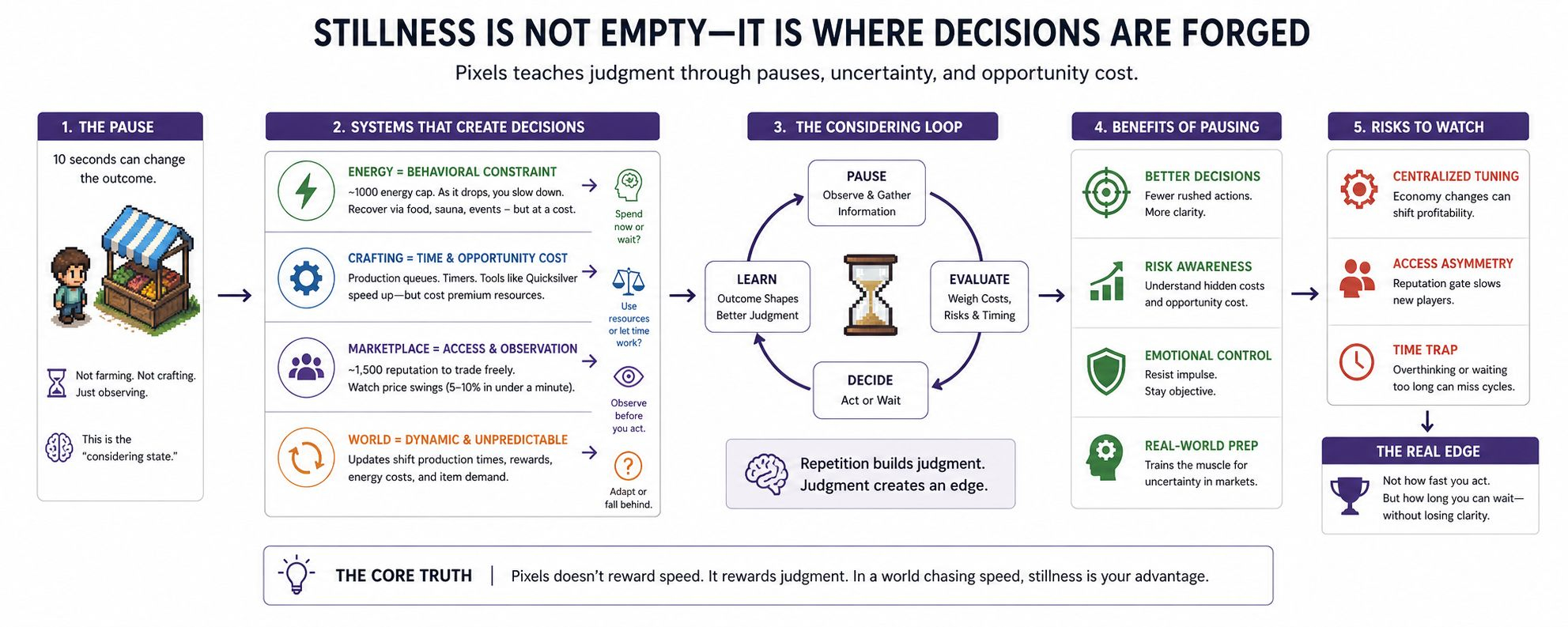
I caught myself doing something strange inside . I wasn’t farming. I wasn’t crafting. I wasn’t even trading. I was just… standing still, staring at the marketplace, waiting. And the weird part? That 10-second pause felt more important than everything I did before it.
As a trader, I started treating it like an experiment. What exactly happens inside these pauses? Why does this game, built on the , feel less like grinding and more like decision training?
By April 2026, Pixels has already crossed millions of users globally, and its economy has gone through multiple recalibrations since its 2024 migration to Ronin. The systems are not static. Energy costs shift. production timers change. task rewards fluctuate. And that’s where it gets interesting.
Pixels doesn’t remove friction. It reshapes it.
Energy, for example, is not just a stamina bar. It’s a behavioral constraint. You start with a capped pool around 1000 energy and as it drops, your character literally slows down. You feel it. Movement becomes heavier. Actions feel expensive. You can recover through food, sauna, or events, but every recovery path has a cost or delay. So you pause. You think. You ask yourself do I spend now, or wait?
That’s not gameplay. That’s economic conditioning.
The same pattern shows up in crafting. Production queues fill up. Timers stretch. And yes, there are tools like Quicksilver to speed things up, but they introduce another layer of decision-making. Is it worth burning a premium resource now? Or do I let time do its job? I’ve caught myself staring at a timer, calculating opportunity cost like I would in a real trade.
And then there’s the marketplace. It’s not fully open from day one. You need reputation around 1,500 points to even participate freely. That single design choice filters behavior. New players observe before acting. They watch price swings. Sometimes 5–10% moves in under a minute. And when you finally get access, you’re not rushing you’re cautious.
That’s the “considering state.”
It’s subtle. No alerts. No tutorials telling you what to do. Just repeated micro-moments where you’re forced to decide under uncertainty.
In traditional Play-to-Earn models like , the optimal path was often clear. Follow the meta. Execute faster. Scale repetition. But Pixels doesn’t let a fixed meta settle for long. Updates adjust production time, rebalance industries, tweak rewards. What worked last month might underperform today.
So you pause again.
From a trading perspective, this feels familiar. In real crypto markets, especially post-2022 volatility cycles, speed alone stopped being the edge. Execution is increasingly automated. Bots handle arbitrage. AI tools scan patterns faster than any human. What’s left for us?
Judgment.
The ability to sit in uncertainty without reacting impulsively.
Pixels, intentionally or not, is training that muscle. Not through charts, but through loops. Not through theory, but through repetition.
I tested this on myself. I tracked my own behavior over a week. The more I paused before selling, before crafting, before spending energy the better my outcomes felt. Not always in profit terms, but in decision quality. Fewer rushed actions. Fewer regret trades. More clarity.
But let’s be real. This system isn’t perfect.
There are risks.
First, the economy is still centrally tuned by developers. Changes in reward rates, energy mechanics, or item demand can quickly shift profitability. That means your “intuition” is only as good as your adaptability.
Second, market access being reputation-gated creates asymmetry. Early or active players gain faster exposure to economic opportunities, while new entrants may lag behind.
Third, time itself becomes a resource trap. You can overthink. You can pause too long and miss cycles. I’ve done that. Waiting for a better price that never came.
So no, the pause is not magic. It’s a tool. And like any tool, it depends on how you use it.
Still… something deeper is happening here.
In a space where most protocols try to optimize for speed and efficiency, Pixels quietly introduces hesitation as a feature. It forces you to feel time, not just measure it. It makes you aware that every action even in a game has an invisible cost.
And maybe that’s why it’s trending among both gamers and traders in 2026. Not because it promises easy earnings. But because it mirrors real market behavior in a simplified environment.
I don’t think Pixels set out to build a psychological training ground.
But that’s what it became.
A place where you learn that price is not truth. That timing is not obvious. That doing nothing just for a few seconds can sometimes be the most rational move.
In crypto, we often chase speed. Faster entries. Faster exits. Faster gains.
But the longer I spend inside these small, quiet pauses… the more I start to question that instinct.
Maybe the real edge isn’t how fast you act.
Maybe it’s how long you can wait without losing clarity while everything around you is moving.
