
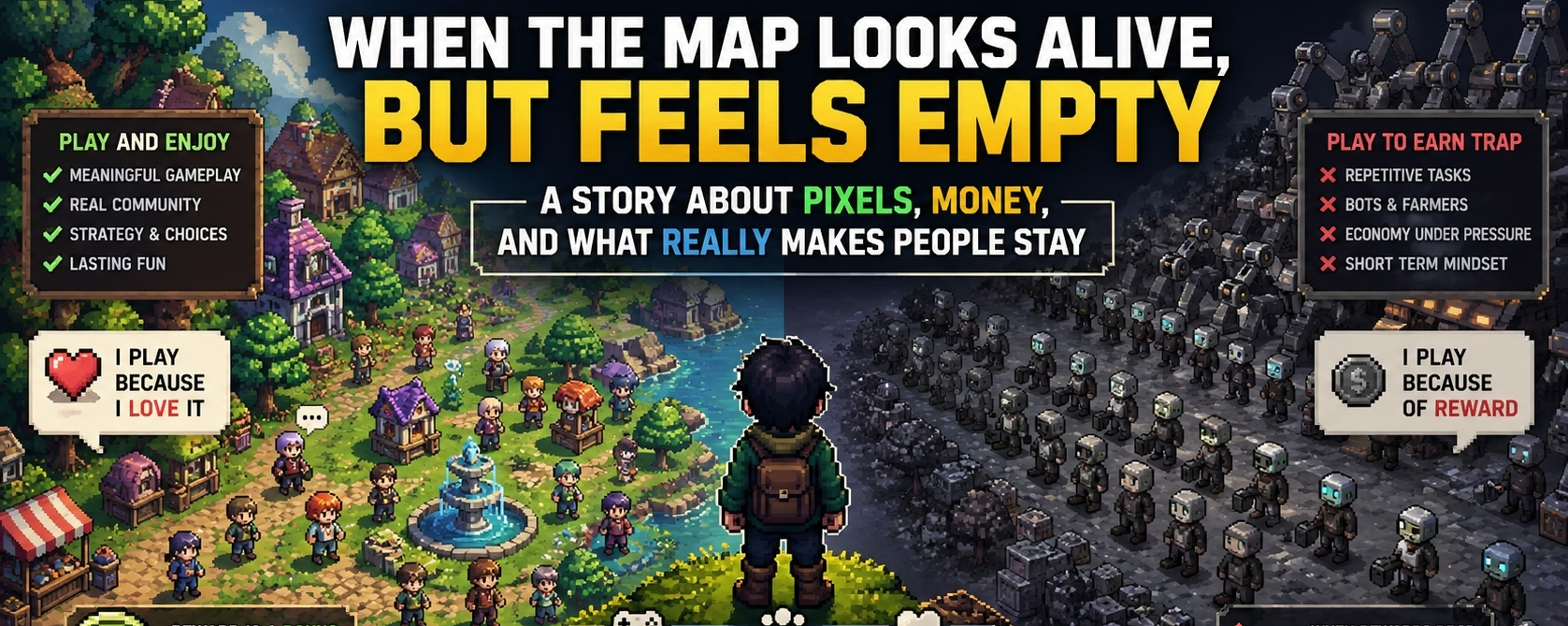
At first, everything felt so logical that there was almost no reason to question it. The idea that a game could offer real rewards to its players sounded like something that had long been missing from the gaming world. For years, people had been used to spending time, energy, and even emotions in games without ever truly owning what they built. So when the concept of play-to-earn appeared, it felt like a door had finally opened. $PIXEL as one of the fast-growing casual social Web3 games on networks like Ronin, once seemed like a perfect example of that promise. An open world, diverse activities, social interaction, and a token-based economy like $PIXEL made everything feel complete. But the longer you look, the more it feels like something doesn’t fully align between what was promised and what actually happens inside the game.
The issue didn’t start from a lack of players..quite the opposite. The map looked full, activity seemed busy, and from the outside, everything appeared alive. But if you looked closer, there was a strange feeling that was hard to explain. Many characters were moving, but it didn’t truly feel like there were real people behind them. Their movements were too precise, too repetitive, too consistent to be called actual gameplay behavior. From one point to another, from trees to rocks, from farms to crafting areas, everything followed the same pattern, as if this game world wasn’t a place to play, but a production line running non-stop. That’s when I realized something important: a crowded world doesn’t always mean a living one. What looks full might not be a community,,it could just be a system being exploited. #pixel
In the early phase, especially during the surge of users after Pixels expanded on Ronin, many joined not because they were interested in the game itself, but because they saw an opportunity. They came with a work mindset, not a play mindset. Their goal was clear: optimize time to maximize returns. In this situation, the concept of play-to-earn began to show its fragility. When rewards are too easy to access and systems too predictable, it doesn’t just attract players..it invites bots and large-scale farmers. Activity increases, but the quality of engagement drops. The economy starts to feel pressure as more value is extracted than added. Prices fall, motivations shift, and players who genuinely want to enjoy the game slowly lose their reason to stay in an environment that feels increasingly mechanical.
From there, the shift toward play-and-earn starts to make more sense, even though it’s often dismissed as just a change in terminology. In reality, the difference is fundamental. In play-to-earn, rewards are the main reason to log in. In play-and-earn, rewards should only be a byproduct of an experience that is already engaging on its own. This means the game must be able to stand on its own without relying entirely on financial incentives. If everything stops feeling interesting when rewards decrease, then the foundation was never strong enough. But if players still want to log in, still want to play,,even when the economy isn’t ideal..then something deeper has been successfully built.
This change doesn’t happen in a single moment, but more like a gradual shift that becomes visible through how the game designs its activities. Tasks that once required no thought begin to demand decisions. Crafting systems stop being simple time-to-output conversions and start allowing room for strategy. Progress is no longer just about numbers going up, but about how players feel involved in the process. In this kind of environment, bots begin to struggle because they rely on stable, repeatable patterns. Farmers who only seek efficiency start losing interest because the system no longer fully supports that approach. Meanwhile, players who genuinely enjoy the game begin to find reasons to stay.
To me, this is where the difference between activity and engagement becomes crucial. Many Web3 systems focus too much on numbers...how many users, how many transactions, how many resources are produced...without really understanding what’s happening behind those numbers. An account that logs in daily doesn’t necessarily have a relationship with the game. High interaction doesn’t always mean a healthy community. A world can look busy but still feel empty if there’s no real engagement. On the other hand, a single player who truly cares.,who interacts, who tries to understand the system, and who builds a meaningful experience,,can have far more impact than hundreds of accounts just running routines.
Eventually, I started to feel a small but meaningful shift myself. There came a point where my reason for logging in changed. At first, it was just to claim rewards or chase results. But then it became about curiosity..wanting to see what had changed, or simply wanting to spend a little time in that world. That’s not something a reward system can force. It comes from an experience that feels alive. And when that happens, rewards change their role. They are no longer the main goal, but something that reinforces the reason to stay.
If there’s one takeaway from all of this, it’s simple but important: a game cannot be built on incentives alone. Money can attract people, but it’s not enough to make them stay. A crowded map doesn’t guarantee a strong community, and an active economy doesn’t always mean a healthy system. In the end, what matters isn’t how much can be extracted from a game, but how much makes people want to return..even when there’s nothing left to take.