
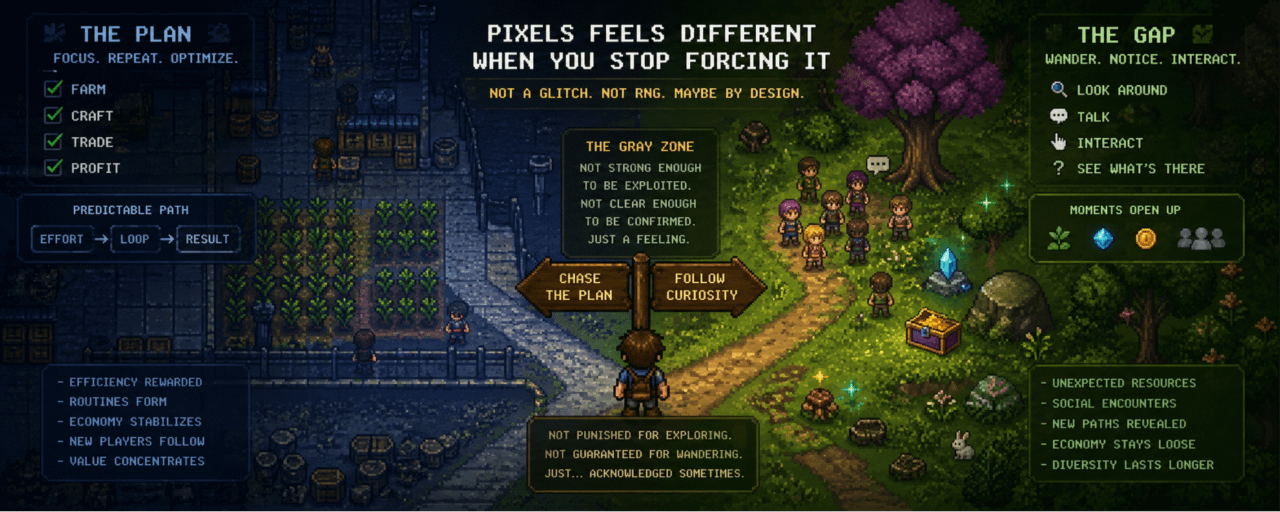
I keep running into this way of playing in Pixels. It does not show up all the time. It shows up in gaps. Moments where I am not chasing anything
When I play with a goal in mind the game feels normal. I farm. I craft. I trade. I look for ways to make a profit. It behaves like games where you put in effort and get something out.. Simple.
Then there are these other moments.
I slow down. I move around without a plan. I check a corner of the map for no reason. I interact with something. That is when the game feels different. It almost feels like it notices that I am not trying to force a result.
Things start to open up in a way.
I find things that do not feel tied to a strict routine. A resource shows up where I did not expect it. A trade feels easier than usual. A path that looked empty now has activity. None of this feels planned. It feels like the game is responding to my curiosity more than my optimization.
That is unusual.
Most game economies punish this kind of behavior. If you break your routine you lose efficiency. If you wander you fall behind. Systems are built to reward focus. Repetition makes you better. That is the model.
Pixels bends that a bit.
It does not fully reward sitting around. You still need to do something.. It does not fully punish exploring either. There is a space where being a little curious seems to get acknowledged by the game.
I am trying to understand if this is design or just my imagination.
One angle is how resources appear. If they appear in a -dynamic way then wandering increases the area I cover. I see more. I catch things others miss. That is not a reward. That is probability.
Another angle is players. When I move without a plan I cross paths with groups. That can create the feeling of discovery. The game is not reacting to me. I am just moving through changing situations.
That does not fully explain it.
There are times where the timing feels too good. Like the game holds rewards until I interact less aggressively. Not guaranteed. Not frequent. Just enough to feel like it's on purpose.
If that is real then it points to a design choice.
A system that avoids making players behave in a loop.
If players lock into a routine early the economy gets predictable. Resources get used up in expected ways. The best strategies form quickly. New players struggle to enter. Value concentrates around known paths.
By rewarding curiosity the system delays that.
Players spread out. They test paths. They do not all converge on the routine at the same time. That keeps the economy loose for longer.
There is a benefit
There is also a risk.
If players start to believe that just sitting around gives a hidden advantage then trust can break. People will question fairness. They will think the game favors randomness over effort. That can push players away.
Now it sits in a gray zone.
It is not strong enough to be exploited. It is not clear enough to be confirmed. It just sits there as a feeling.
That makes it interesting but also unstable.
Another point is how clear progress is.
When systems reward play you can map your path. You know what to do. You can plan your actions. That builds confidence.
Here the signal is weaker.
If part of the system responds to curiosity then progress becomes less predictable. You cannot fully plan your step. That can slow down players who're very efficient. It can also keep players engaged longer.
So it depends on who you're
If you are optimizing hard this design feels slightly obstructive. Like something is always, out of reach of full control.
If you are exploring it feels alive.
Like the game is meeting me halfway.
I am not fully convinced either way.
It could be a phase. Early stage systems often feel more open before patterns lock in. As more players learn the map and mechanics this soft layer might disappear.
It could be intentional.
A way to keep behavior diverse without forcing it.
What I do notice is this.
When I stop pushing for a result and just interact lightly the game feels more responsive. Not always. Not reliably.. Often enough to notice.
That is not how most systems behave.
I am still not sure if that is a strength or something that might break later.