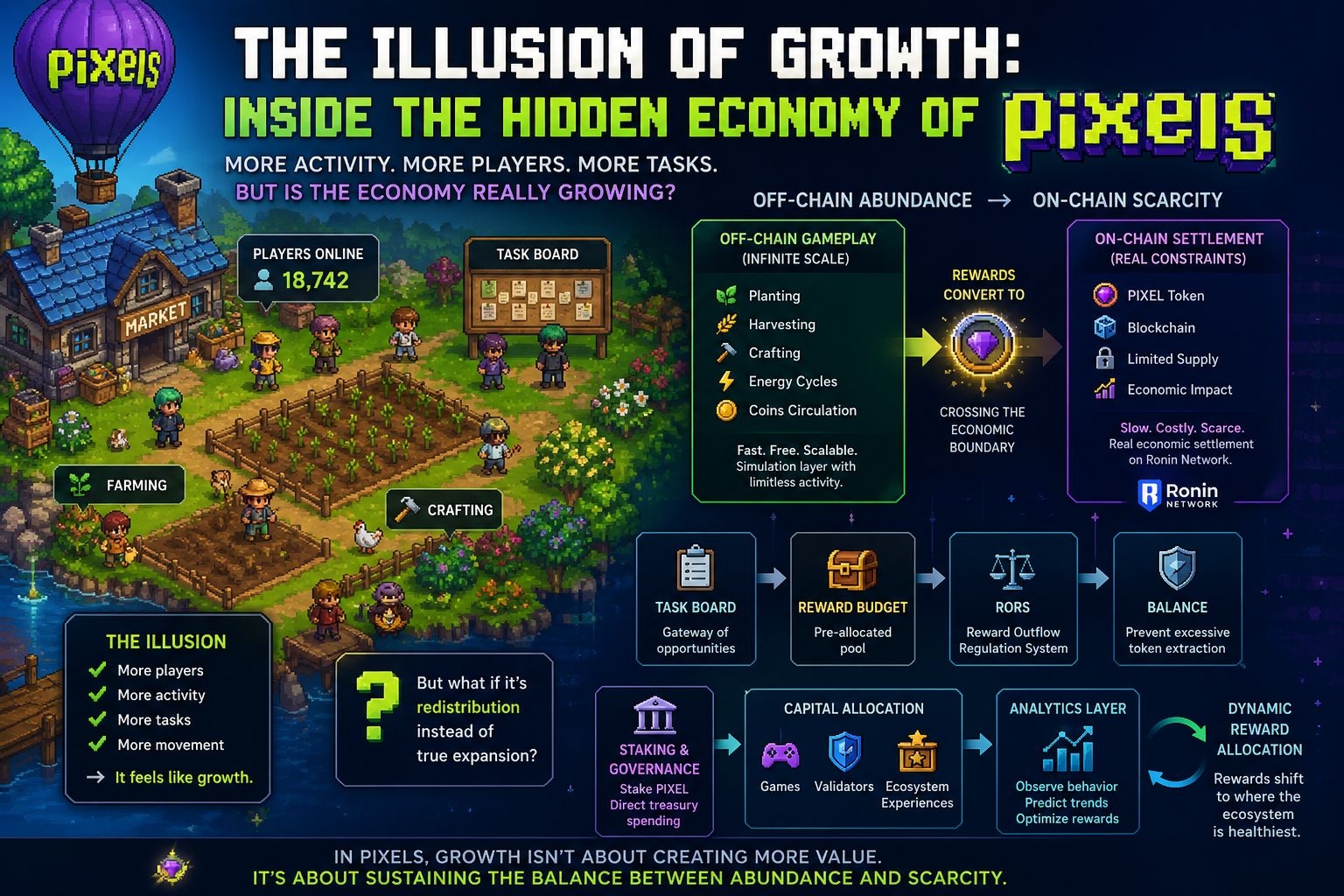
@Pixels #pixel $PIXEL When I first spent time inside Pixels, the ecosystem felt like it was constantly expanding. Everywhere I looked, something was happening. Players were planting crops, harvesting fields, crafting items, completing tasks, and moving between zones. The task board refreshed regularly, new objectives appeared, and activity never seemed to slow down. From the surface, it created the impression of a living economy that was steadily growing.
At first glance, the logic seemed simple: more players farming should mean more value being created. More activity should lead to more rewards. The ecosystem appeared to follow the classic assumption that effort produces growth.
But the longer I observed the system, the more that assumption began to feel incomplete.
What if the growth we see inside Pixels isn’t actually expansion at all? What if it’s redistribution?
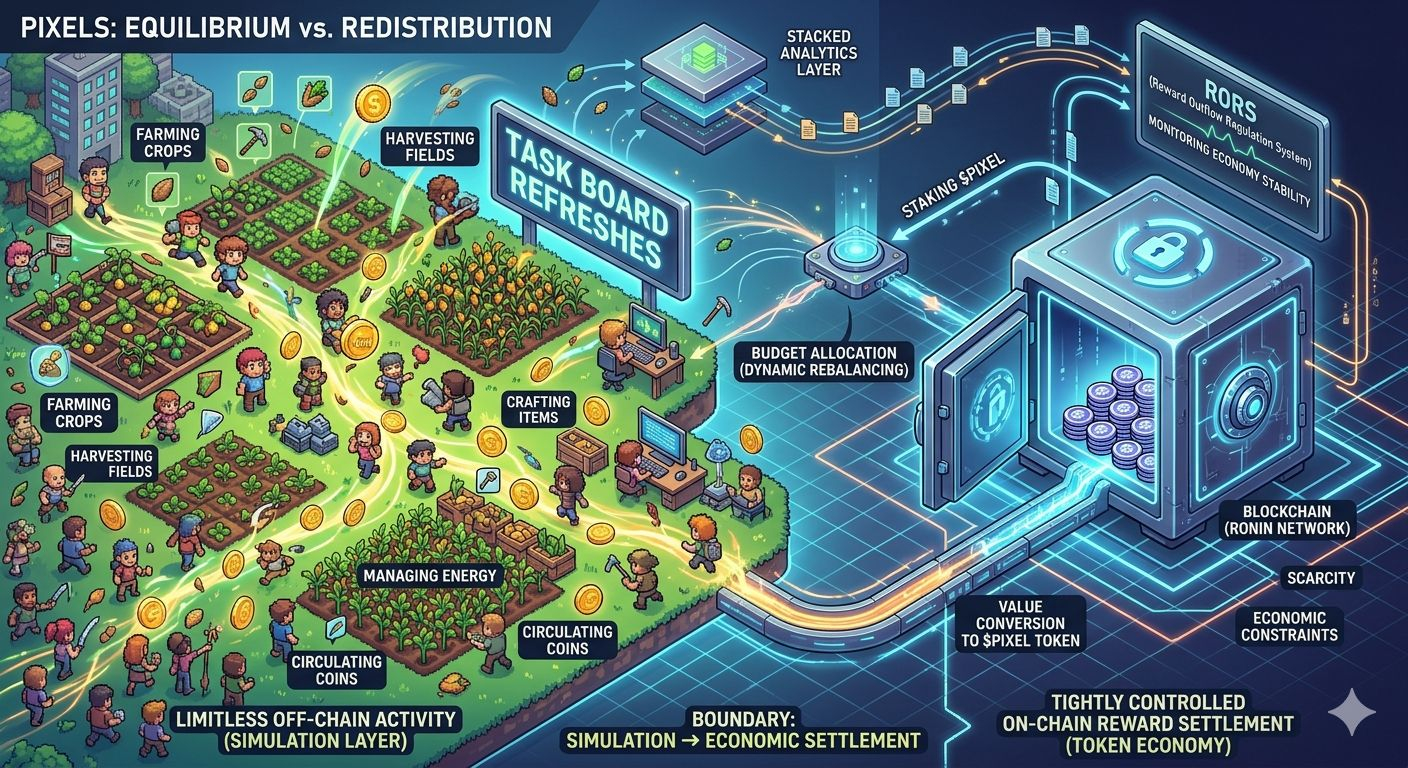
That question started to make more sense when I began thinking about the underlying infrastructure that powers the game. Pixels operates on the Ronin Network, but interestingly, most of what players actually do inside the game doesn’t immediately interact with the blockchain. Planting seeds, harvesting crops, crafting items, managing energy cycles, and circulating Coins all happen off-chain. These loops operate inside a simulation layer that can scale almost infinitely because it doesn’t require costly blockchain transactions for every action.
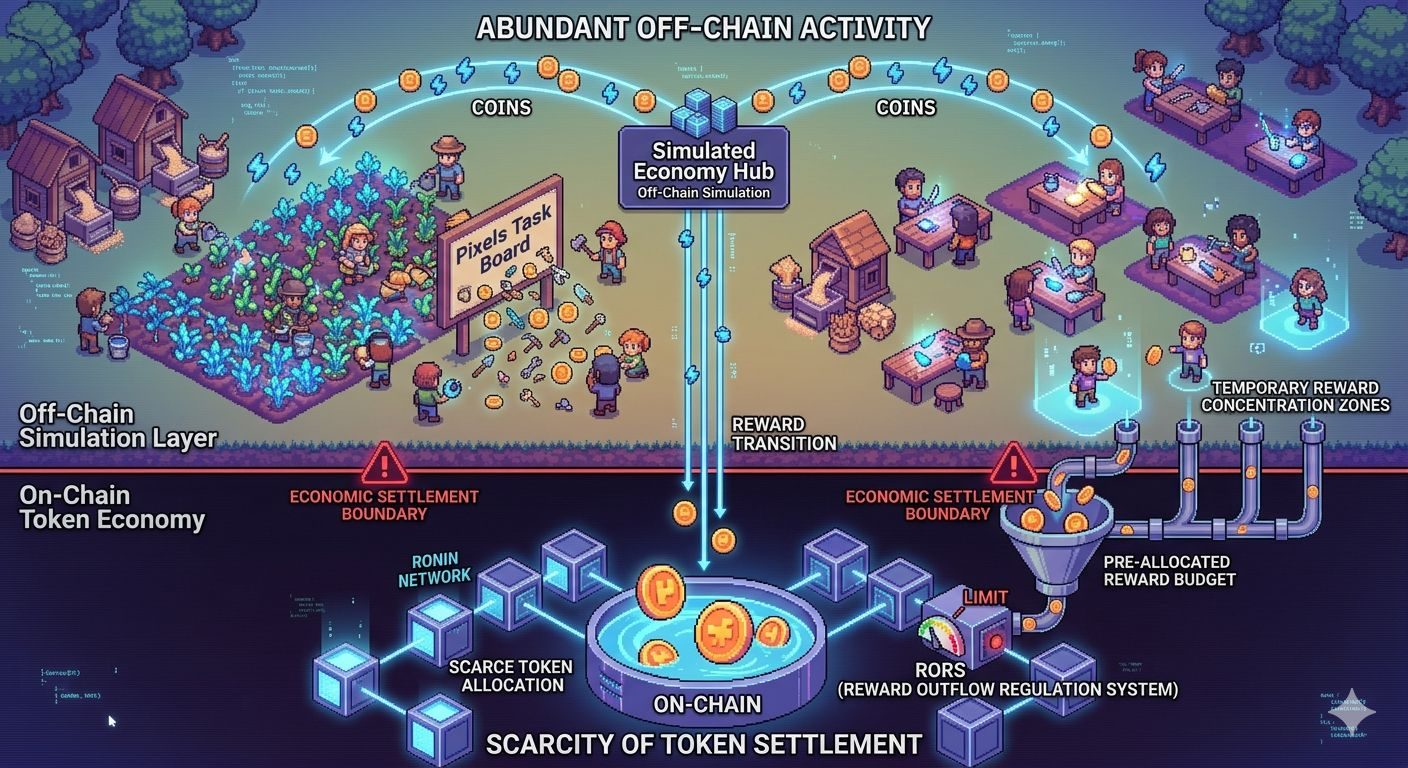
In other words, gameplay activity itself is abundant.
The blockchain only becomes relevant when rewards transition from that simulated environment into the token economy specifically when value converts into the PIXEL token. At that moment, the system crosses a boundary from simulation into economic settlement.
That boundary introduces real constraints.
Blockchain tokens cannot expand infinitely without consequences. Every token that enters circulation affects supply, price stability, and the long-term sustainability of the ecosystem. Because of this, Pixels appears to operate with a careful separation: limitless off-chain activity paired with tightly controlled on-chain reward settlement.
The most interesting place where this boundary becomes visible is the Pixels Task Board.
At first, the task board feels like an engine of opportunity. New tasks appear frequently. Objectives rotate. Rewards seem plentiful. It creates the impression that the system is constantly generating new economic value for players to claim.
But after spending enough time watching it, a different pattern begins to emerge.
The rewards rarely feel like they are expanding. Instead, they behave more like a pool that players compete to access.
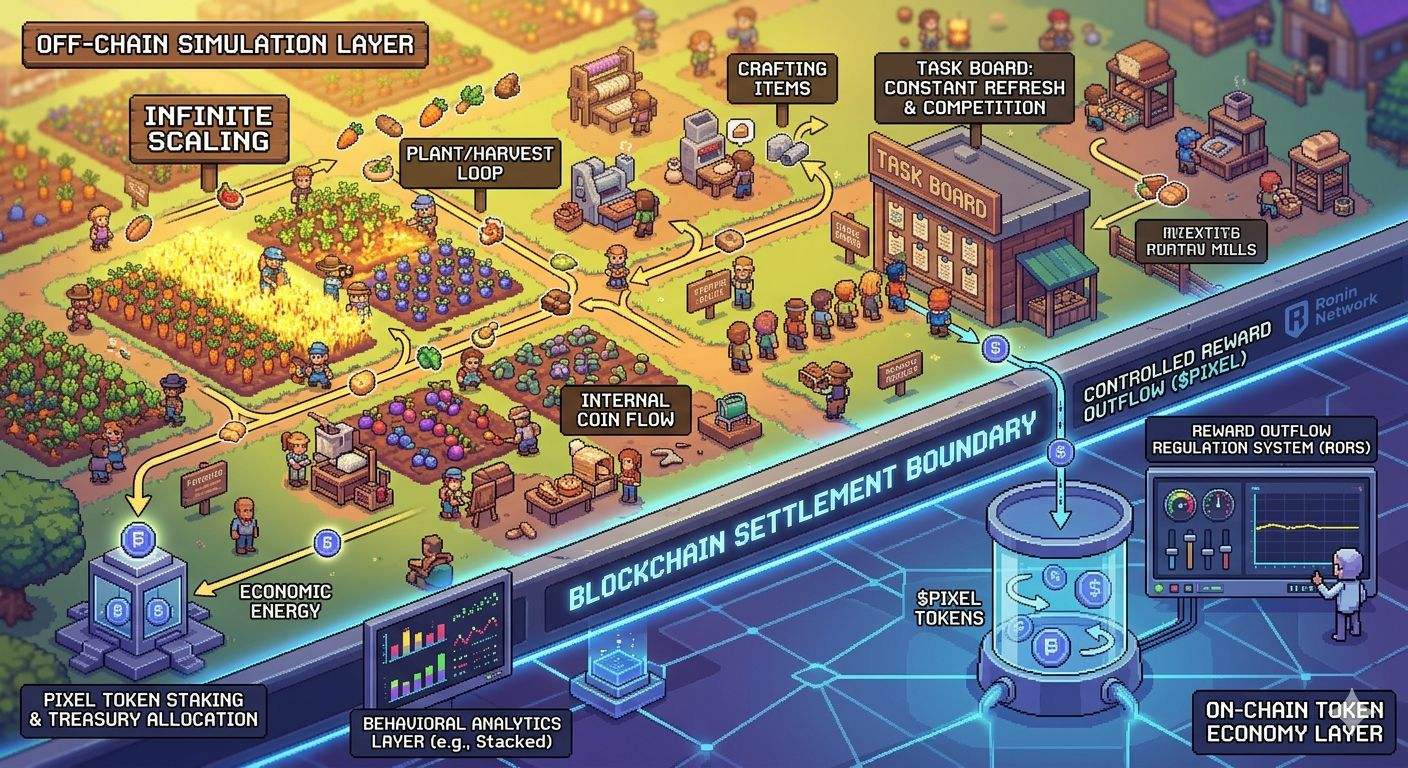
This suggests that the task board may not be creating value but distributing a pre-allocated reward budget. Each refresh feels like a new opportunity, yet the total reward outflow appears carefully regulated. If too many players complete tasks simultaneously, the value of each opportunity subtly diminishes.
This is where the concept of economic pressure points becomes important.
Web3 games exist in a strange hybrid environment. They simulate economies internally while simultaneously settling real economic value on-chain. The critical moment occurs when simulated activity attempts to extract real tokens. That moment creates pressure on the system.
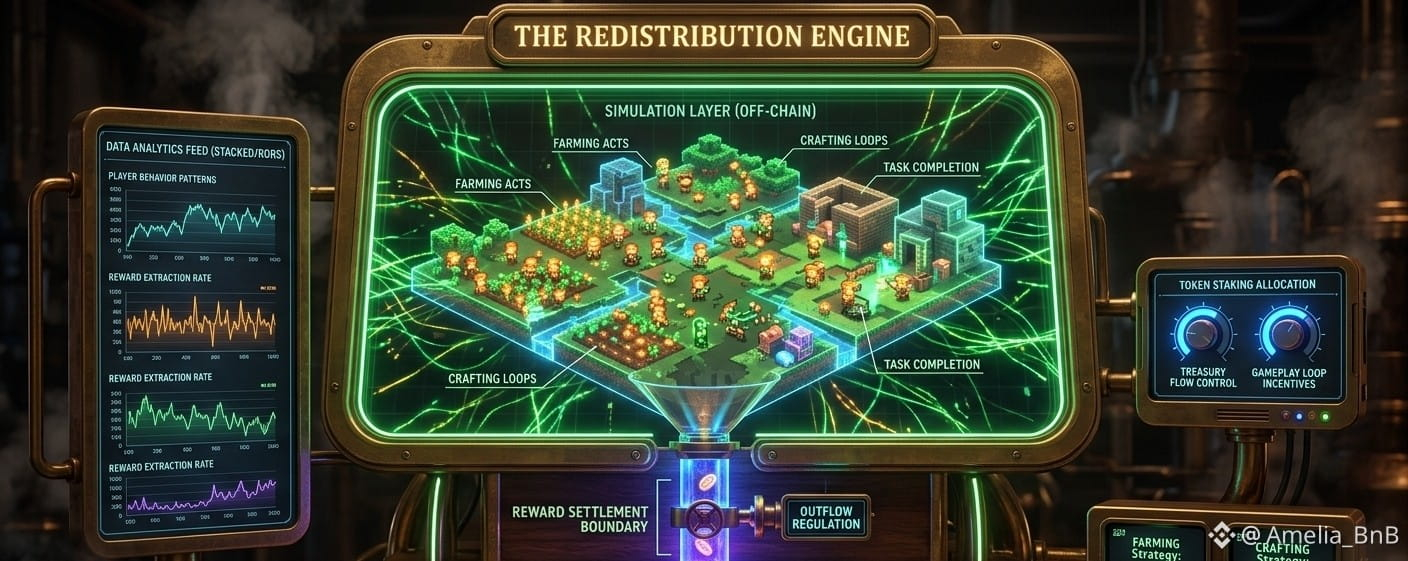
Pixels appears to manage this pressure through internal control mechanisms designed to regulate reward outflows. Systems such as RORS the Reward Outflow Regulation System likely monitor how quickly tokens are leaving the ecosystem. If reward extraction becomes too aggressive, the system can rebalance tasks, adjust reward structures, or redistribute incentives to maintain economic stability.
What emerges from this structure is something that looks less like an open economy and more like a closed-loop reward environment.
In such a system, activity does not necessarily create new value. Instead, players compete for access to a limited allocation of rewards that are periodically redistributed throughout the ecosystem.
This perspective becomes even more interesting when considering the role of token staking. When players stake the PIXEL token, they may influence how treasury resources are allocated across the broader ecosystem including games, validators, and experimental gameplay loops. In effect, staking becomes a form of capital allocation. It directs where economic energy flows inside the system.
From this angle, the game begins to resemble a dynamic budgeting machine.
And that machine is likely informed by data.
Modern Web3 ecosystems increasingly rely on behavioral analytics layers that observe millions of player actions. Systems like Stacked or similar analytics frameworks embedded within gaming ecosystems can analyze farming patterns, crafting behavior, task completion rates, and reward extraction trends. With enough data, these systems could theoretically predict which gameplay loops produce healthy engagement without destabilizing the token economy.
If that’s the case, rewards inside Pixels may not simply exist. They may be continuously adjusted.
One area of the game might receive deeper rewards because it generates positive economic feedback. Another area might slowly lose reward depth if extraction becomes too concentrated.
This makes progression feel dynamic but also slightly illusory.
Players may believe they are moving forward through a growing economy. In reality, they may simply be moving through shifting zones of reward allocation.
When a particular farming strategy feels profitable, it might not be because new value was created. It may simply mean that the system temporarily concentrated rewards in that area. As more players discover the strategy, the reward density naturally redistributes elsewhere.
In traditional game economies, growth usually means expansion. More content, more rewards, more opportunities for everyone even if those opportunities are unevenly distributed.
Pixels appears to operate differently.
Here, growth may not be expansion but equilibrium. The system balances an abundant off-chain simulation against the scarcity of on-chain token settlement. Instead of continuously increasing rewards, it constantly redistributes them to maintain long-term sustainability.
From the player’s perspective, this creates an unusual question about effort.
When I spend more time farming, crafting, and completing tasks, am I actually generating new value for the ecosystem? Or am I simply increasing my probability of intersecting with wherever the reward budget currently happens to be concentrated?
The answer may be somewhere in between.
Pixels may not be designed to grow indefinitely in the way traditional online games do. Instead, it may be engineered to maintain equilibrium carefully regulating how tokens flow out of the ecosystem relative to how value flows into it.
If that’s true, then the real game inside Pixels isn’t just farming.
It’s understanding the invisible economic currents that decide where rewards appear next.