
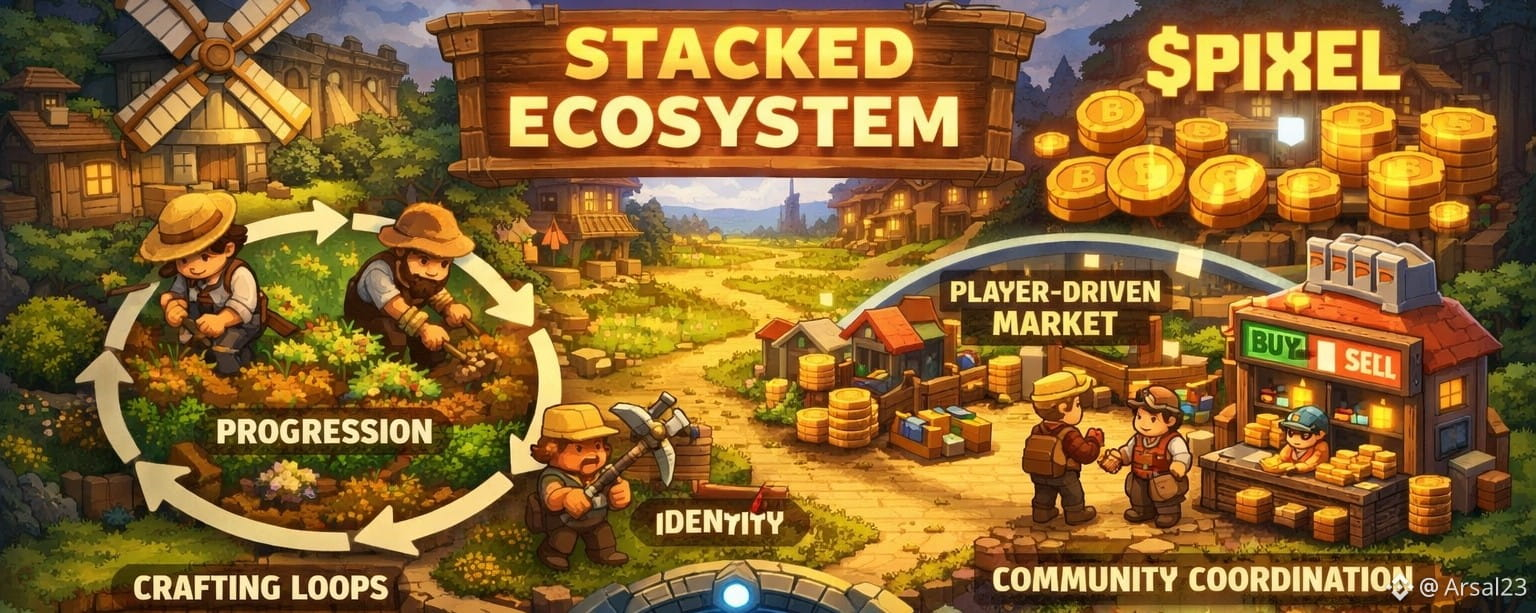
If you’re tracking @Pixels, it’s easy to focus on surface-level metrics—daily activity, market sentiment, or short-term price reactions around $PIXEL. But the more important story is structure: what makes a game-economy durable after the first wave of excitement fades? That’s where the Stacked ecosystem becomes the real narrative.
Most blockchain games struggle with the same fragility: rewards attract attention, attention creates inflation, inflation erodes meaning, and then the loop resets. A “stacked” approach aims for the opposite. It’s about designing systems where your actions leave useful traces—resources that feed other systems, progression that opens new choices, and identity/reputation that matters socially. When multiple loops connect (production, crafting, trading, coordination), the economy starts to feel less like a faucet and more like a living network.
What makes this compelling is how Stacked can encourage specialization. In a healthy ecosystem, not everyone does everything. Some players optimize farming loops, some master crafting routes, some trade, and others coordinate communities. When these roles interlock, markets gain depth, and gameplay becomes community infrastructure—not a solo grind.
For anyone watching $PIXEL, the most bullish signal isn’t a single update; it’s whether the world keeps improving its “plumbing”:
Balanced sinks vs. sources (so value doesn’t endlessly dilute)
Meaningful constraints (friction that creates strategy)
Composable progression (new features that connect to existing systems rather than replacing them)
If Stacked keeps pushing Pixels toward compounding utility—where effort, assets, and coordination reinforce each other—then Pixels isn’t just shipping content. It’s building a world people can invest time into without feeling like everything resets when incentives change.
What do you think will be the biggest long-term driver in the Stacked ecosystem for @Pixels: deeper crafting loops, stronger player-driven markets, or community coordination layers? #pixel $PIXEL