
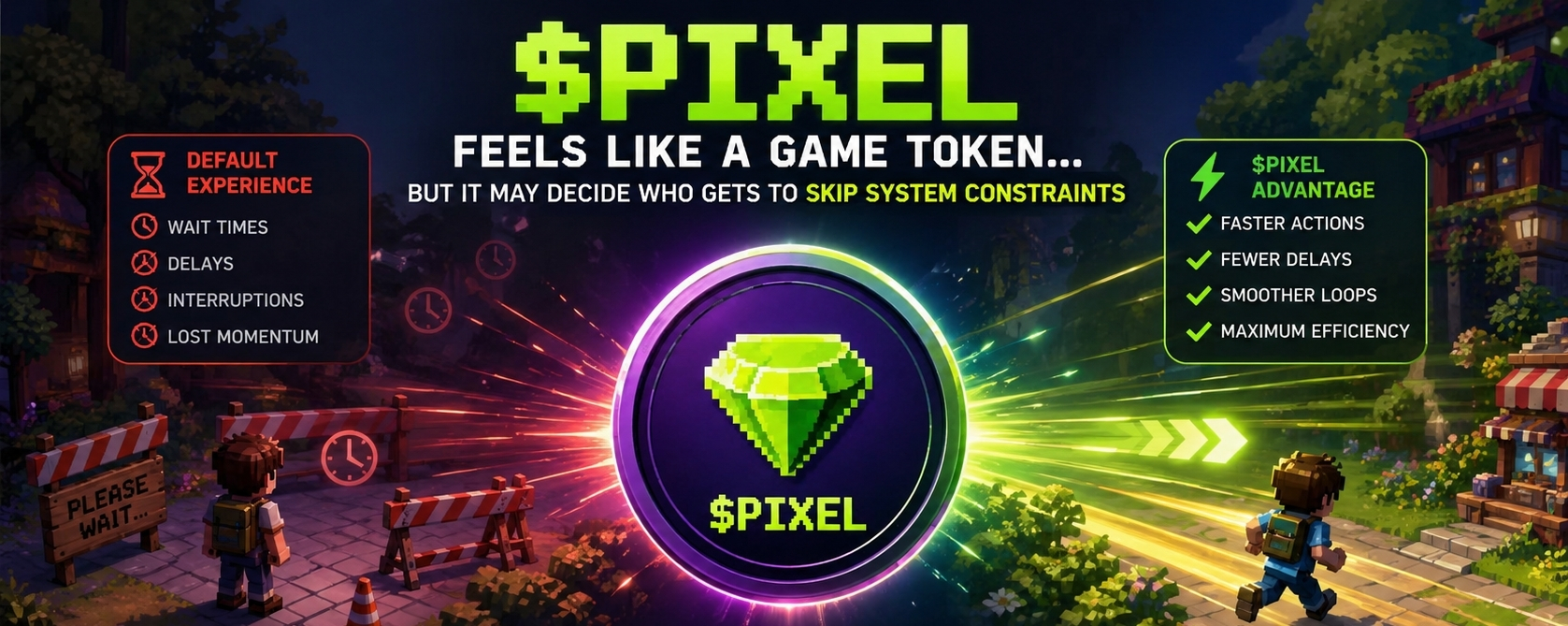
@Pixels At the beginning, nothing about it feels restrictive. You enter the system and everything seems open, almost welcoming in a way that makes you stop questioning how it works. You plant, you harvest, you repeat the loop, and it all flows in a calm, predictable rhythm. There’s no visible barrier, no harsh limitation forcing you to stop or rethink your approach. It gives you just enough freedom to believe that everyone inside is experiencing the same pace, the same conditions, the same opportunities. But the longer you stay, the more that feeling starts to shift—not suddenly, not in a way that feels obvious, but slowly, like something slightly out of sync that you can’t immediately explain.
It’s not that the system blocks you. It doesn’t. You can still do everything you were doing before. But there’s a subtle drag that begins to appear, a kind of quiet resistance that doesn’t stop your progress but makes it feel just a bit heavier. You start noticing moments where things could have been faster, smoother, more continuous. Small pauses begin to stand out—tiny interruptions that break your flow just enough to make you aware of them. And once you notice them, it becomes hard to ignore that not everyone seems to be experiencing those same interruptions in the same way.
This kind of feeling isn’t new if you’ve spent time in markets. Two people can look at the same opportunity, understand it the same way, and still end up with completely different results. One gets in smoothly, almost effortlessly, while the other hesitates or arrives a second too late. It’s rarely about who is smarter in that moment. It’s about who is positioned better—who is closer to execution, closer to movement, closer to that invisible layer where action happens without delay. That slight difference in timing doesn’t seem like much at first, but it compounds quickly, creating a gap that feels larger than it should be.
Pixels carries that same energy, just translated into a softer environment. On the surface, it feels like a relaxed GameFi loop, something you can play without overthinking. But underneath that simplicity, there’s a pattern forming. Players aren’t really chasing rewards in the way most systems expect them to. They’re chasing smoothness. They’re trying to stay in motion without being interrupted, trying to maintain a rhythm that doesn’t get broken by small delays or waiting periods. It’s less about what you earn and more about how cleanly you can move through the process of earning.
That’s where $PIXEL starts to reveal its role, but it does so quietly. It doesn’t demand your attention or present itself as something you must have. Instead, it sits in the background, subtly shaping how friction behaves inside the system. You can ignore it completely, and technically nothing stops you from continuing. But the experience changes. The system feels slower, more fragmented, less responsive. Those small pauses you noticed earlier start to feel more frequent, more noticeable, like tiny gaps in an otherwise continuous flow.
What’s interesting is that the system never explicitly tells you this. There’s no clear moment where it says you need to engage with to improve your experience. Instead, you come to that realization on your own. You begin to see where time is being lost, where efficiency drops, where your rhythm breaks. And naturally, you start looking for ways to fix it. Not because you were told to, but because it feels like the logical next step. That’s where the real demand forms—not from pressure, but from repeated moments of friction that you’d rather avoid.
Over time, these small choices begin to stack in ways that aren’t immediately obvious. One player finds ways to reduce delays, to smooth out their loop, to keep moving without interruption. Another continues at the default pace, dealing with the same small pauses, the same slight inefficiencies. At first, the difference between them feels negligible. But as time passes, that gap quietly expands. It’s not that one is doing significantly more work—it’s that they’re losing less time. And in a system where everything compounds, losing less becomes more powerful than doing more.
This is where the system starts to feel less like a simple game and more like a layered structure. It remains open—anyone can enter, anyone can participate—but performance begins to separate. Some players operate closer to the system’s ideal state, moving through it with a kind of continuity that feels almost effortless. Others remain within the default experience, where progress is steady but interrupted just enough to keep them slightly behind that ideal flow. It’s not a visible hierarchy, but it’s there, shaping outcomes in a quiet and consistent way.
There’s something slightly uncomfortable about that realization, even if it doesn’t feel unfair on the surface. The system isn’t denying access to anyone, but it isn’t treating all experiences equally either. The difference lies in efficiency, in how smoothly you can interact with the system over time. And seems to sit right at that intersection, not as a direct reward mechanism, but as a way to reduce the invisible costs that most people accept without thinking.
Whether this balance holds in the long run is hard to say. Systems like this often depend on how noticeable these differences become. If the gap between smooth and interrupted experiences grows too clear, it risks changing how players perceive fairness. But if it stays subtle, just beneath the surface, it can continue guiding behavior without drawing too much attention to itself. That quiet influence is what makes it effective—and also what makes it easy to overlook at first.
Right now, doesn’t feel like something that gives you more in an obvious way. It feels like something that helps you avoid losing what you didn’t realize you were losing in the first place. Time, flow, continuity—things that don’t stand out until they’re disrupted. And once you become aware of them, it changes how you see the entire system. Not as a place where rewards are simply earned, but as one where efficiency quietly decides how far you can really go.