
I’ve watched enough games come and go to know when something is playing it quiet on purpose.
Pixels does exactly that.
You log in and nothing jumps at you. No flashing buttons. No countdown timers trying to scare you into staying active. No constant pressure. Just a calm little farm, a few tasks, and other players doing their own thing.
It almost feels too slow.
That’s where most people get it wrong.
Because this isn’t laziness. It’s design.
If you’ve followed Web3 gaming even casually, you’ve seen the chaos. Loud launches. Tokens pumping. Everyone rushing in for quick profits. And then—inevitably—the crash. Bad economics, poor planning, and a lot of overconfidence from teams who thought hype could replace sustainability.
Pixels clearly learned from that mess.
Instead of shouting, it whispers.
And weirdly, that works.
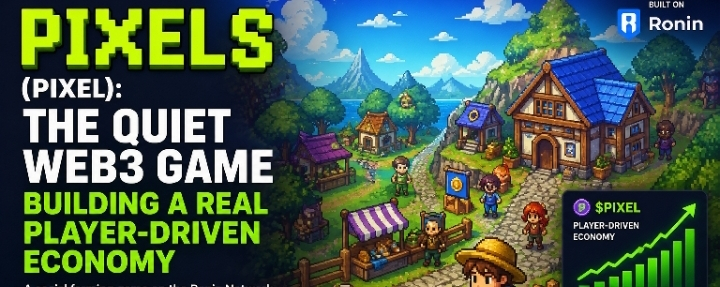
On the surface, it’s a farming game. You plant crops, wait, harvest, repeat. Nothing complicated. No steep learning curve at the beginning. Anyone can pick it up in minutes.
But stay a little longer.
That’s when it starts to reveal itself.
Because what looks like a simple loop is actually feeding into something much bigger—a live, player-driven economy that doesn’t hold your hand or guide your decisions.
You’re on your own.
And that’s the point.
I’ve seen players treat it like any other casual game. They farm randomly, spend hours doing repetitive tasks, and expect steady progress. But Pixels doesn’t reward that kind of thinking.
Another player comes in, observes the market, adjusts strategy, chooses better crops, times their actions—and suddenly they’re moving ahead much faster with less effort.
Same game. Different awareness.
That gap is where the real game lives.
And honestly, most people never notice it.
The PIXEL token sits right in the middle of all this. It powers trades, rewards, and progression. It’s what connects player activity to real value.
But let’s not pretend it’s risk-free.
Like every token in this space, it moves with the market. Good days, bad days, unpredictable swings. You might be making all the right moves in the game and still feel external pressure from the broader crypto environment.
That’s just how it is.
There’s also the time factor. Pixels doesn’t rush you, which sounds great until you realize progress can feel slow if you don’t understand what you’re doing. This isn’t a game that rewards mindless grinding. It rewards attention.
And attention takes effort.
One thing I find interesting is how the social layer quietly shapes everything. You don’t have to interact directly, but other players are always influencing the system. What they grow, what they sell, what they ignore—it all affects the economy.
It’s subtle, but powerful.
Over time, you start noticing patterns. Certain resources become scarce. Prices shift. Opportunities appear for players who are paying attention.
It starts to feel less like a game and more like a small digital marketplace.
But let’s be real—it’s not perfect.
There are rough edges. Bugs show up. Systems don’t always behave the way you expect. That’s normal, especially for a game trying to balance gameplay with a real economic layer. Add developer pressure, scaling challenges, and constant updates into the mix, and things can get messy behind the scenes.
Still, that’s part of the territory.
Another thing that catches players off guard is the learning curve. At the beginning, everything feels easy. Too easy. Then you realize you’ve been inefficient the whole time—wasting time on low-value actions, missing better opportunities.
The game never tells you.
You just figure it out… eventually.
And by then, someone else is already ahead.
A lot of people also walk in with the wrong mindset. They think it’s a quick way to make money.
It’s not.
Yes, there’s earning potential. But it’s tied to how well you understand the system, not how long you stay online. If you treat it like a shortcut, you’ll probably burn out.
I’ve seen that happen more than once.
The players who do well here take a different approach. They slow down. They watch what’s happening. They adapt. They treat it like a system, not just a game.
That’s the difference.
If you’ve been around this space long enough, you start recognizing which projects are built for short-term hype and which ones are trying to last. Pixels feels like it’s aiming for the second category.
It’s not loud. It’s not flashy. It doesn’t try to impress you immediately.
Instead, it builds slowly.
And that’s exactly why it stands out.
The bottom line?
Pixels isn’t here to grab your attention for a moment. It’s designed to keep it over time. The longer you stay, the more you start to see what’s really going on beneath the surface.
It looks like a simple farming game.
But it’s actually a system.
And systems like this—the quiet, well-built ones—are usually the ones that stick around long after the noise fades.