It started with something small—so small I almost ignored it.
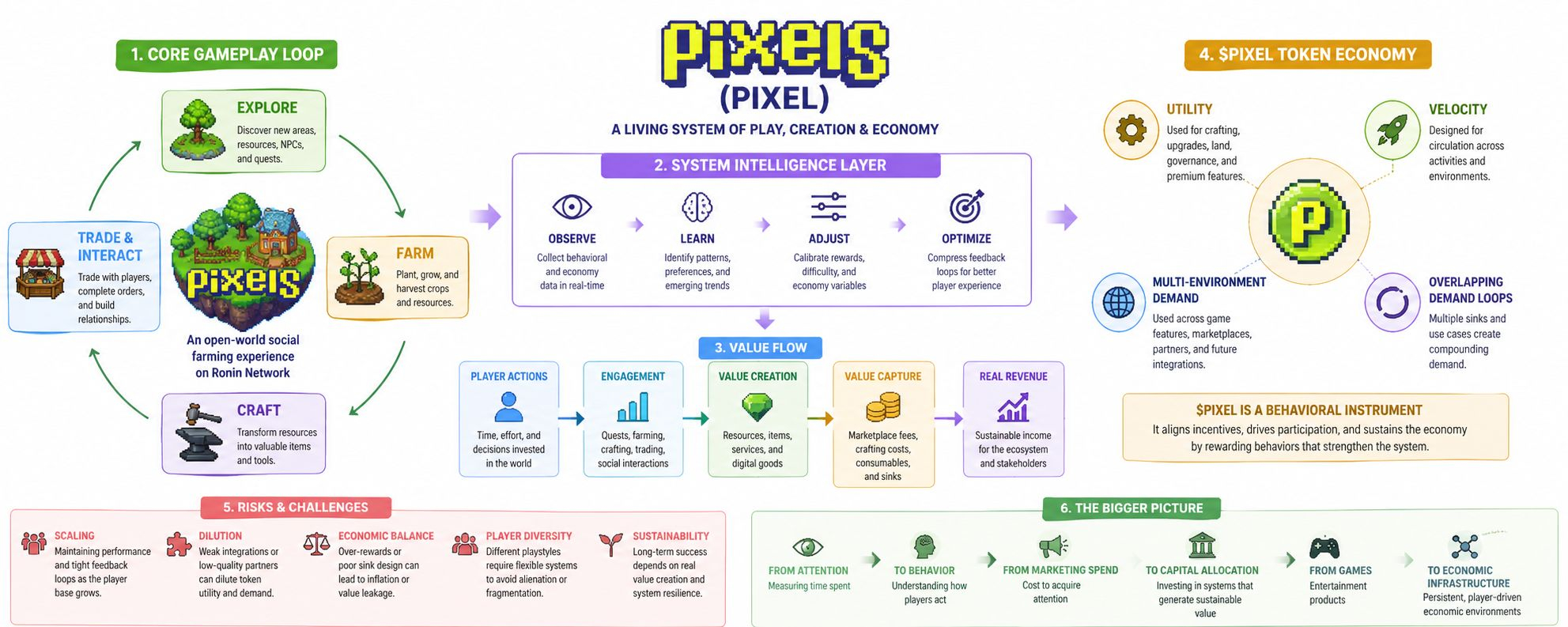
I was moving through the usual loop: plant, wait, harvest, craft, repeat. Nothing unusual on the surface. The rhythm felt familiar, almost comforting. But then, somewhere between harvesting and replanting, I noticed a subtle hesitation in my own behavior. Not a disruption, not even a conscious decision—just a slight shift. I wasn’t playing the loop anymore. I was adjusting to it.
I might be wrong, but that was the moment Pixels stopped feeling like a game to me.
At first glance, the system presents itself simply: play, earn, repeat. It’s a structure we’ve seen before, almost expected in Web3 environments. But the longer I stayed inside it, the more that simplicity started to feel like a surface layer—something designed not to explain the system, but to ease you into it.
Underneath, something quieter was happening.
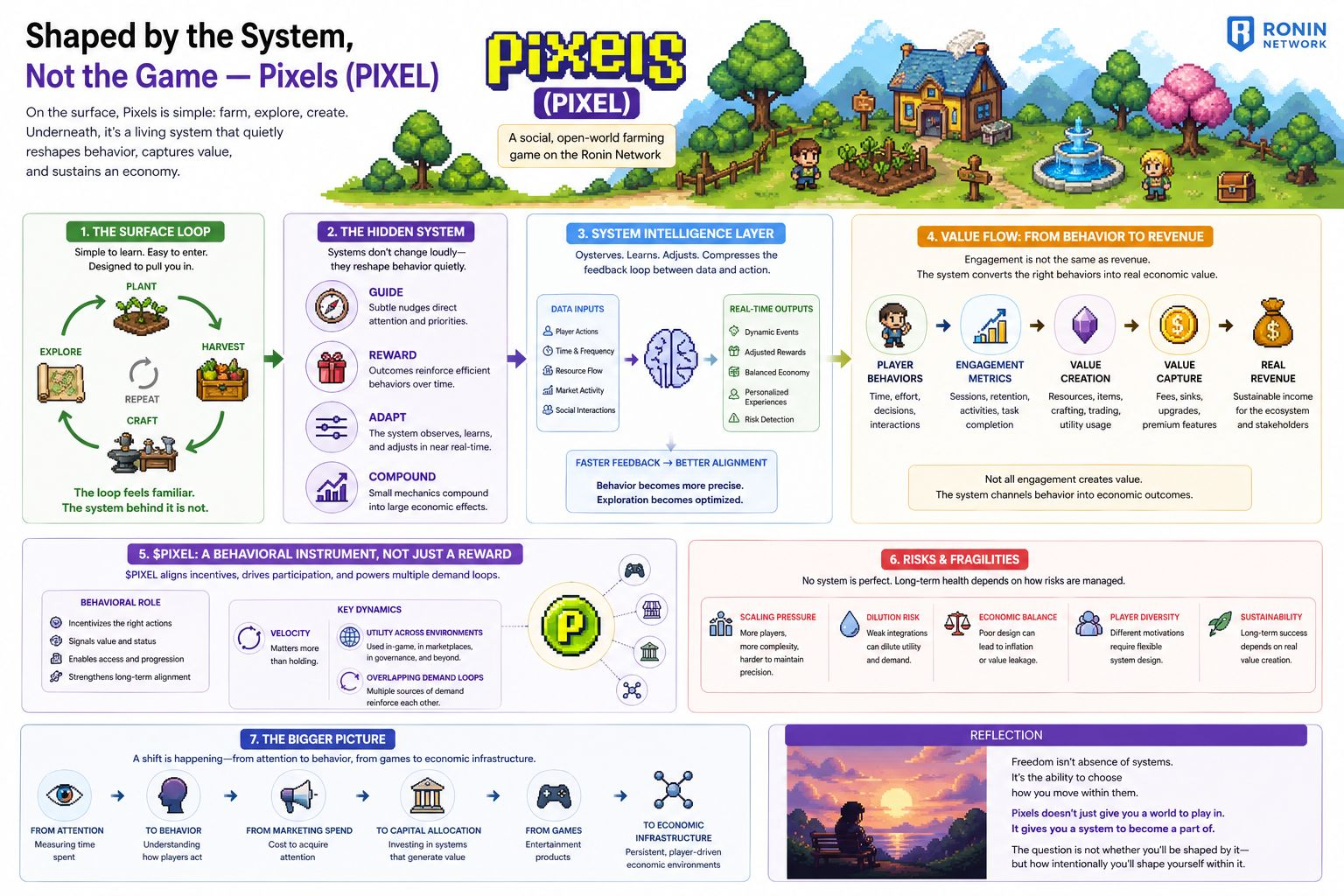
The mechanics weren’t asking me to optimize, but they were gently rewarding it. Not explicitly, not aggressively—but consistently enough that inefficiency began to feel uncomfortable. I didn’t decide to become more efficient. The system made inefficiency feel like friction, and over time, I adjusted to remove it.
That’s when it started to feel like behavior was the real output—not crops, not items, not even tokens.
I spend a lot of time thinking about game economies and behavioral systems, and one pattern keeps reappearing: systems don’t change loudly—they reshape behavior quietly. Pixels seems to lean into that idea with unusual precision. It doesn’t demand attention; it redirects it. It doesn’t force decisions; it narrows the space in which decisions feel optimal.
And once you notice that, the loop starts to look different.
Planting isn’t just planting—it’s time allocation. Harvesting isn’t just harvesting—it’s yield optimization. Crafting becomes less about creation and more about conversion efficiency. Each action feeds into the next, but more importantly, each action subtly trains you for the next.
It started to feel like the system was less interested in what I produced and more interested in how I behaved while producing it.
There’s a layer of intelligence here that’s easy to miss because it doesn’t announce itself. But it shows up in how quickly feedback loops tighten. The system observes—quietly—what players do, how they respond, where they slow down, where they accelerate. And then, without friction, it adjusts.
Not in dramatic patches or visible overhauls, but in small calibrations. A shift in timing. A tweak in reward pacing. A slight rebalance that nudges behavior in a new direction.
I can’t point to a single moment where this happens. It’s more like the system is always learning, always compressing the distance between action and feedback. And as that distance shrinks, behavior becomes more precise—less exploratory, more intentional.
It’s not that players stop exploring. It’s that exploration itself becomes optimized.
That’s where the economic layer starts to reveal itself.
Because what looks like engagement on the surface isn’t always where value is actually being created. Time spent doesn’t necessarily translate to revenue generated. There’s a separation there—subtle, but important.
Some actions feel engaging but don’t move value. Others feel repetitive, even mundane, but sit directly in the path of value creation. Over time, the system gently teaches you to distinguish between the two—not through explanation, but through outcomes.
You begin to notice which loops sustain themselves and which ones quietly fade. Which activities hold economic weight and which ones are more decorative than functional.
And without realizing it, you start reallocating your attention.
This is where behavioral nudges turn into something more concrete. Efficiency becomes income—not in a direct, transactional sense, but through alignment with the system’s internal logic. The better your behavior fits the system, the more smoothly value flows through you.
It doesn’t feel like optimization in the traditional sense. It feels more like adaptation.
The token layer adds another dimension to this.
$PIXEL, at first, looks like a familiar construct—a reward, a unit of value, something to accumulate. But the longer I observed it, the harder it became to see it that way. It behaves less like a static reward and more like a moving signal.
Its velocity matters more than its presence. How quickly it moves, where it flows, how often it’s reused across different loops—these things seem to shape its role more than its nominal value.
There’s also something interesting about how it connects different environments. Not just within the game, but across adjacent systems. Utility isn’t confined to a single loop; it overlaps, creating multiple demand layers that reinforce each other—at least when things are working well.
But that’s also where some uncertainty comes in.
I might be wrong, but systems like this often carry a kind of fragility beneath their flexibility. The more layers you add, the more dependent the system becomes on alignment between them. If one layer weakens—if integrations become shallow, or if demand loops lose coherence—the effects don’t always stay isolated.
They ripple.
Scaling introduces another tension. What works at a smaller scale—tight feedback loops, responsive adjustments, behavioral clarity—can become harder to maintain as more players enter the system. Noise increases. Signals get diluted. The system has to work harder to maintain the same level of behavioral precision.
And then there’s the question of player diversity.
Not all players behave the same way. Some optimize quickly. Others resist it. Some engage deeply with the economic layer; others remain closer to the surface. A system that relies on behavioral alignment has to account for this variation without breaking its internal logic.
That’s not easy to do.
Still, what keeps pulling my attention back is not whether the system succeeds or fails in the traditional sense, but what it represents.
There’s a broader shift happening—one that extends beyond any single game or token. It’s a shift from attention to behavior. From measuring how long someone stays to understanding how they act while they’re there. From spending on marketing to allocating capital within systems that generate their own momentum.
Games, in this context, start to look less like entertainment products and more like economic environments. Not in a dramatic, fully-formed way—but in fragments. In early patterns.
Pixels feels like one of those fragments.
It doesn’t present itself as infrastructure, but it behaves like it in certain moments. Value flows through it. Behavior is shaped within it. Decisions made inside it have consequences that extend beyond immediate gameplay.
And yet, it still feels like a game.
Maybe that’s the most interesting part.
Because it raises a quiet question about control and freedom. About whether optimizing within a system is a form of agency or a response to invisible constraints. About whether ownership in these environments is as clear as it seems, or if it’s mediated by layers of permission we don’t fully see.
I don’t have a clear answer to that.
What I do notice is how easily behavior adapts when the system is designed well. How quickly patterns form, and how difficult they are to recognize from the inside. And how something that begins as play can gradually take on the structure of work—or something close to it.
Maybe that’s where identity starts to come into it.
Not just what we earn or what we own, but how we choose to act within these systems. Whether we lean into efficiency or resist it. Whether we follow the paths the system makes easy or look for the ones it doesn’t highlight.
Or maybe those choices are more constrained than they appear.
I’m not entirely sure.
But I keep coming back to that initial moment—that small hesitation in an otherwise familiar loop. The point where something felt just slightly off, not because it was broken, but because it was working exactly as intended.
And I realized, quietly, that I wasn’t just playing the system anymore.
I was being shaped by it