
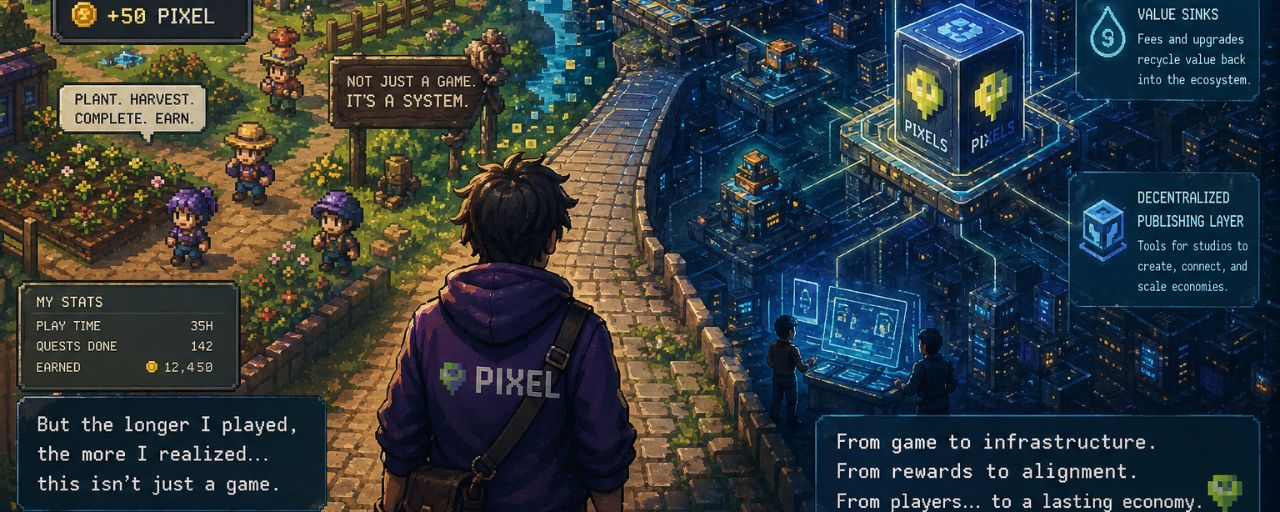

I remember the moment it started to feel slightly off. I had Pixels open, moving through my usual loop, and then I checked the $PIXEL chart almost automatically. Somewhere between planting and collecting, I realized I wasn’t really “playing” anymore, I was adjusting behavior. Timing things differently, choosing certain actions over others, skipping what didn’t feel worth it. It wasn’t obvious, but it felt like the system was quietly steering me.
I assumed it would behave like most Web3 games. Learn the loop, scale activity, extract value, and leave when it breaks. That cycle has repeated enough times to feel predictable. But Pixels didn’t unwind the same way. Players didn’t disappear as quickly, and the loop didn’t feel purely volume driven. Maybe I’m overthinking it, but it didn’t feel like a simple “more input, more output” system.
The shift became clearer the longer I stayed. Rewards didn’t scale linearly with effort. Some actions paid off more than expected, others less, even when the time spent felt similar. At first I thought it was just balancing, but it started to feel more deliberate than that. Like the system wasn’t just distributing rewards, it was evaluating behavior.
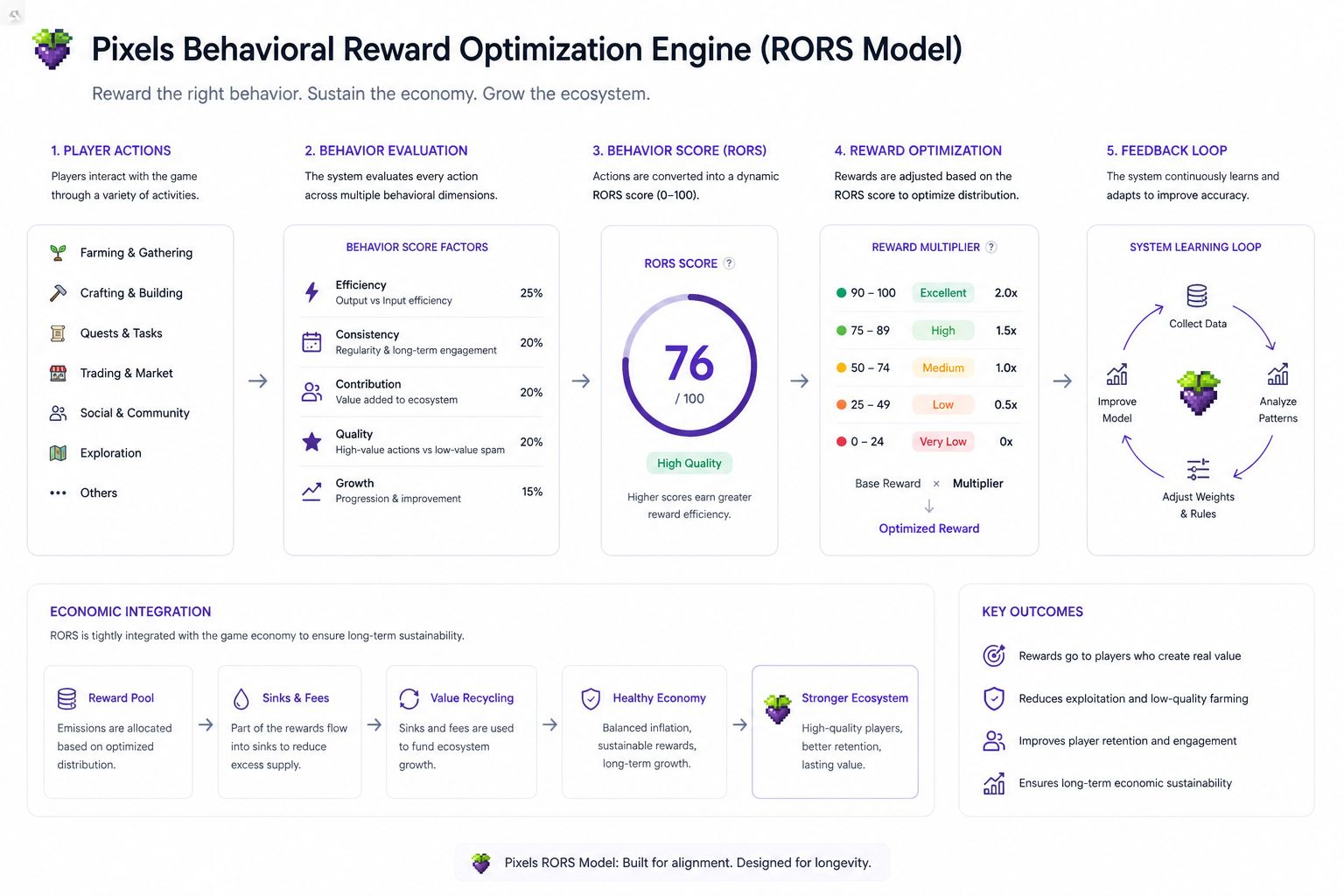
And this is where it clicked for me. It’s not just what you do, it’s how efficiently you do it. There’s this underlying idea, never fully visible that rewards are adjusted based on how well your actions translate into meaningful outcomes. Not raw grinding, but conversion quality. Which sounds abstract, but in practice it changes everything. It quietly filters out low signal activity and redirects value toward patterns the system recognizes as “useful.”
That’s a very different foundation from most GameFi designs. Usually, volume wins. Here, alignment seems to matter more. And once you notice that, the rest of the system starts to make more sense. The sinks aren’t just there to slow extraction, they’re absorbing and rerouting value back into the loop. Fees, upgrades, progression friction, they’re not cosmetic. They’re controlling where value goes and who gets to keep it.
At that point, it stopped feeling like a single game economy and more like a controlled environment for value flow. @Pixels is testing how rewards, behavior, and retention interact under constraints. The mechanics, reward adjustment, sinks, progression gates, they feel modular. Like they could be applied beyond this one game. That’s where the “infrastructure” idea starts to feel less like a narrative and more like a direction.
But then the market layer sits on top of all this, and it plays by completely different rules. The token still moves on attention, liquidity, and timing. You can have a system optimizing reward efficiency underneath, but if emissions meet weak demand, the price reacts instantly. That disconnect is hard to ignore, a system trying to reward the right behavior, and a market that mostly rewards momentum.
And I’m not convinced those layers ever fully align. A system can be logically sound filtering behavior, reducing waste, improving reward targeting and still feel restrictive. It reminds me of platforms that optimize user actions so tightly that you stop exploring and start complying. In Pixels, I sometimes catch myself wondering if I’m playing or just performing within a framework.
That tradeoff feels central. The more precisely a system identifies “valuable” behavior, the more it narrows what players actually do. Efficiency improves, but freedom might shrink. And in games, that balance matters more than most systems account for. Because players don’t just respond to incentives, they respond to how those incentives feel over time.
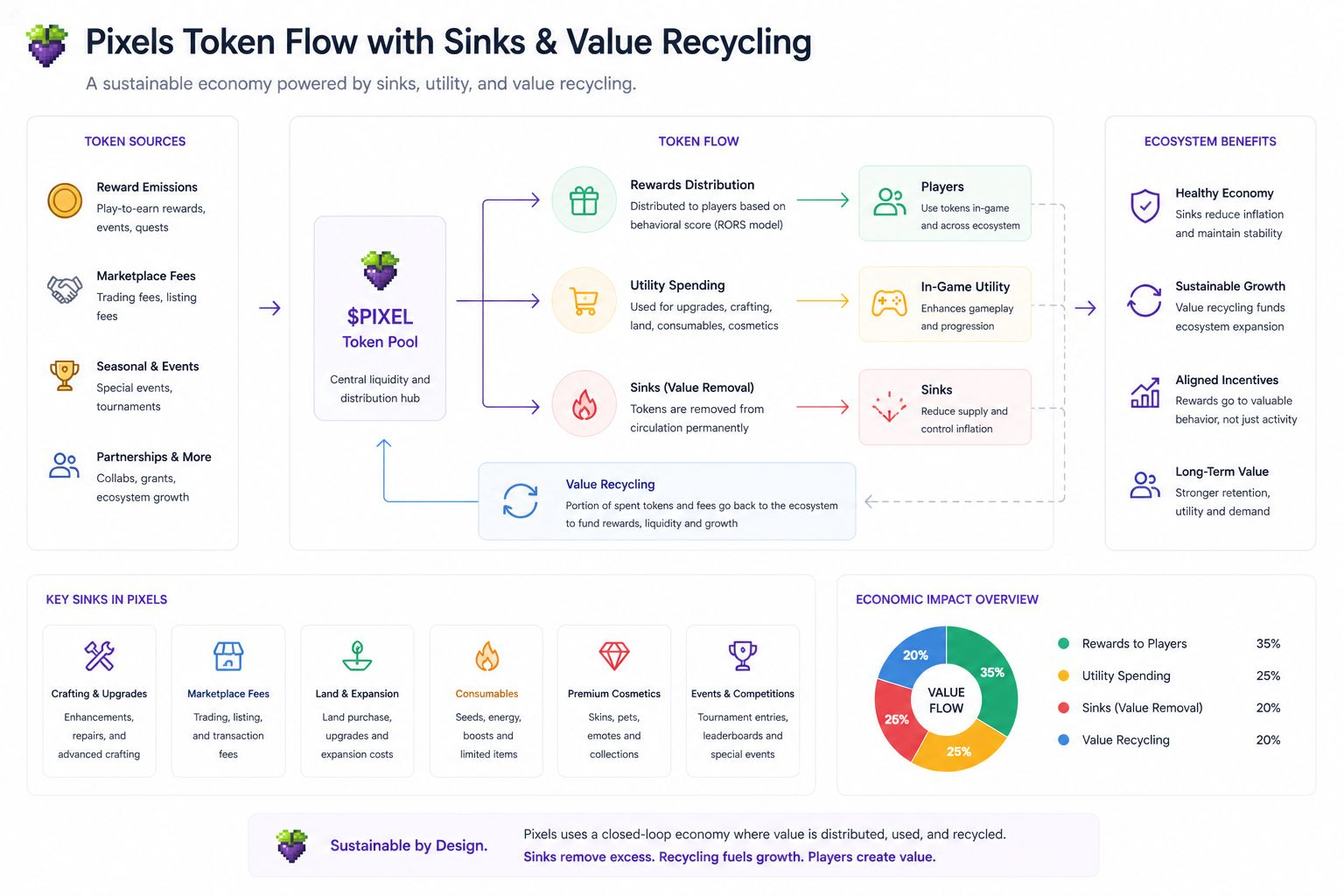
Still, the part that keeps me thinking about it isn’t the reward, it’s the return. People come back. Not just for extraction, but because the loop holds together longer than expected. And that says more than any chart. Because none of this, behavior scoring, reward adjustment, sinks, works if players don’t show up again. Utility only works if someone comes back tomorrow.
So I’ve started reframing #pixel not really as a game, and not just as a token, but as a system that’s trying to decide how value should move based on behavior, not just activity. Something closer to an economic layer than a standalone experience. Maybe even a blueprint other games could borrow from, if it holds.
I’m still not sure if that’s enough. A system can be precise and still miss the emotional reason people play. But it’s clearly not trying to be another loop built on extraction alone. It feels more like an experiment in aligning incentives with actual participation, even if that comes with tradeoffs.
And maybe that’s the real shift here. This isn’t just a game trying to retain players, it’s a system trying to understand which players are worth retaining in the first place.