
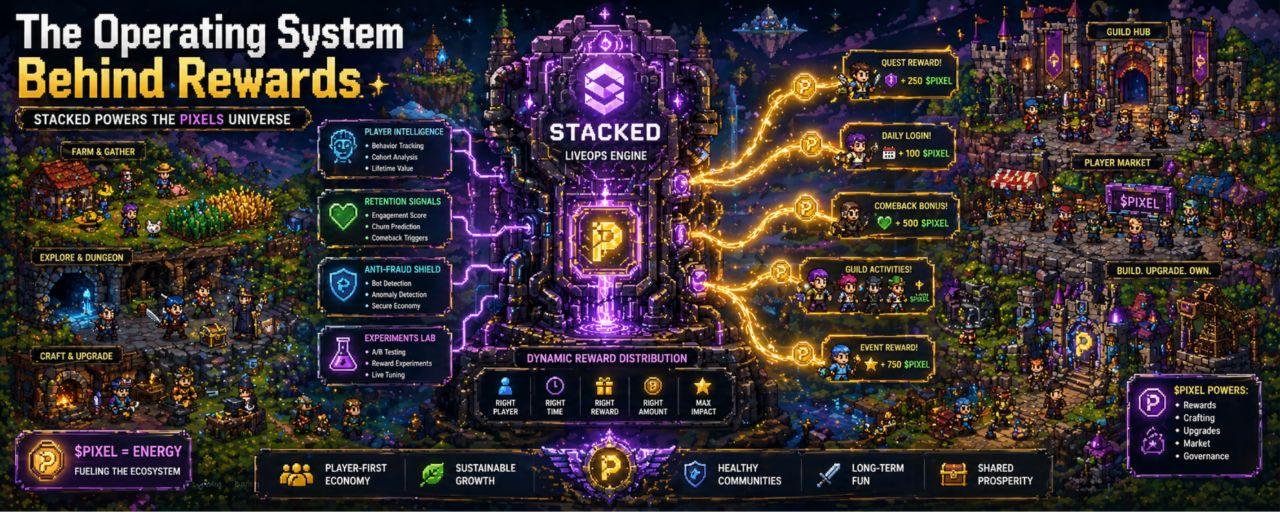

Most people think player rewards are just incentives. What if they are actually infrastructure? That may be one of the most underrated ideas behind @Pixels Stacked.
Gaming studios spend billions on user acquisition, but much of that spend leaks through ad platforms, weak targeting, and low-quality installs. That model is expensive and often inefficient.
Stacked proposes a different thesis: what if part of that budget flowed directly to players who actually engage? That changes rewards from a marketing cost into a measurable growth engine.
This is where Stacked looks different from a generic rewards app. It behaves more like growth infrastructure. Studios can run reward campaigns tied to measurable outcomes such as retention lift, revenue lift, and LTV improvement. Rewards stop being promotional gimmicks and become optimization tools.
Another major differentiator is the fraud-resistance moat. Most teams can launch quests. Very few can build systems that survive adversarial usage at scale. Fraud prevention, anti-bot systems, behavioral data, and reward design intelligence are not features copied overnight. They are infrastructure advantages built in production.
This is also why Stacked feels bigger than one game. It is positioned as infrastructure for many studios, not just one ecosystem. That changes the opportunity from a single-game narrative into a platform narrative.
For $PIXEL, this may matter a lot. If Stacked expands across more games, $PIXEL could evolve beyond a game token into a broader rewards and loyalty layer across an expanding ecosystem. That expands utility and strengthens the demand surface.
What makes Stacked compelling isn’t simply rewards. It rethinks growth, incentives, and game economics as infrastructure.
Built in production, not in a deck.
What do you think — could redirecting ad spend to players reshape game economies? And do you see Stacked as GameFi… or infrastructure?
