
Looks Like a Game Token, Yet It May Quietly Determine Who Bypasses System Limits
I kept running into the same quiet limitation in different systems.
It didn’t show up as an error or a warning. It was more subtle than that. You could only craft a certain number of items in a session. Only access certain areas after waiting. Only progress so far before something slowed you down. None of it felt broken, but it was clearly intentional.
A kind of invisible ceiling.
At first, I assumed it was just pacing. A way to keep things fair, to stop people from rushing through everything too quickly. But after a while, it started to feel less like balance and more like control. Not everyone was moving through those limits in the same way.
At that moment, I realized most systems don’t just set limits—they create ways around them.
Not always obvious ones, but mechanisms that let certain players move faster, access more, or bypass friction if they understand how the system is structured.That’s where something like @PIXEL started to stand out to me.
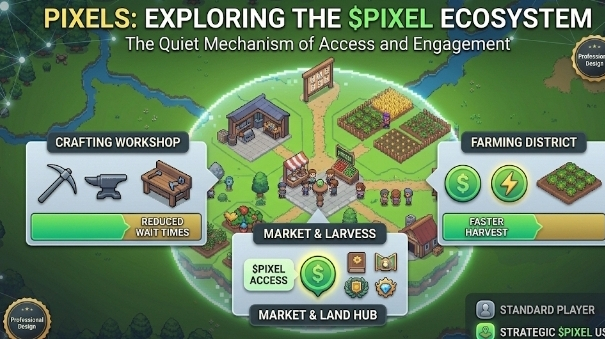
On the surface, Pixels is a browser-based farming and social game built around resource loops—planting, crafting, trading, and interacting with a shared environment. It feels slow by design. Almost intentionally relaxed.
Initially, I thought that meant limits would apply evenly. Everyone working within the same boundaries, progressing at roughly the same pace.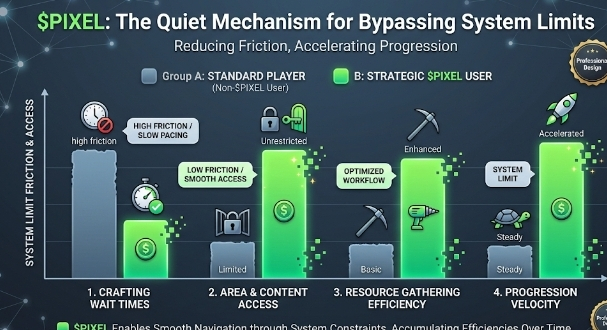
But the more I paid attention, the more I noticed that pixel sits quietly at the edge of those boundaries.
It doesn’t remove limits directly. It doesn’t break the system. But it changes how those limits are experienced.
Pixel is used across different parts of the game—upgrades, crafting processes, access to certain features, participation in events, and interactions with other players. And while basic gameplay doesn’t always require it, deeper progression tends to intersect with it more often.
That’s where things start to shift.
Players who have access to $PIXEL, or understand when to use it, can move through certain constraints more smoothly. Not instantly, not unfairly, but with less friction. Waiting becomes shorter in practice. Access becomes easier. Options open up that aren’t immediately visible to everyone.
So the limit still exists—but it doesn’t feel the same for every player.
What I find interesting is that this isn’t presented as a shortcut.
It’s embedded in the system. You don’t “skip” the game—you interact with it differently. And over time, those differences accumulate. Small efficiencies, repeated consistently, start to separate progression paths.
Still, I had doubts.
If a game already feels relaxed and playable without focusing on $PIXEL, does this layer really matter? Or is it just an optional path that only affects a small group of users?
Initially, it felt like something that might complicate the balance.
But upon reflection, most systems already have this dynamic—they just hide it less effectively. Some players always find ways to optimize, to move faster, to reduce friction. The difference here is that it’s structured, not accidental.
Pixel becomes a kind of permission layer.
Not in a strict sense, but as a way to interact with limits differently. It doesn’t eliminate them, but it allows the system to remain intact while still offering flexibility.
If this works as intended, it opens up a more adaptable environment.
You can have a baseline experience that stays consistent for everyone, while still allowing variation in how players engage with it. Progression doesn’t need to be uniform, but it also doesn’t become chaotic.
And if pixel represents that interaction—how players navigate constraints—then it starts to carry meaning beyond just being a token. It reflects access, decisions, and positioning within the system.That could extend further.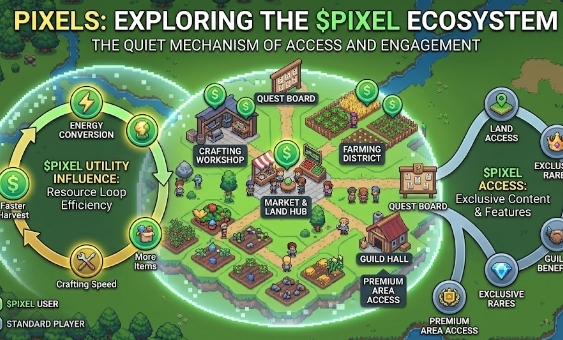
If other systems begin to recognize those signals, you could see environments where user behavior—how they manage limits, not just how much they play—becomes part of their identity. Not tightly integrated, but loosely connected through shared references.
But I don’t think this becomes widely visible, at least not yet.
There’s still friction in understanding these layers. Many players will just play the game as it is, without thinking about system limits or how they’re shaped. And that’s fine. The system has to work for them too.
There’s also the risk of imbalance. If $PIXEL becomes too influential, it could shift the experience too far away from its relaxed foundation.
Right now, I’m still observing.
I hold a small amount of $PIXEL, mostly to stay connected to how these mechanics evolve. I’m not fully convinced it defines progression, but I can see how it quietly shapes it.
For me, the proof is simple.
If over time, players who understand and use $PIXEL consistently experience less friction—without breaking the system for others—then the layer is doing something meaningful.
And if those patterns persist, becoming part of how users naturally engage with the game, then it stops being just a token.
It becomes a quiet way the system decides who moves through its limits, and how.
